TED has links from more than 900K websites, yet Google sends it only about 300K visits a month in the US.
You'd expect far more from a site this famous. And more than half of those visits come from people who already typed the name TED.
We ran TED through our whole SEO toolkit to find out where the rest of the traffic goes. The answer is a lesson for anyone who makes videos, podcasts or talks.
Here are 9 lessons you can copy, plus the part you can't.
Don't lean on your brand name
We started with our Organic Traffic Checker. It estimates a site's organic traffic, meaning the people who find it on Google without ads.
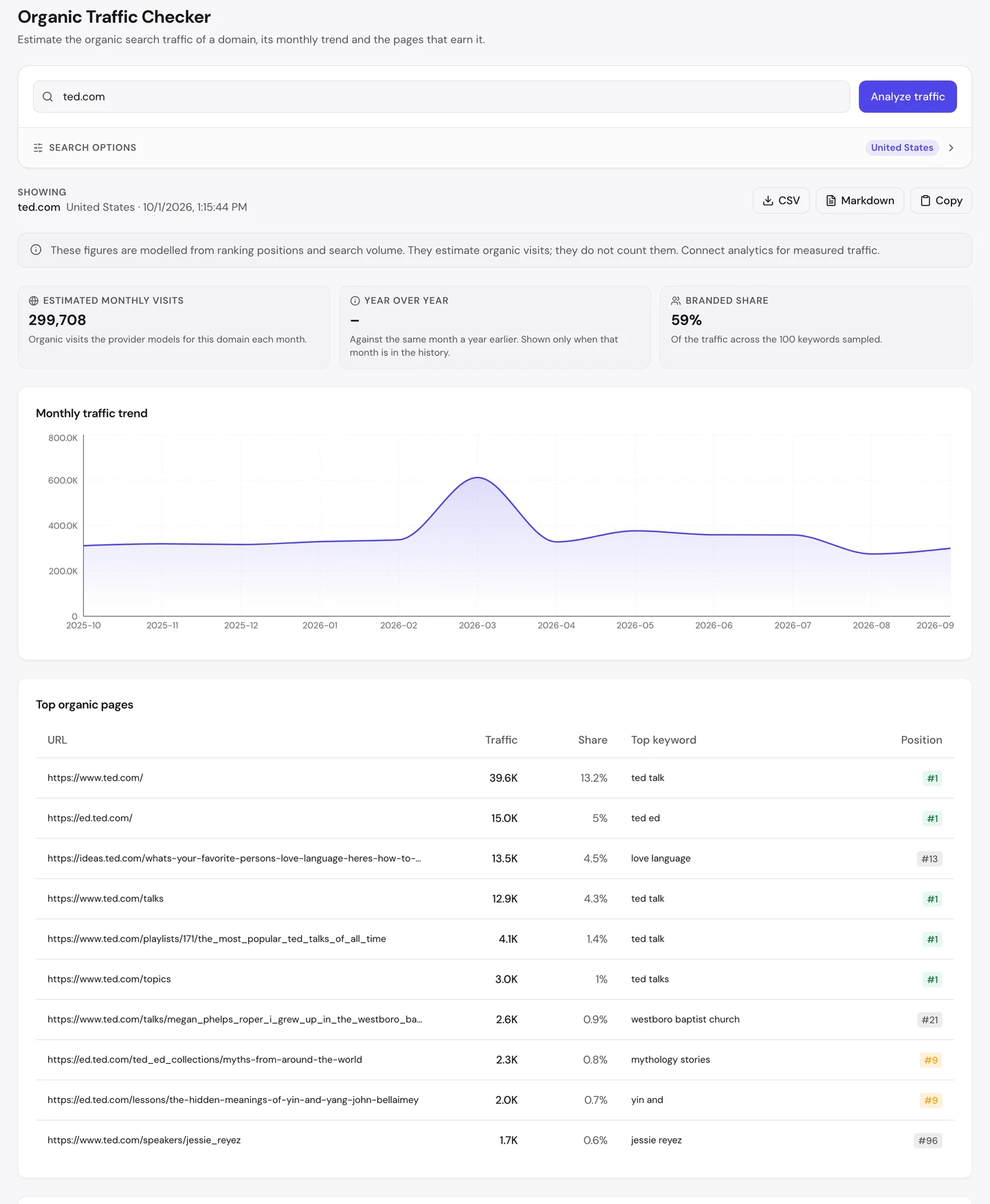
For TED, that's about 300K visits a month in the US. The chart has stayed close to that level all year, apart from a short spike in March.
Now look at the top pages. The homepage, TED-Ed and the talks page all rank first for searches like "ted talk" and "ted ed".
Those people knew TED before they searched, just like you probably do. In the searches we sampled, 59% of the traffic came from people typing the brand name.
That's the opposite of Rotten Tomatoes, which we studied too. Almost none of its visitors type its name, because it has a page that wins each film's search.
The Traffic tab of our Website Audit shows the whole world.
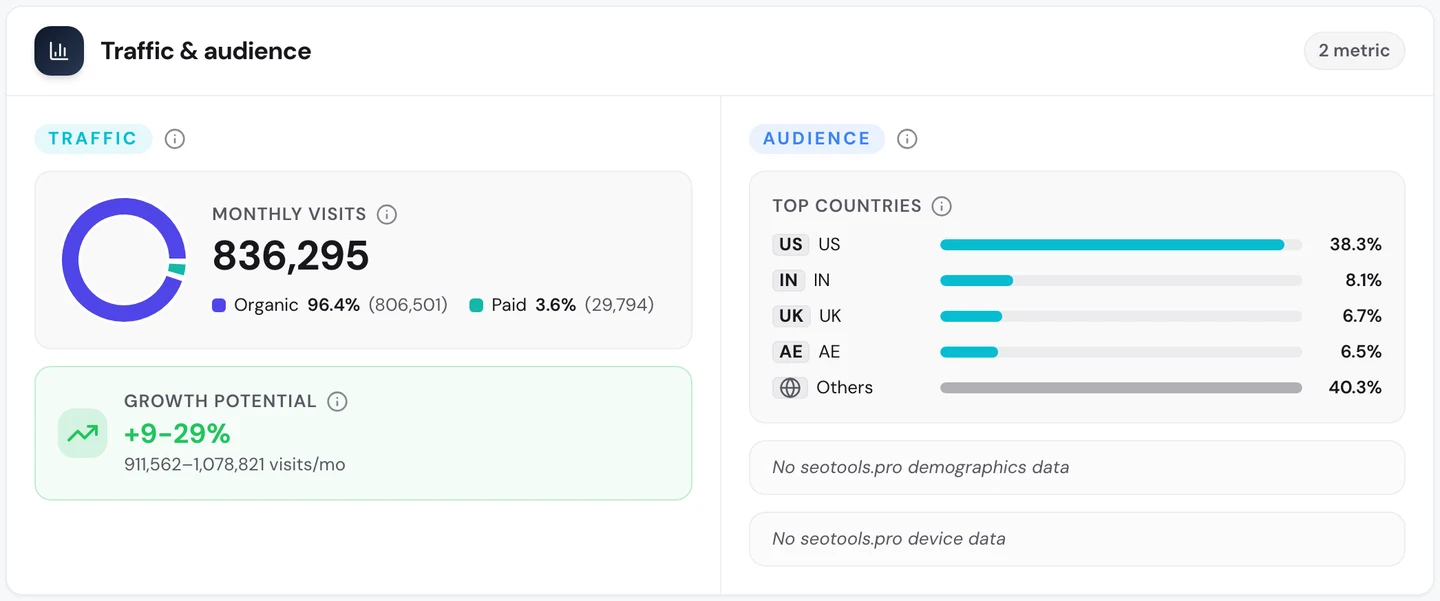
Worldwide it's about 800K search visits a month. That still isn't much for a library of talks watched by millions.
So ask yourself one question. If nobody knew your name, which searches would still bring people to you?
Put the words on the page
Here's one of TED's most watched talks.
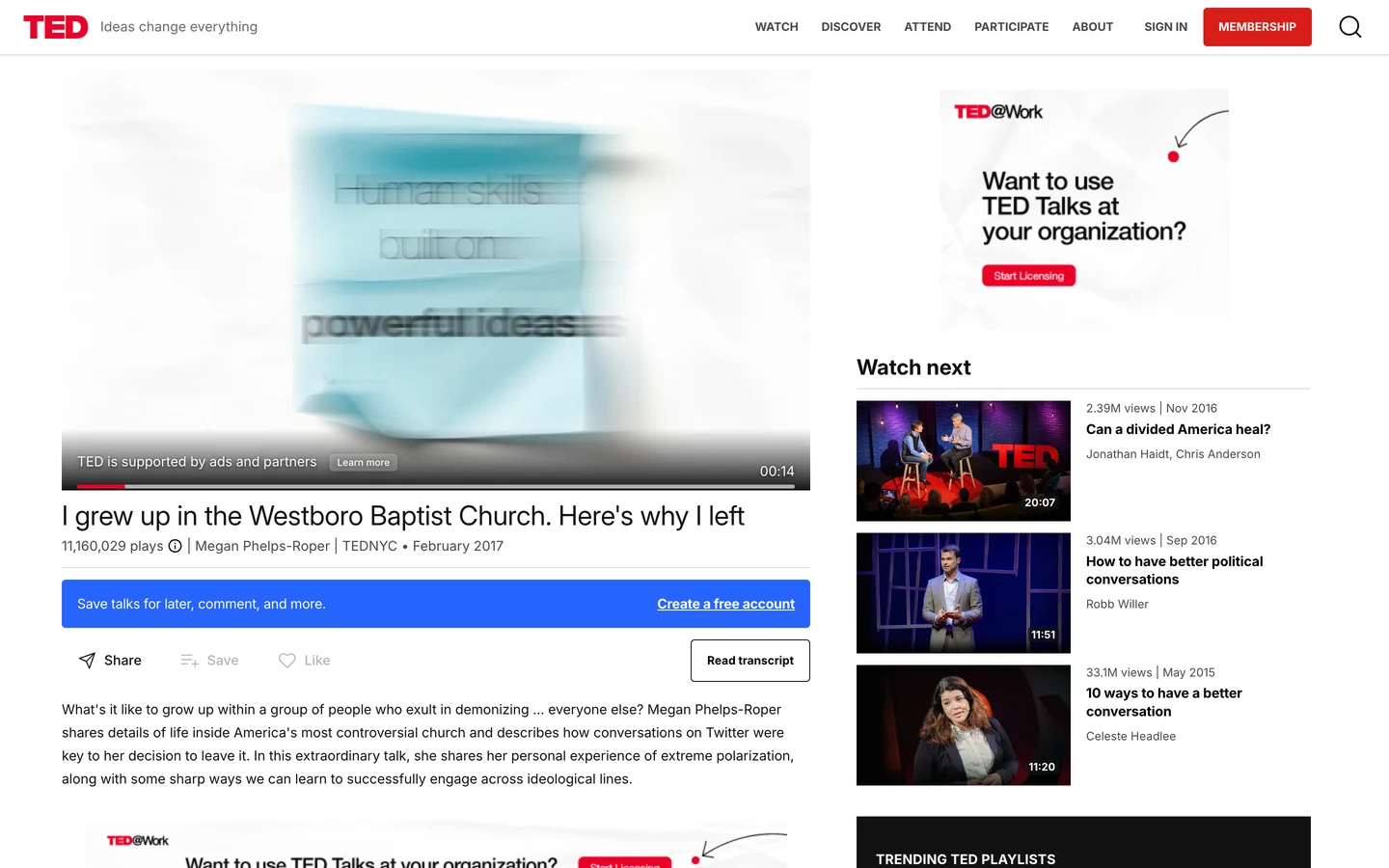
It has been played about 11M times. Yet Google sends it only about 2.6K US visits a month.
Look under the video. You get a short summary and a button that says Read transcript.
The transcript is the full talk written out. But until you click that button, those words aren't part of the page you see.
Our free browser extension shows what's there. Open the page, click the seotools.pro icon, and a panel opens beside it with 35 SEO checks.
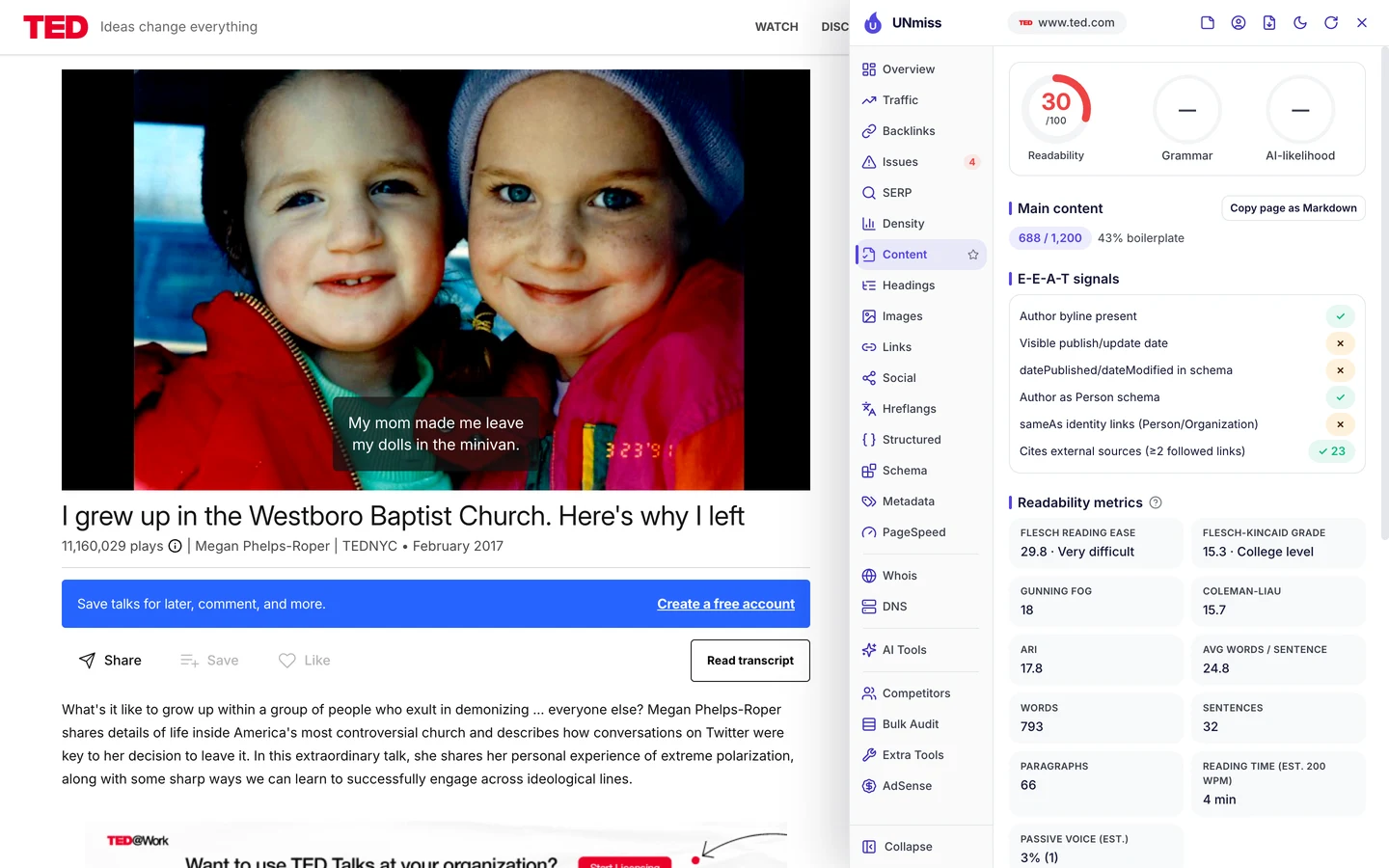
Its Content tab counts under 800 words on the whole page. Almost half of them are menus, buttons and other text that repeats on every page.
The talk itself runs for 15 minutes, about 2,500 words. Those are the words Google could match to searches, and it can't easily see them.
So if you make videos or podcasts, put the full transcript on the page as plain text. Add headings so people can skim it.
TED's talks get millions of plays, but Google can't read most of what's said in them. We turn video and podcast libraries into pages that search engines and AI tools can read and rank.
- We find the searches your talks and episodes already answer
- We design a page template with the transcript built in
- We fix titles and descriptions so Google shows them in full
- SEO and GEO, so AI answers can quote you too
See who ranks with your words
If TED doesn't put its words on the page, someone else will. The audit's Competitors tab lists the sites that rank for the same searches as you.
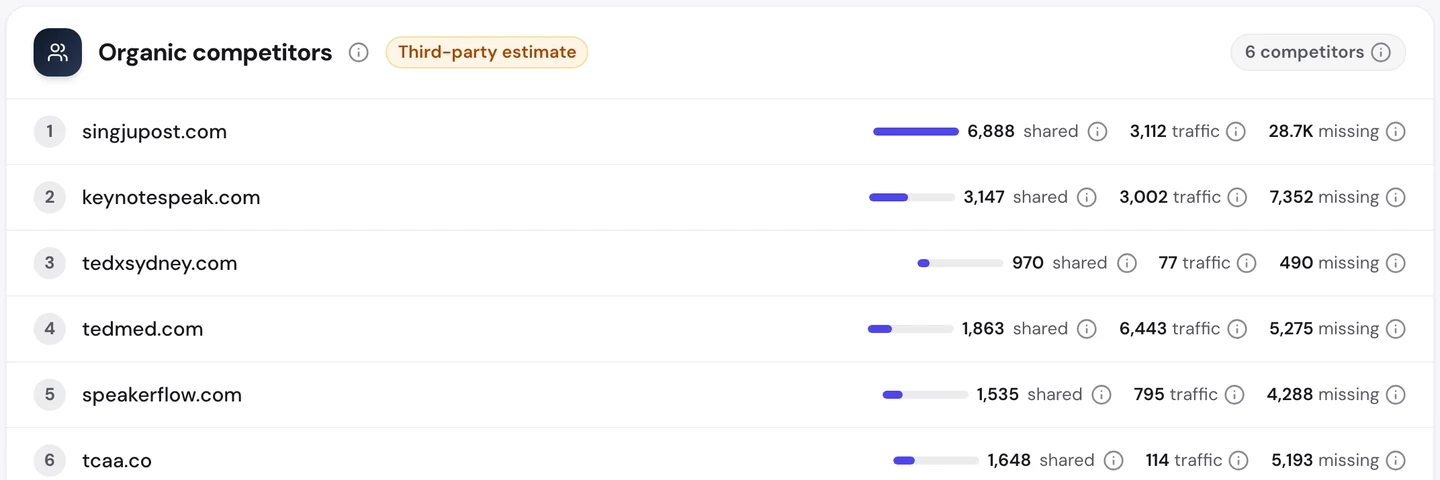
TED's top rival is The Singju Post, a site that publishes transcripts of talks and speeches. It shares about 6.9K searches with TED.
Think about what that means for you. A site built on the written words of talks competes with the site that hosts the talks.
The next rivals are speaker agencies and event sites. They all compete for searches about speakers and their talks.
So check who ranks for your own content with our Competitor Analysis. If a stranger wins with your words, put those words on your own page first.
Write titles for searchers
The title and the description are the 2 lines Google may show for your page. The description is the short summary under the title.
Here's what the extension's Overview tab found on the same talk.
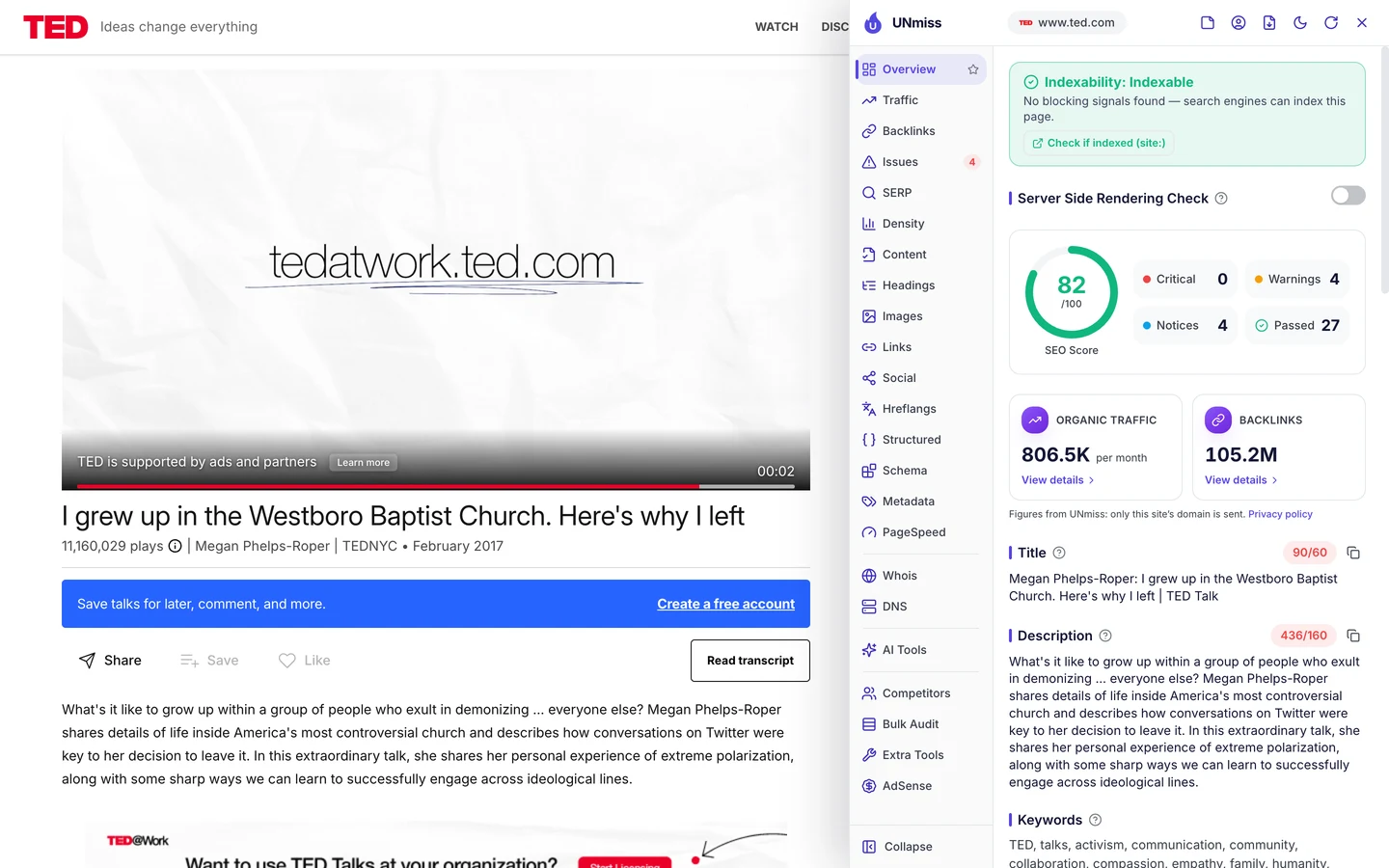
The page scores a solid 82 out of 100. But the title runs to 90 characters, and Google usually cuts titles at about 60.
The description is worse. It's 436 characters, almost 3 times what Google shows.
The title is the talk's stage name, the one you saw above the video. That's great on a stage.
But people search for "westboro baptist church", and the talk ranks only 21st.
So keep the words people search for at the start of the title. Then preview it with our SERP Simulator to see where Google will cut it.
Let your blog chase big topics
TED's third biggest page isn't a talk at all. It's an article on its Ideas blog about love languages.
The Keywords tab of our audit lists every search a site ranks for, where it ranks and how many visits each one sends.
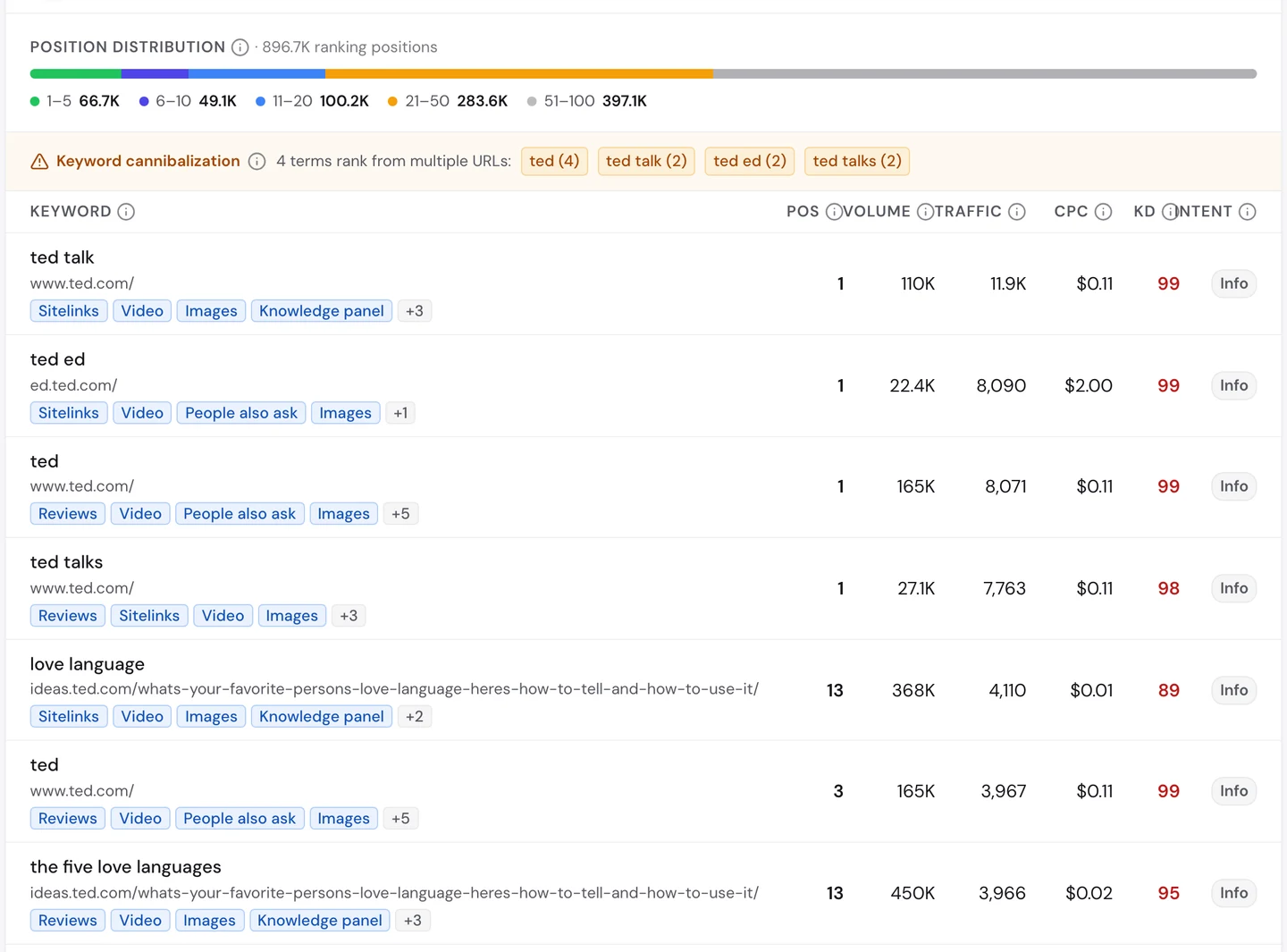
The article ranks 13th for "love language" and 13th for the name of the book it's about. Together those are searched more than 800K times a month.
Position 13 is the top of page 2. How often do you click through to page 2?
A move to page 1 could bring you many times more visits.
Look at the warning above the table too. 4 brand searches, like "ted", rank with more than one TED page.
That's called keyword cannibalization, when your own pages compete for the same search. GeeksforGeeks, which we studied too, has it on the search "c".
Here's what the extension found on the love languages article.
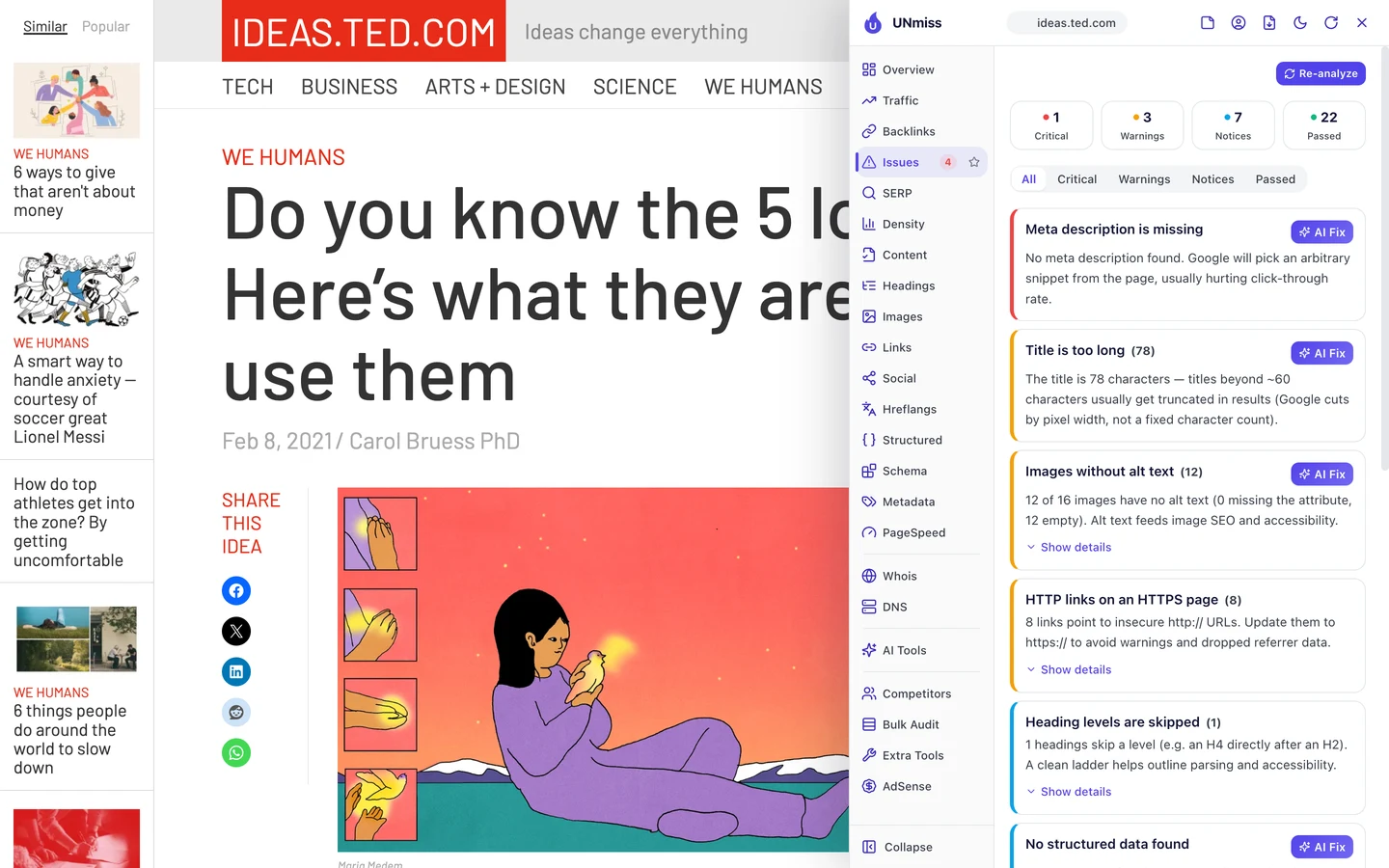
It has no description at all, so Google picks some text from the page and you don't get a say. 12 of its 16 images have no alt text, a short description that tells Google what a picture shows.
It also has no structured data, code that tells Google what a page is. These are small fixes you could make in an afternoon, on a page that already ranks.
NerdWallet, the money site we studied, shows how far this can go. Its biggest page is a guide to a big everyday topic.
So write articles on the big topics your talks touch, and finish every one of them properly. Check the searches with our Keyword Research tool, and write the missing description with our Meta Tag Generator.
Send link power to deep pages
A backlink is a link from another website to yours. Google treats each one a bit like a vote of trust.
The Backlinks tab of our audit shows the same data as our Backlink Analyzer.
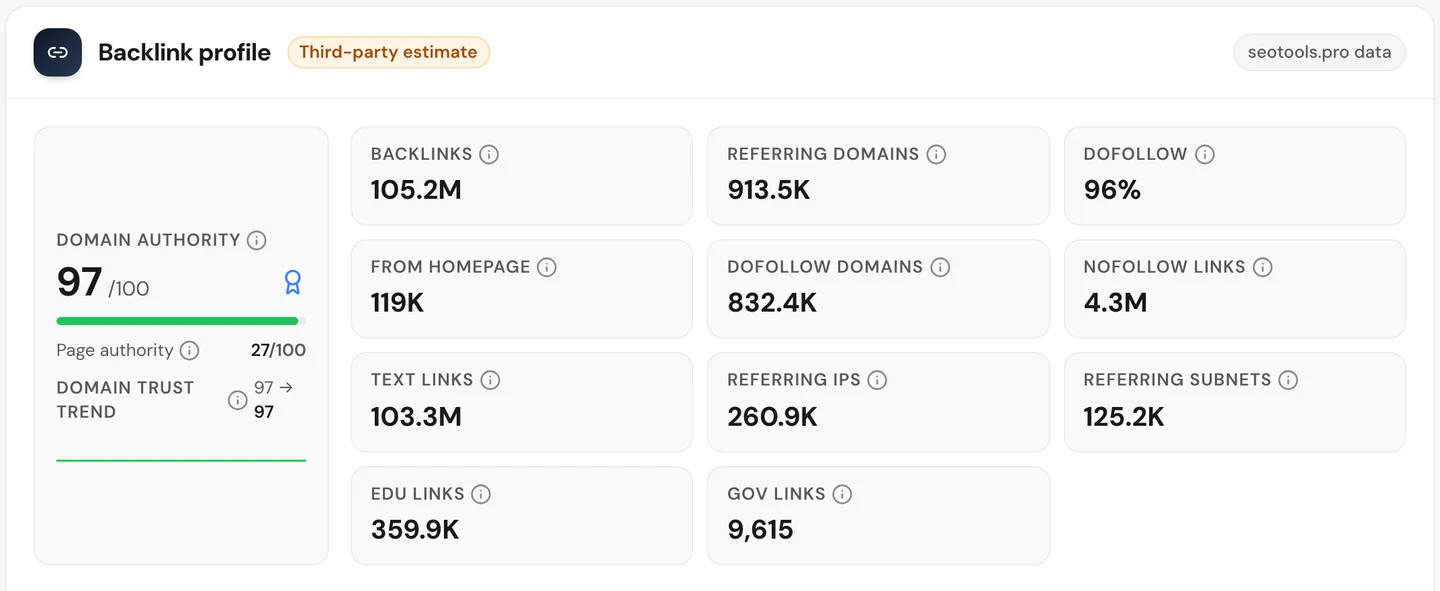
TED has about 105M links from more than 900K websites, including about 360K from universities. Its Domain Authority, our 0 to 100 score for a site's link strength, is 97.
Very few sites in the world score that high. So you'd expect TED to rank at the top for almost anything it covers.
Our Domain Overview shows what really happens.
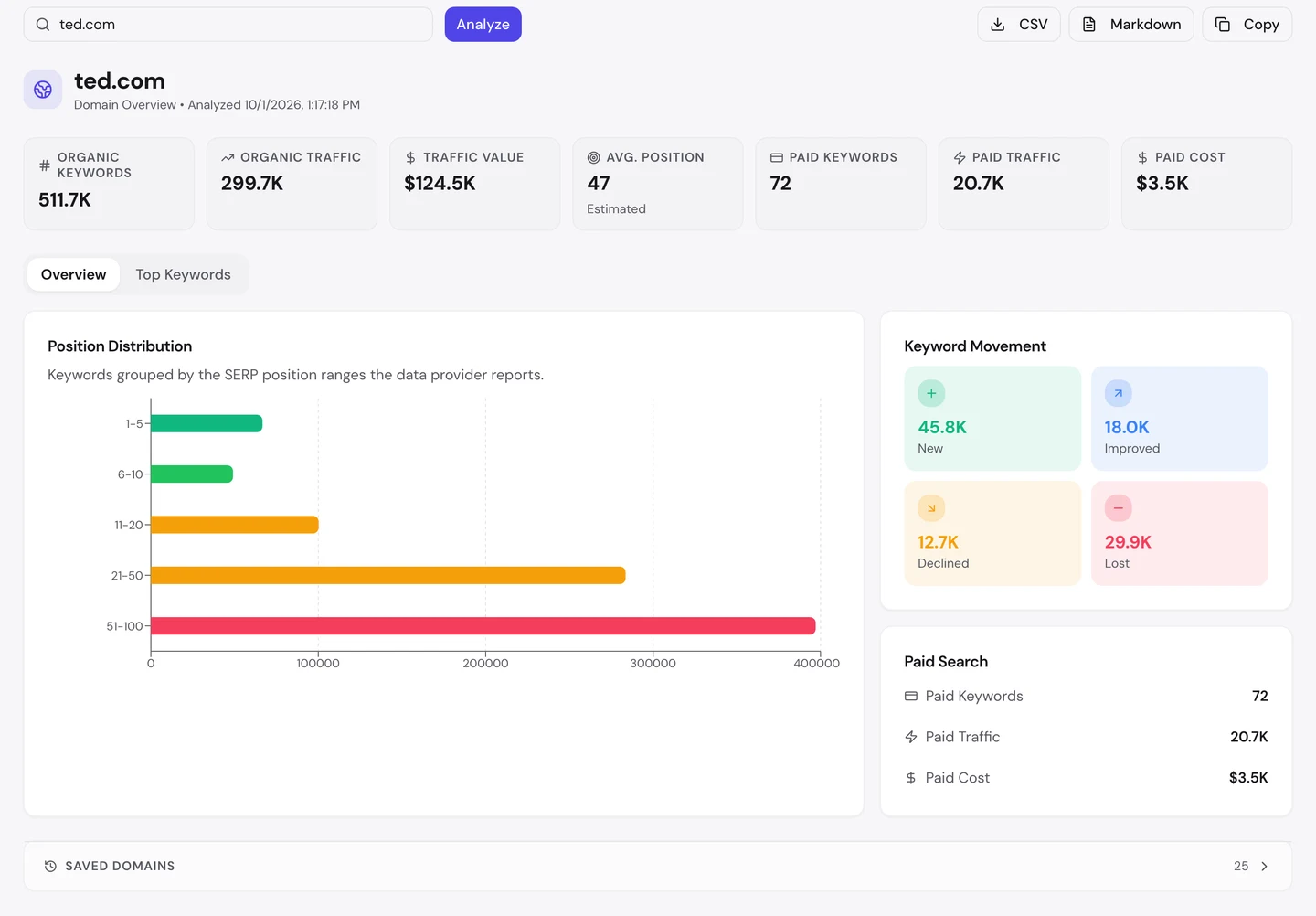
TED ranks for about 500K searches, but its average position is 47. That's page 5 of Google, where almost nobody clicks.
The most linked page is the homepage, with about 13M links on its own. That trust has to travel from there to each talk through TED's own links.
The audit found most talk pages sit 3 clicks from the homepage. And 206 of the pages we crawled link through redirects, a detour that wastes a little of that trust each time.
So link from your homepage and your topic pages straight to the pages that match big searches. Point every link at the final address, not at an old one that redirects.
Audit the talk page template
TED has many thousands of talk pages built from one template. If you build pages from a template, one mistake repeats on every page.
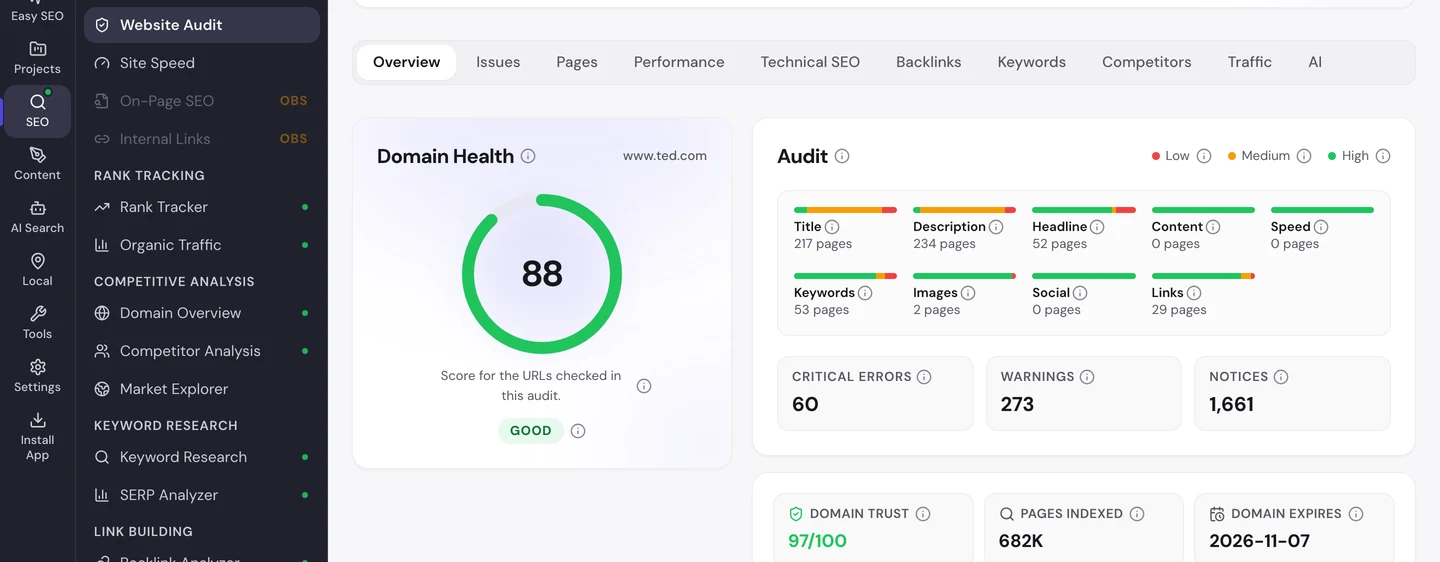
So we checked TED with our Website Audit. It crawls a site the way Google does, opening each page and following the links to the next ones.
We had it crawl 250 pages. TED scored 88 out of 100, which the report rates as good.
The Issues tab sorts the problems by how much they matter to you.
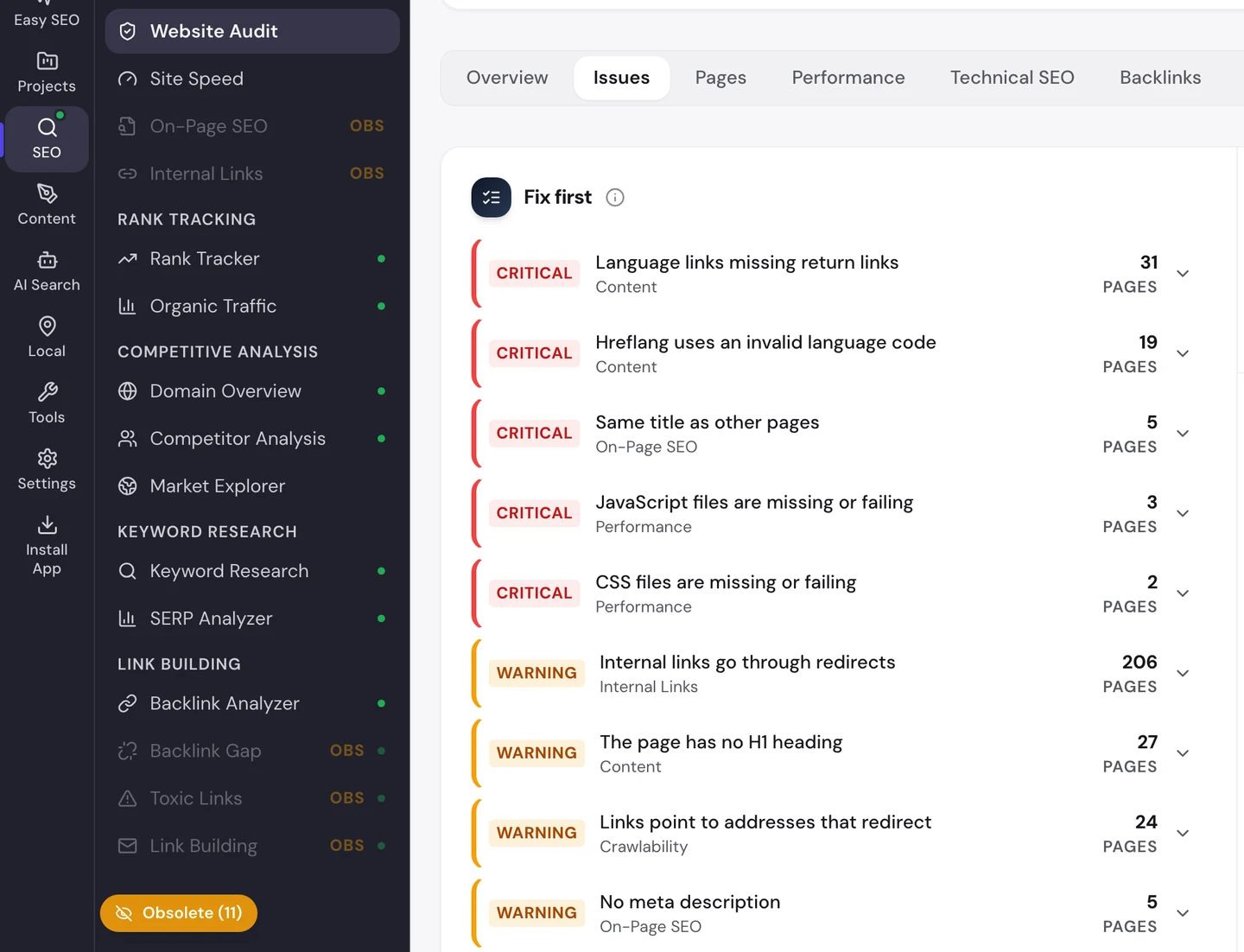
Your eye goes straight to the top 2 errors, and both are about hreflang. That's a tag that tells Google which language version of a page to show to which visitor.
TED talks come with subtitles in many languages, and the extension's Hreflangs tab shows how many versions this talk points to.
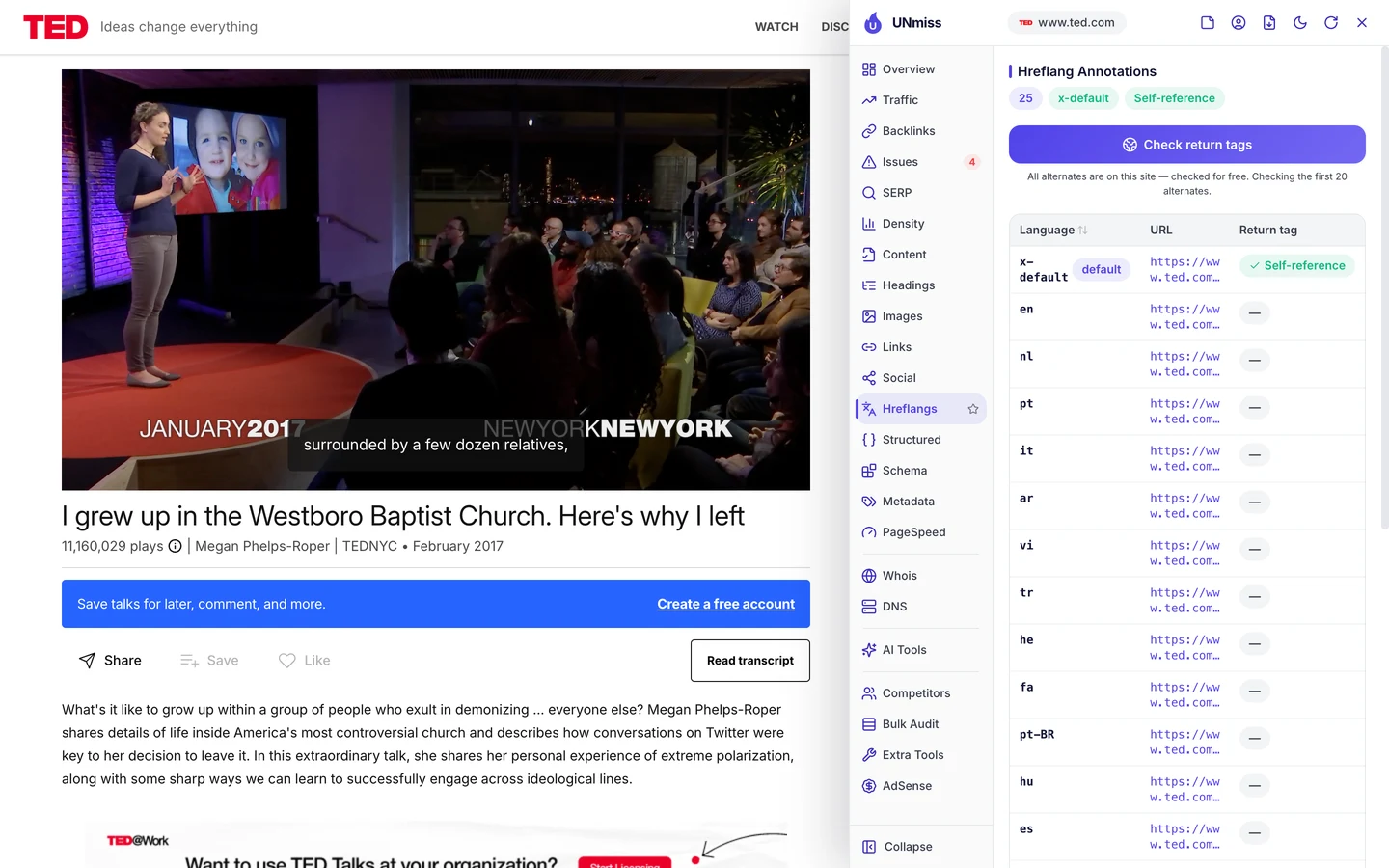
This one talk points to 25 versions. Each version has to point back, or Google may ignore the whole set, and the audit found pages where that return link is missing.
IKEA, whose language setup we studied on its own, keeps these links in its sitemap, the file that lists a site's pages for Google, instead of on each page. Wise had the same kind of errors as TED.
The Pages tab shows how far the problems reach.
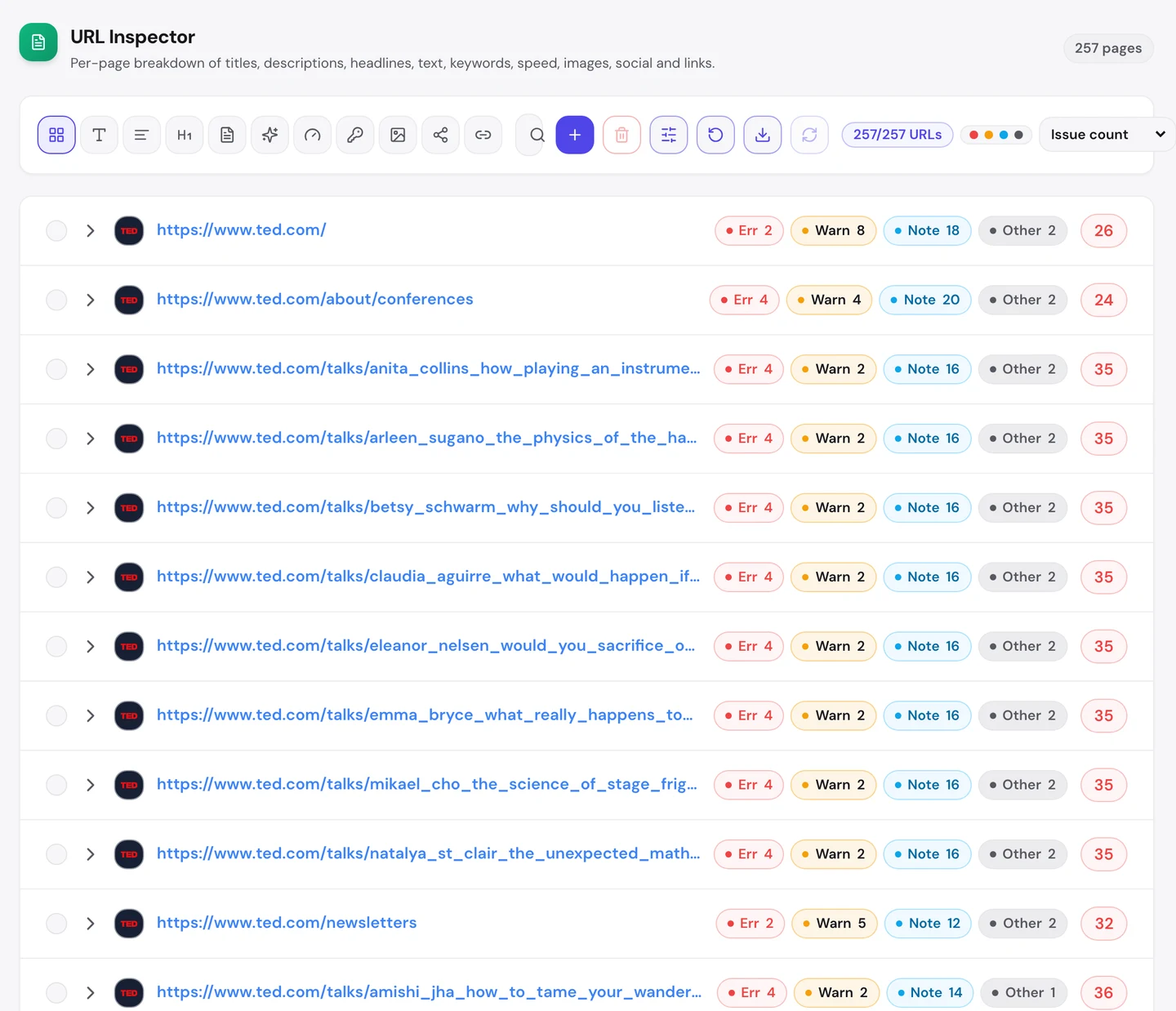
You'll see talk after talk scoring 35, with the same 4 errors. That's one template, copied onto every talk.
The Technical SEO tab adds 2 more finds.
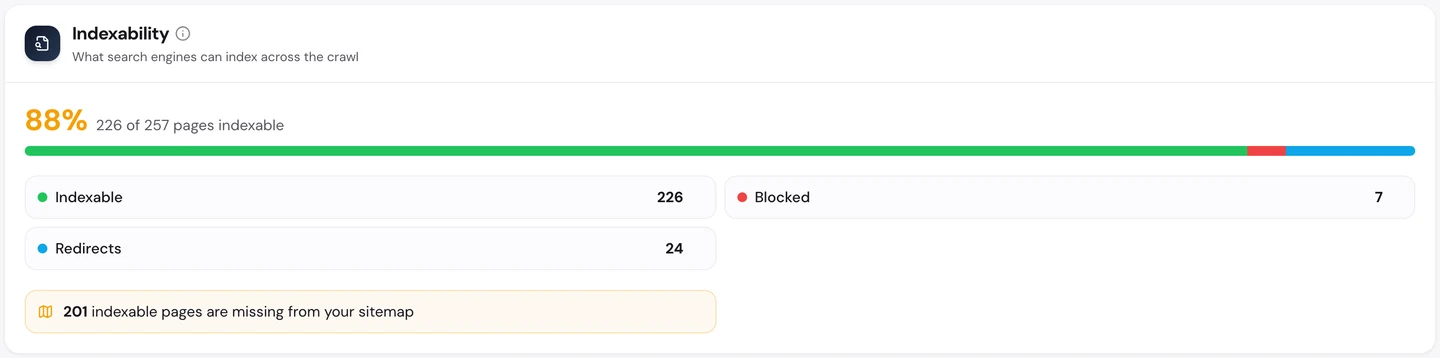
201 pages that Google may list are missing from TED's sitemap.
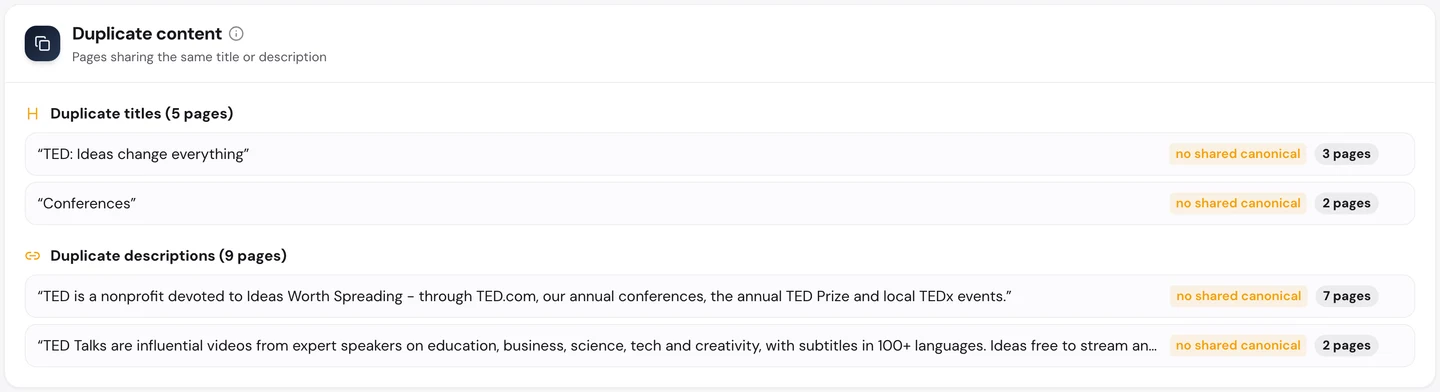
And 3 pages share the same title, so Google can't tell them apart from the title alone.
You don't have to work out what to fix first. The audit's AI tab writes the plan: a short summary, each problem with how to fix it, and a 90-day to-do list.
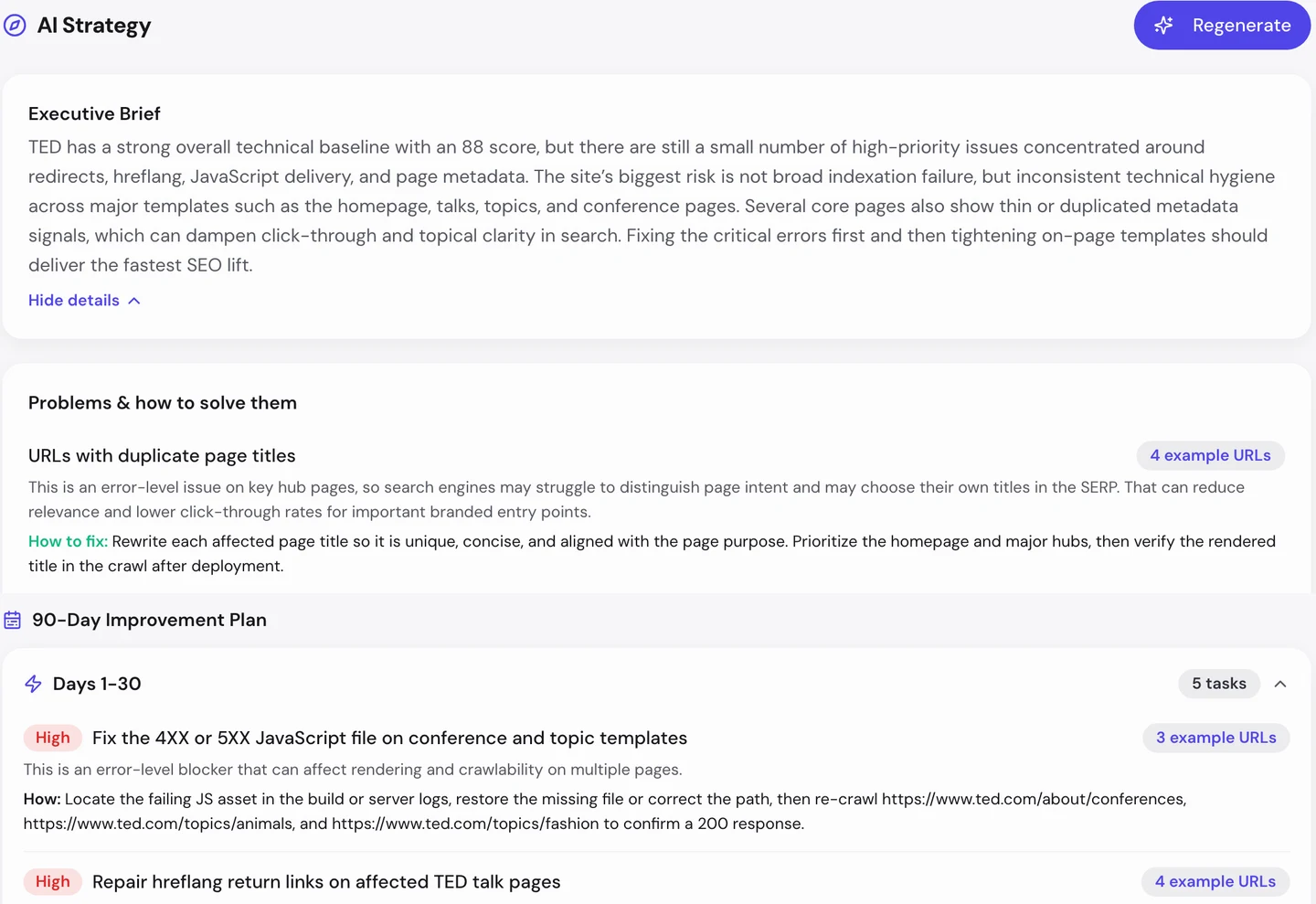
For TED, the first month goes to a broken script and the missing return links. Fix the template once, and every talk page gets better.
Make phone pages steady
The Performance tab of the audit shows Core Web Vitals. These are Google's 3 checks of how fast a page loads, how fast it reacts and whether it stays still, measured on real visitors' devices.
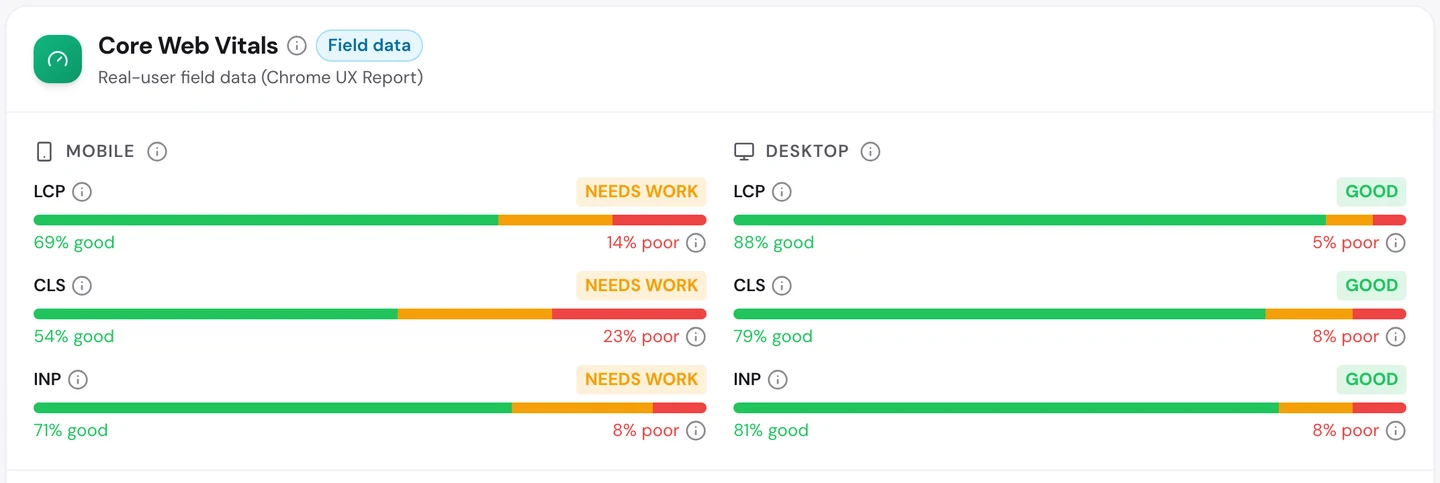
If you visit TED on a desktop, it passes all 3. On your phone, all 3 need work.
The worst one for you is layout shift, when a page jumps around while it loads. About 1 in 4 phone visits sees a bad jump, often when a video player or an ad pops in late.
You've probably tapped the wrong thing on a page like that. It's annoying, and Google counts it.
So give every video, image and ad a fixed space before it loads, and test on a phone first. Our Site Speed tool shows what slows each page down.
Then watch whether your fixes move your rankings. Our Rank Tracker follows the searches that matter most to you, day by day.
Block training, allow AI search
More and more people ask ChatGPT or Claude about an idea instead of searching Google. So we checked which AI tools may read TED.
Each AI tool sends a crawler, a program that visits pages and reads them. The rules for crawlers live in robots.txt, a file that tells crawlers what they may read, and our extension reads it for you.
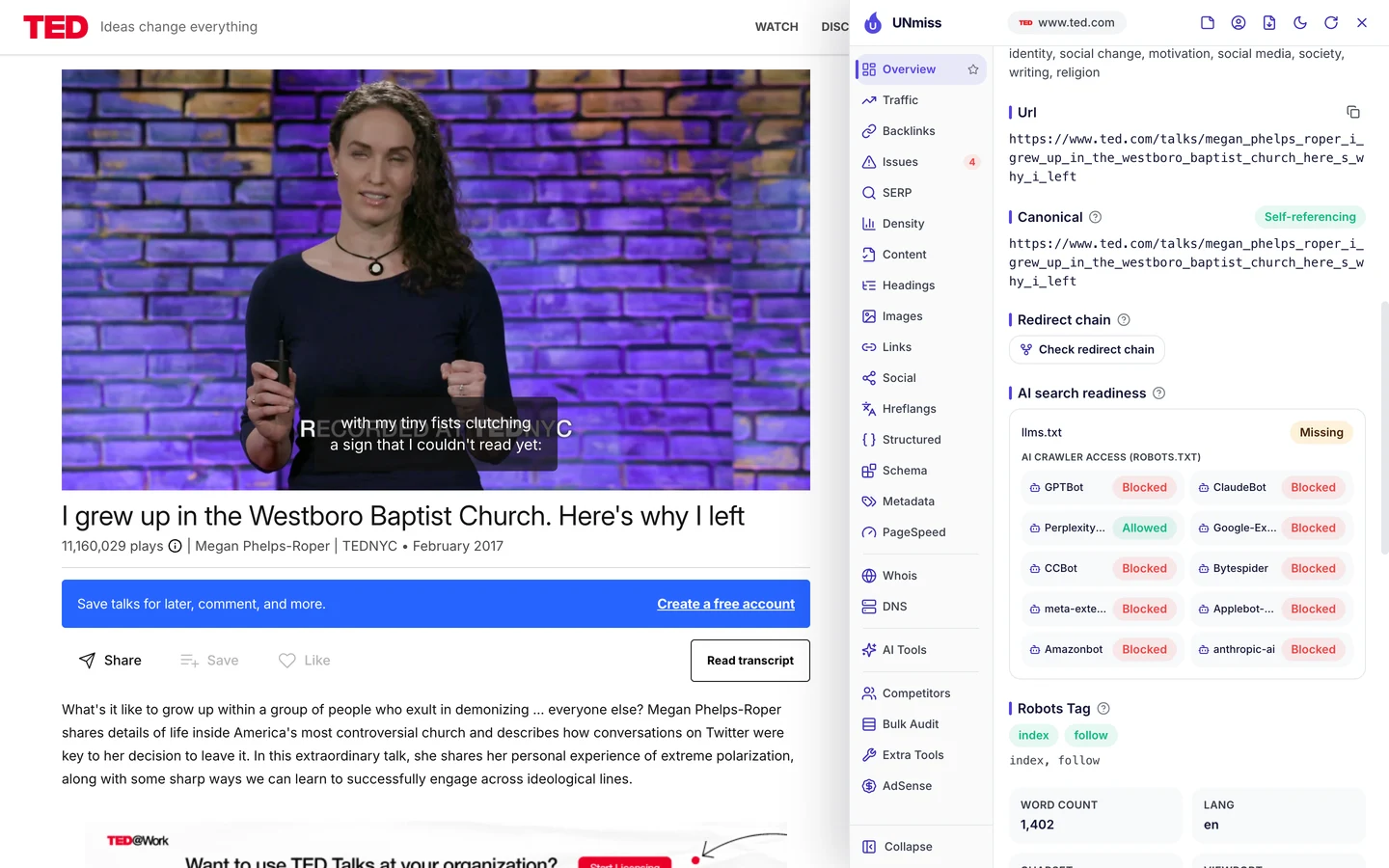
TED blocks the crawlers that collect pages to train AI models. But its robots.txt lets in the crawlers that fetch pages to answer a question and link to the source, like ChatGPT's search and Perplexity.
The notes in its own file explain why. Training crawlers send no visitors back, while AI search tools quote TED and link to it.
That's a smart middle way, and you can copy it in a few lines. wikiHow, the how-to site we studied, blocks almost every AI crawler, while Rotten Tomatoes lets them all in.
Make your choice on purpose. Write your rules with our robots.txt generator, then check whether AI tools mention you with our AI Visibility Checker.
More than half of TED's search traffic comes from people who already know it. Our Organic Traffic Checker shows your branded share and your top pages, so you can see how many strangers find you.
- The same report that measured TED
- Each top page's traffic, share and top search
- Run it on any rival's domain too
What you cannot copy
First, the part you can't copy: more than 40 years of famous speakers, and a name the whole world knows.
That name is why TED still gets millions of visits with so few of its talks ranking. A new site has no name yet, so it has to win searches with its pages from day one.
Now a few honest notes on the numbers.
We took our figures on 1 October 2026. The 300K figure counts US searches, and the 800K worldwide figure comes from the audit's Traffic tab.
Both are estimates. Nobody outside TED can count its real visits, so tools work them out from rankings and search volume.
We set the crawl to 250 pages, a sample of a very big site. So we used it to find problems that repeat, not to count every error.
The one number to take away
47.
That's TED's average position on Google, page 5, even with one of the strongest link profiles on the web. Links alone don't win a search if the page doesn't hold the words people type.
That's the lesson for anyone who makes videos, podcasts or talks. Your best ideas are in what you say, so write them down where Google can read them.
Got a video or an episode that people love? Its transcript could be your next page.
You can run every one of these checks on your own site, and on your rivals', and see the same numbers for yourself.
Frequently asked questions
Does Google read the captions inside a video?
Not reliably. Google can work out what some videos are about, but it ranks pages mainly on the text it finds on them. A transcript on the page is the safe way to make sure your words count.
Should a transcript be hidden behind a button or a tab?
Show it as normal page text if you can. A tab that loads the text only after a click may never be seen by Google. If you do use a tab, make sure the text is in the page from the start.
Are automatic transcripts good enough?
They're a fine start, but read them through before you publish. Fix names, numbers and technical words, because those are often what people search for. Then add headings so readers can skim.
What should go on a speaker or guest page?
A short bio, their role, links to their own sites, and every talk or episode they appear in. That gives the page something to rank for when people search for their name.
Is it worth translating transcripts into other languages?
Only if you can keep each version properly linked to the others. Use hreflang tags that point both ways, and start with the languages your visitors already use.
Can an old blog post really rank on page 1?
Yes, often faster than a new one, because it already has links and age. Update the content, write a proper description and fix the images. Then request a fresh look in Google Search Console.
Will blocking AI training crawlers hurt my Google rankings?
No. Google's normal crawler is separate from Google-Extended, the one used for AI training. You can block training and still be listed in Google search as usual.
How long do fixes like these take to show up?
Title and description changes can show within days, once Google crawls the page again. Ranking gains from new content and better links usually take a few weeks to a few months.