Meetup gets about 378K visits a month from Google in the US, and some of its best pages are written by members, like a New York line-dancing group that ranks first for "line dancing near me".
Meetup gives every group its own page. People fill those pages with photos, events and reviews, and Google sends them strangers who want to join in.
We ran Meetup through our whole SEO toolkit to see how those pages win, and why a site this famous doesn't get more.
Here are 9 lessons you can copy, plus the part you can't.
Let your members build pages
We started with our Organic Traffic Checker. It estimates a site's organic traffic, meaning the people who find it on Google without ads.
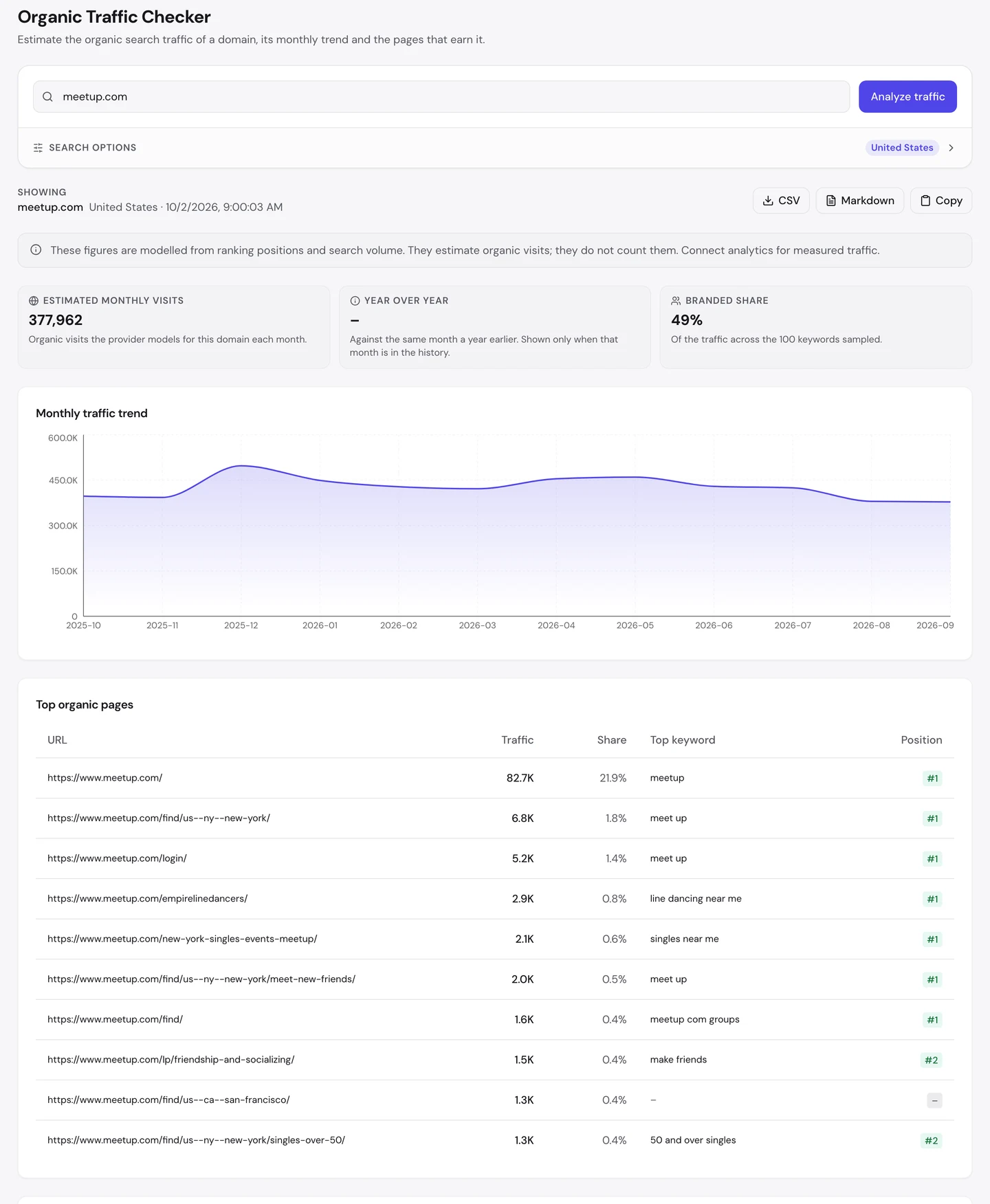
For Meetup, that's about 378K visits a month in the US. The chart peaked last December and has eased down since.
Now look at the top pages. After the homepage and the login page, 2 of the top 5 are groups: a line-dancing class and a singles club, both in New York.
Meetup didn't write those pages. The organisers did, and they keep them fresh with every event they post.
The Traffic tab of our Website Audit shows the whole world.
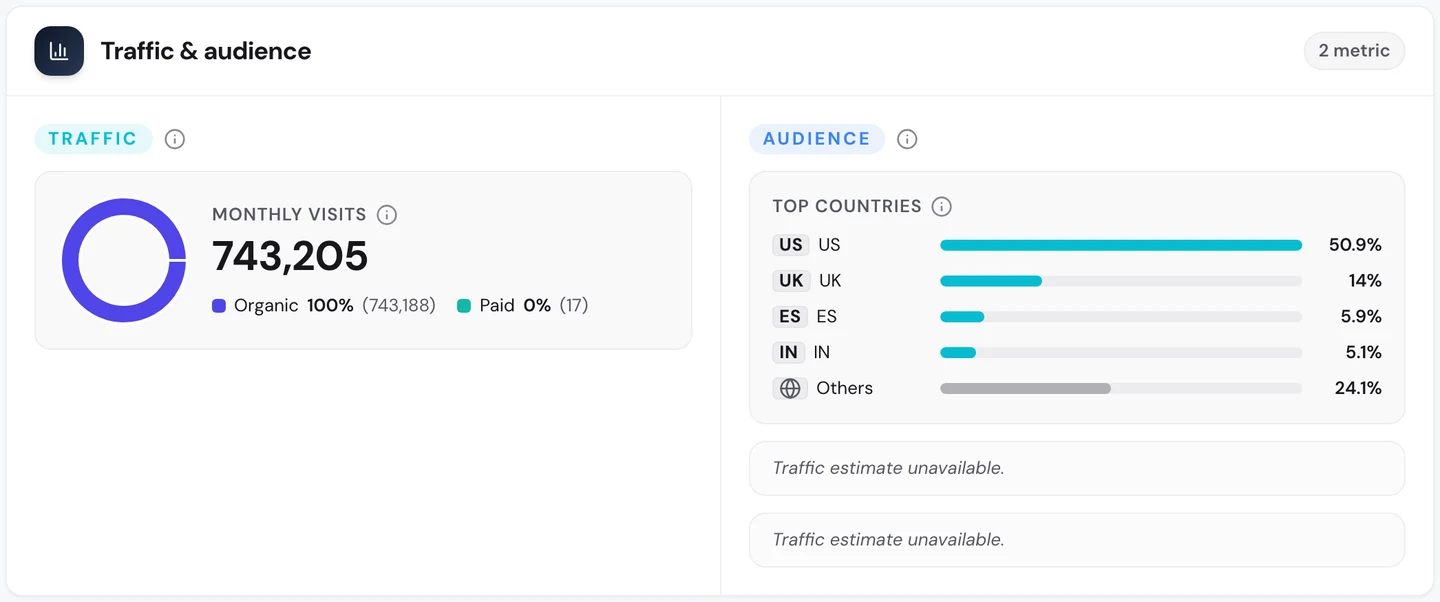
Worldwide it's about 740K search visits a month, and half come from the US.
So if your customers create things, give each one a page. Every page they fill is a new door into your site.
Win the "near me" searches
The Keywords tab of our audit lists every search a site ranks for, where it ranks and how many visits each one sends.
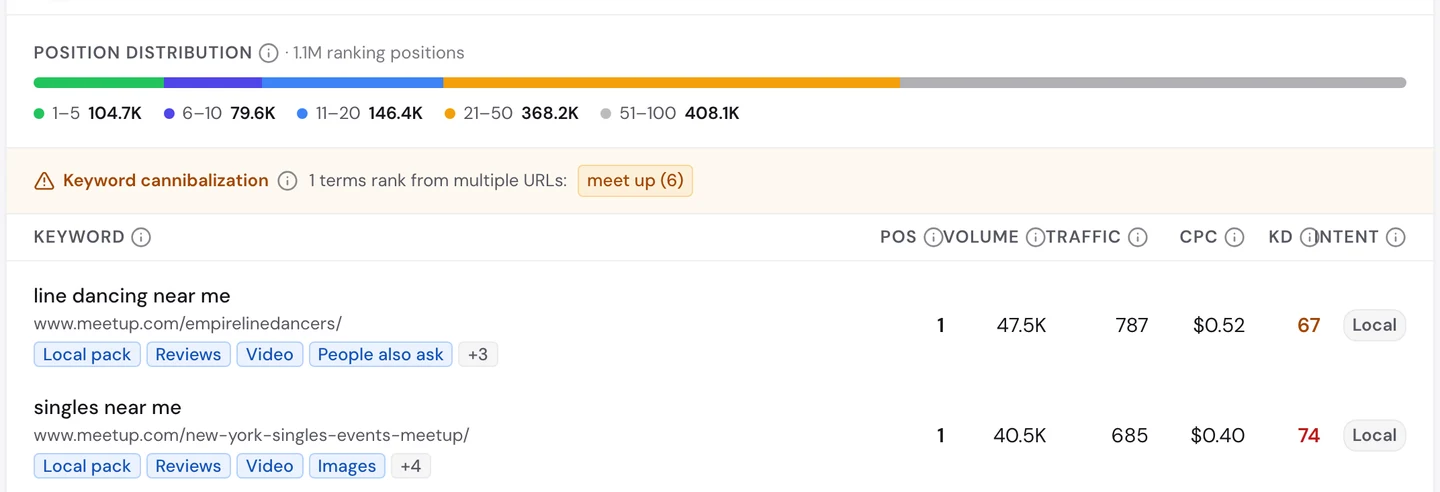
"Line dancing near me" is searched about 48K times a month. A group page ranks first for it, and "singles near me" goes the same way.
Google loves these pages for local searches, and so do you when you're the one searching. They name a real place, show real people and list real dates.
Look at the warning above the rows too. The search "meet up" lands on 6 different Meetup pages, a problem called keyword cannibalization, when your own pages compete for the same search.
And in the searches we sampled, 49% of the traffic came from people typing the name Meetup. Half the visitors already knew where they were going.
So look for the "near me" searches in your field, and make sure you have a local page that answers each one. Find them with our Keyword Research tool.
Keep member text in check
Here's the group that ranks first for "line dancing near me".
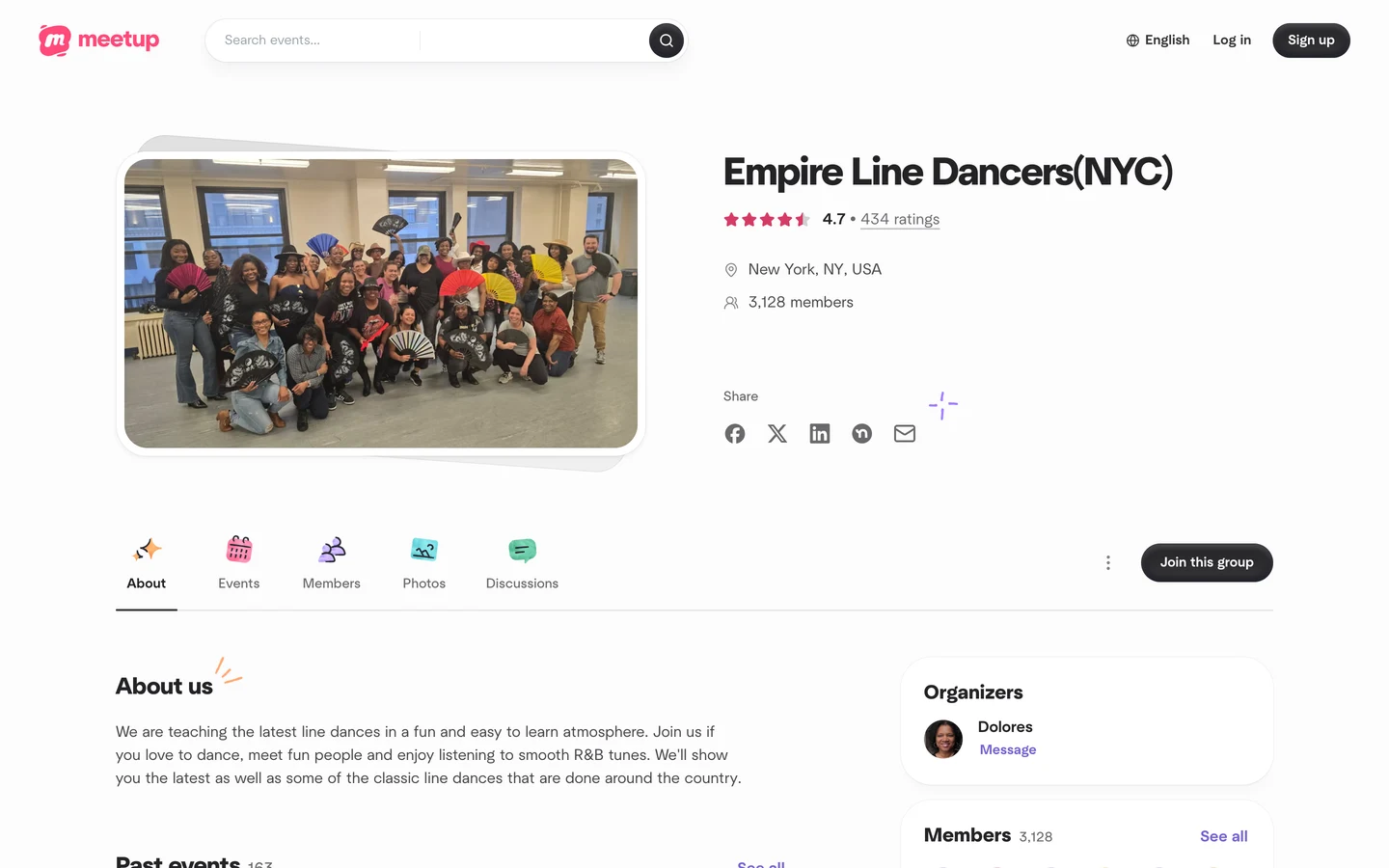
It shows a star rating, more than 3K members and an "About us" text. Everything on the page tells you this group is real and busy.
Our free browser extension shows how the page is built. Open the page, click the seotools.pro icon, and a panel opens beside it with 35 SEO checks.
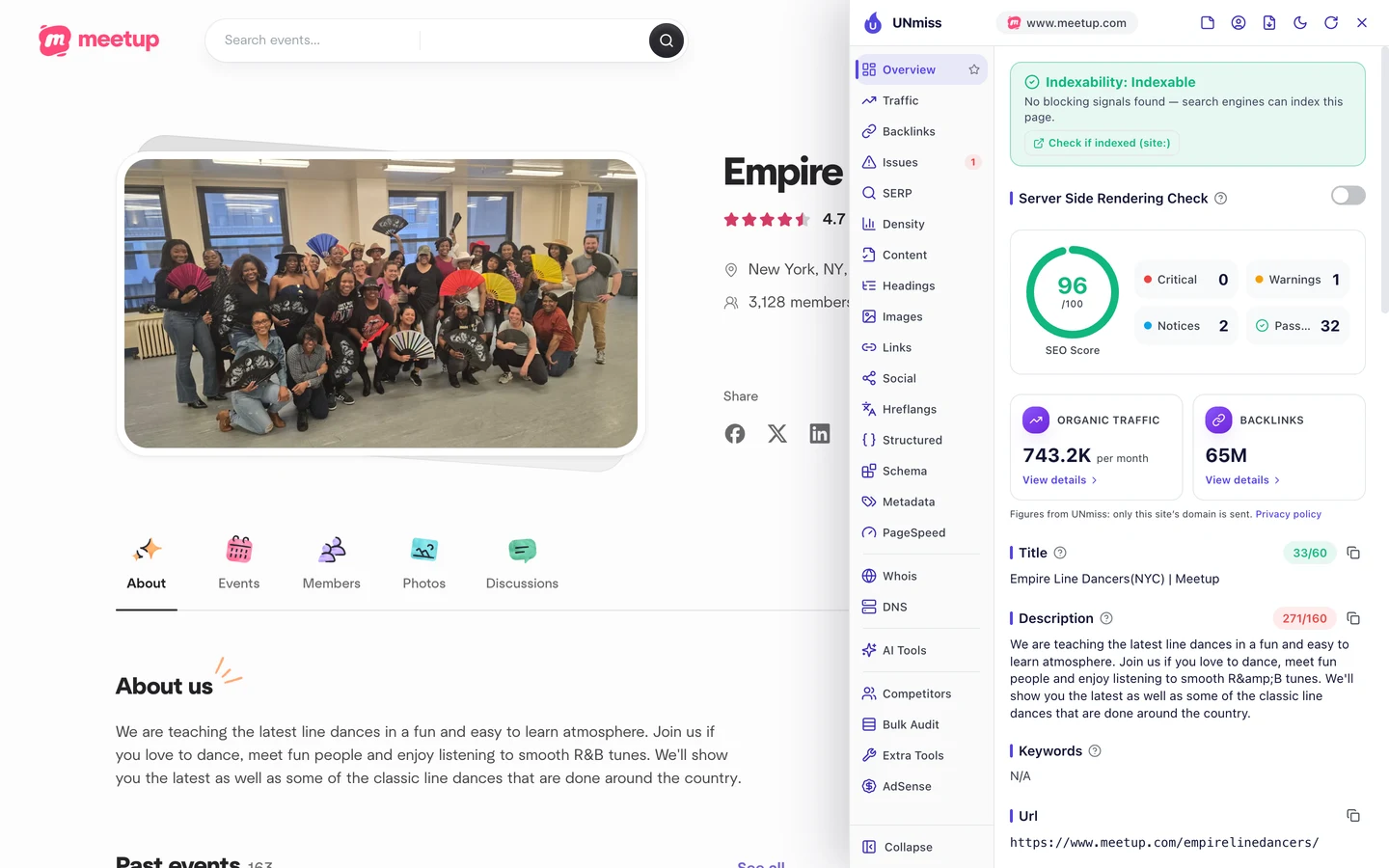
It scores 96 out of 100. The only warning is the description, the short summary Google may show under the title.
Meetup copies the group's own "About us" text into it, all 271 characters. Google usually shows about 160, so the rest gets cut off.
Members don't write for Google, and that's fine. Your template's job is to trim what they write into something that fits.
So cut member text to about 150 characters at the end of a sentence, and use it as the description. Our Meta Tag Generator shows how long yours should be.
Mark up every event in code
Meetup's city pages list events from many groups. Here's what the extension's Structured tab found on the New York page.
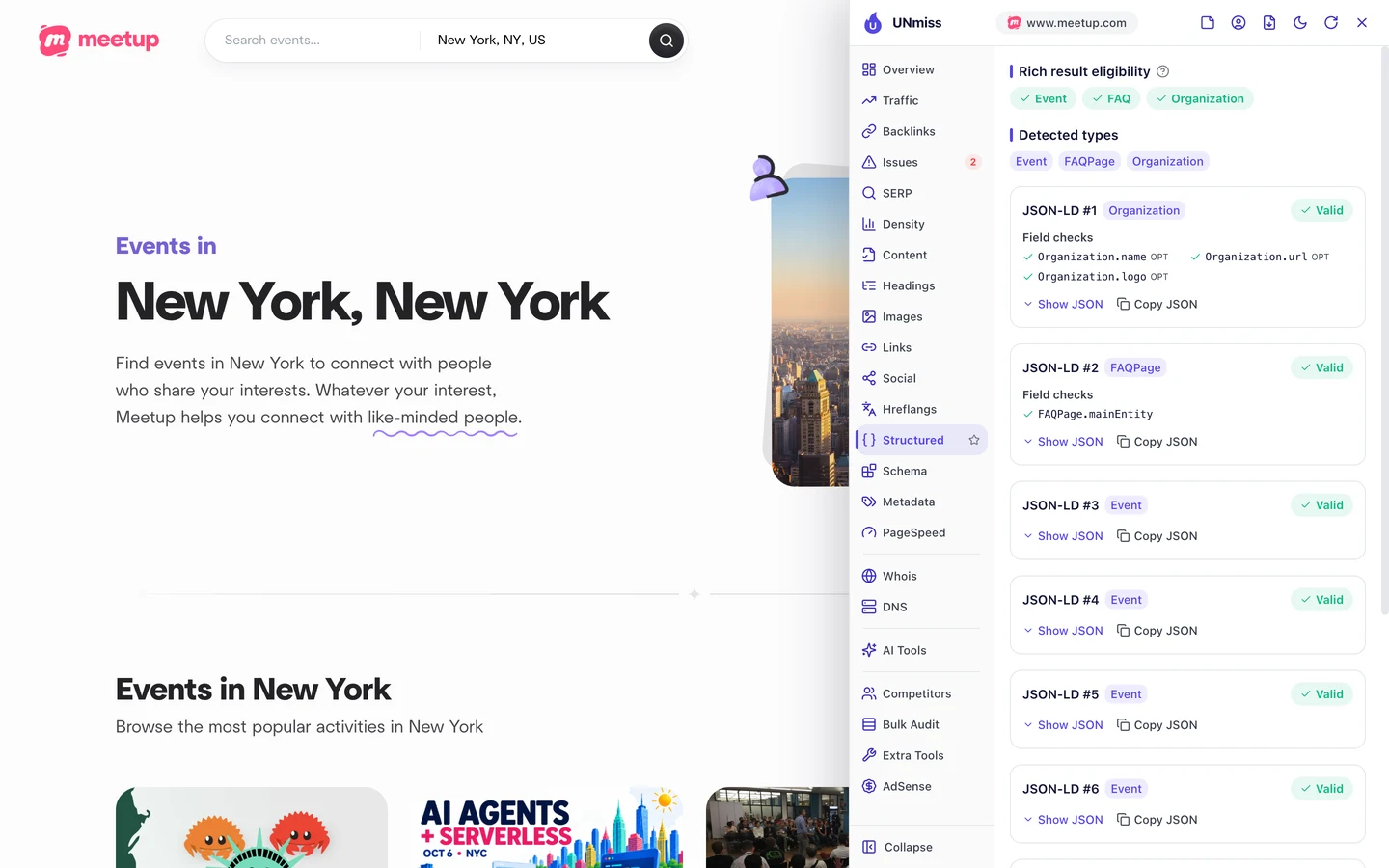
Structured data is code that tells Google what a page is. This page has a block for each event on it, plus a block for its questions and answers.
That's how an event can show up in Google with its date and place, right in the results. Eventbrite, which we studied too, does the same, and Google says it helped double Eventbrite's event traffic.
So if you list events, products or courses, describe each one in code. Our Schema Markup Generator writes it for you.
Meetup's groups win local searches because members fill their pages with real details. We build page templates for your members, sellers or partners, so everything they add helps you rank.
- We find the local searches your community can win
- We design templates that turn member text into clean titles and descriptions
- We add the event and product code Google reads
- SEO and GEO, so AI answers can quote you too
Point your links at what ranks
A backlink is a link from another website to yours. Google treats each one a bit like a vote of trust.
The Backlinks tab of our audit shows the same data as our Backlink Analyzer.
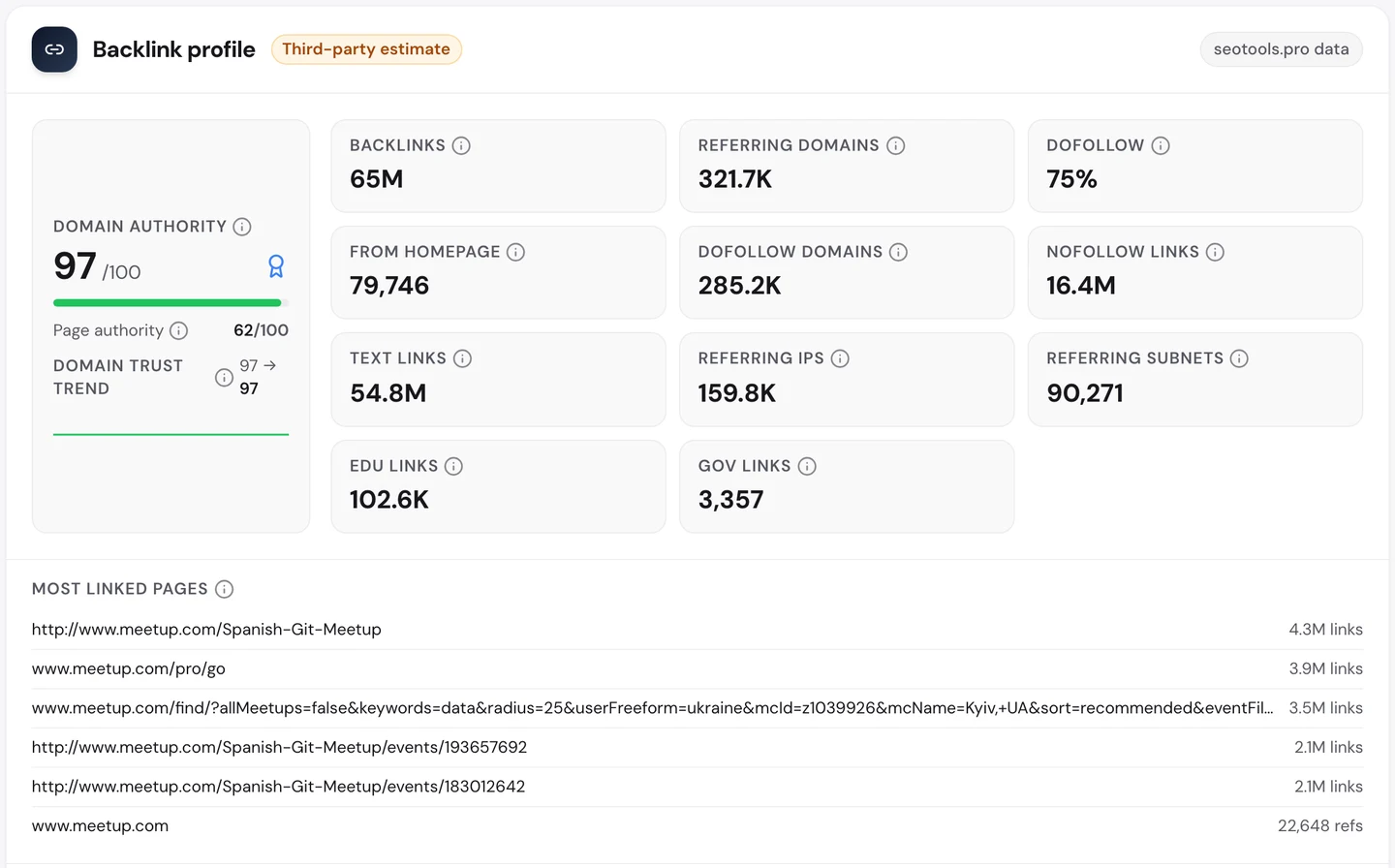
Meetup has about 65M links from more than 320K websites. Its Domain Authority, our 0 to 100 score for a site's link strength, is 97.
But look at where the links go. The most linked page is a small Spanish-language Git user group, with about 4.3M links, and a search page for data events in Kyiv comes third.
Those pages don't win any big searches you'd care about. All that trust lands on pages that don't need it.
Our Domain Overview shows what Meetup gets for it.
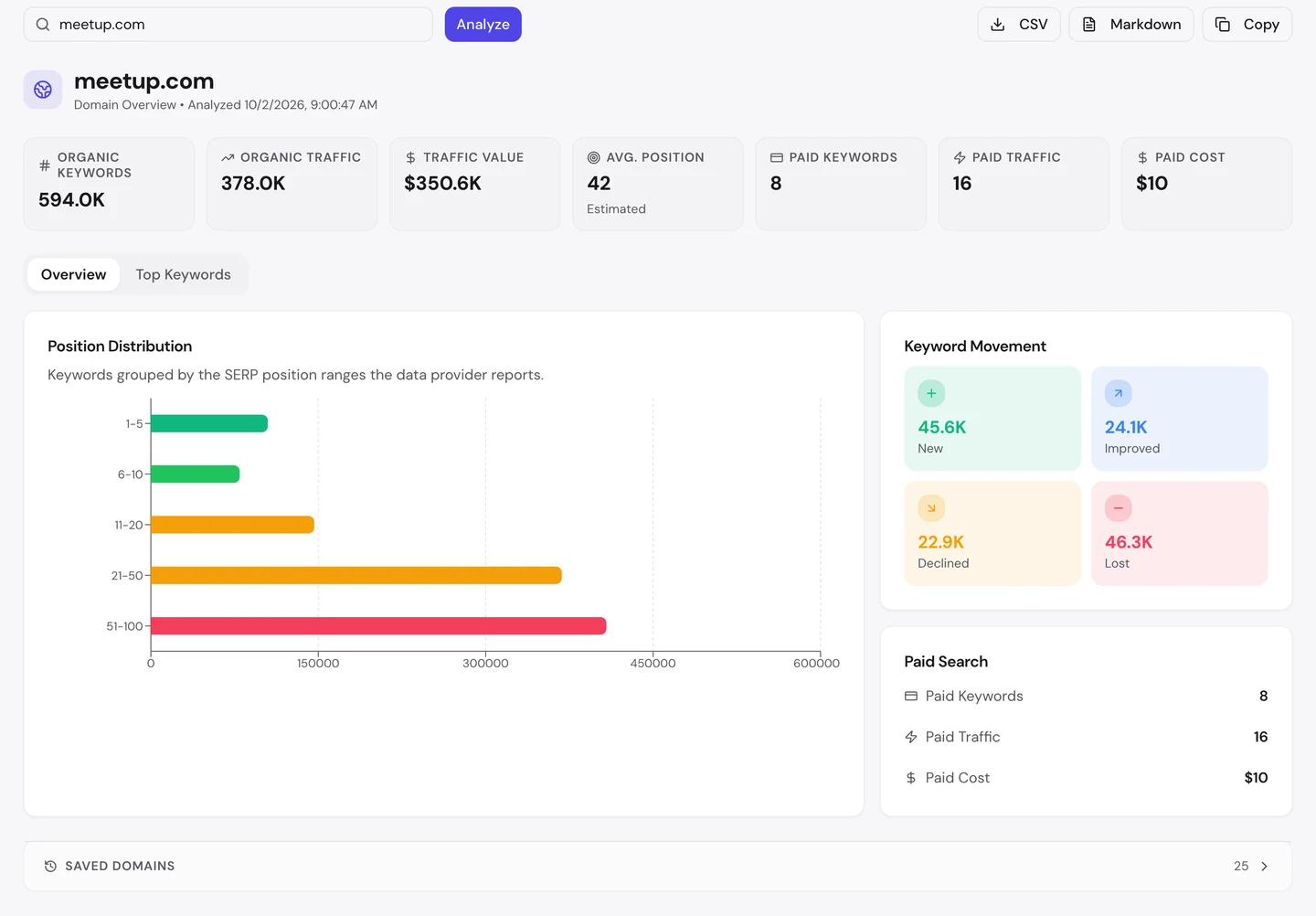
Its average position is 42, on page 5 of Google. And it lost slightly more keywords than it gained.
TED, which we studied too, has the same problem: huge link numbers, and an average position deep on page 5.
So check which of your pages get the links, then link from those pages to the ones you want to rank. A link that lands on a forgotten page is trust you could use somewhere else.
Audit your shared templates
We checked Meetup with our Website Audit. It sends a crawler, a program that visits pages the way Google does, opening each page and following the links to the next ones.
We had it crawl 249 pages. Meetup scored 81 out of 100, which the report rates as good.
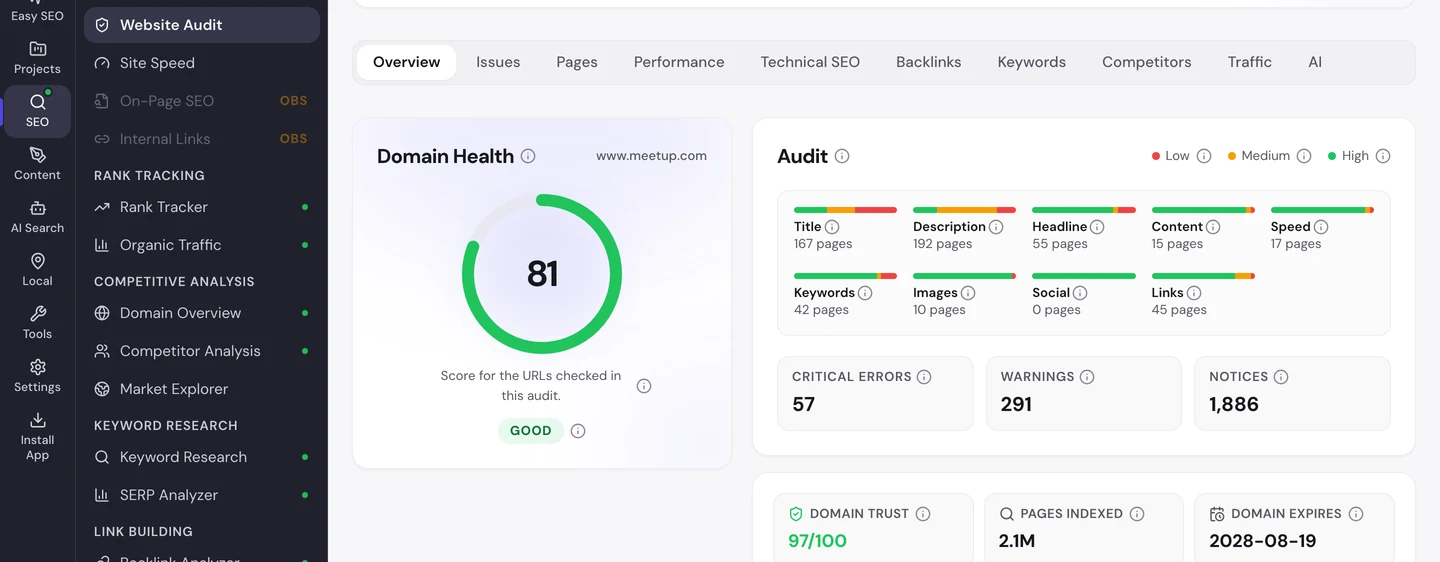
The Issues tab sorts the problems by how much they matter to you.
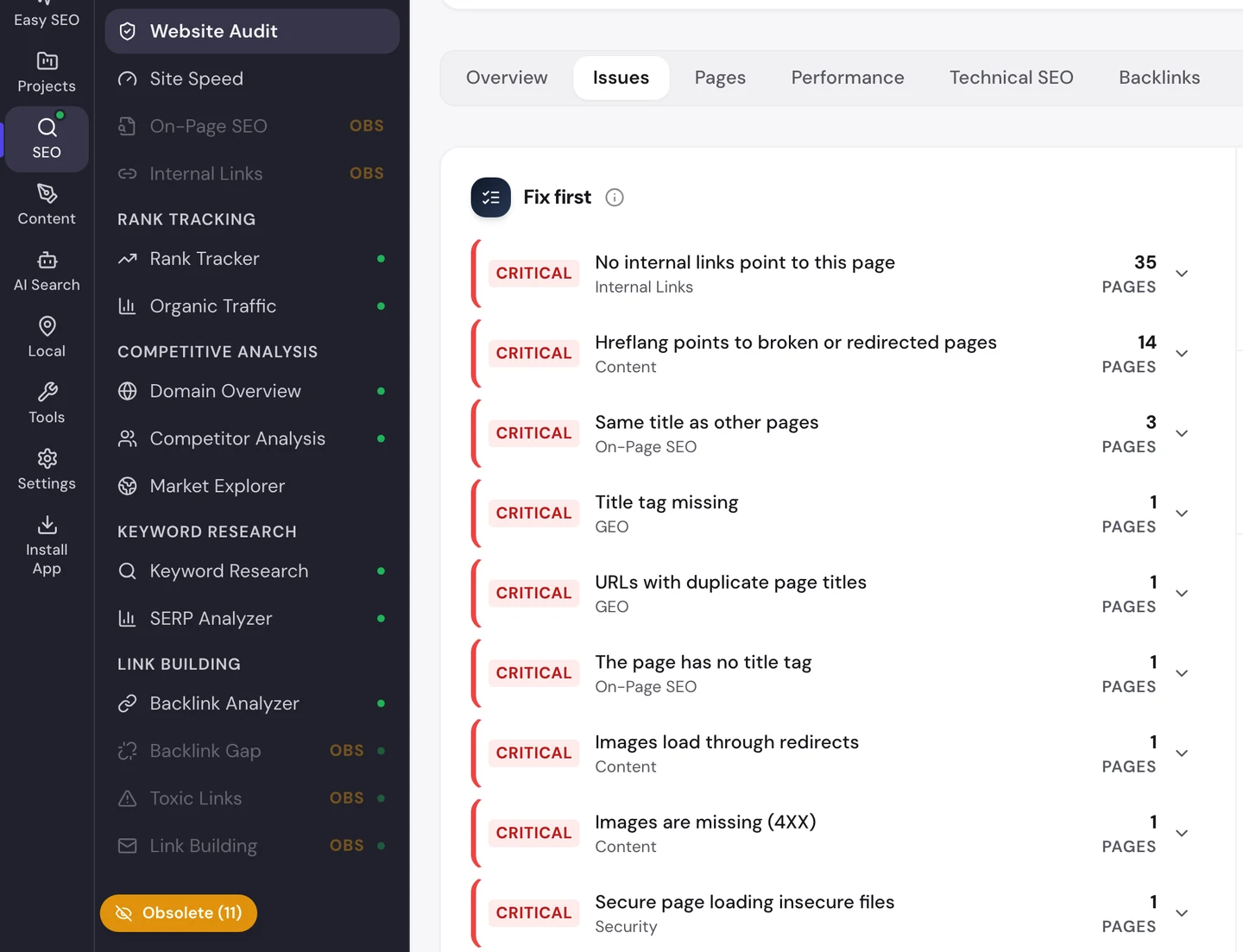
The top error is 35 pages that no other page in the crawl links to. A page without links is hard for Google to find, and gets none of the site's trust.
Next come language links that point to pages that moved or broke. Hreflang is a tag that tells Google which language version of a page to show.
The Technical SEO tab shows one template problem clearly.
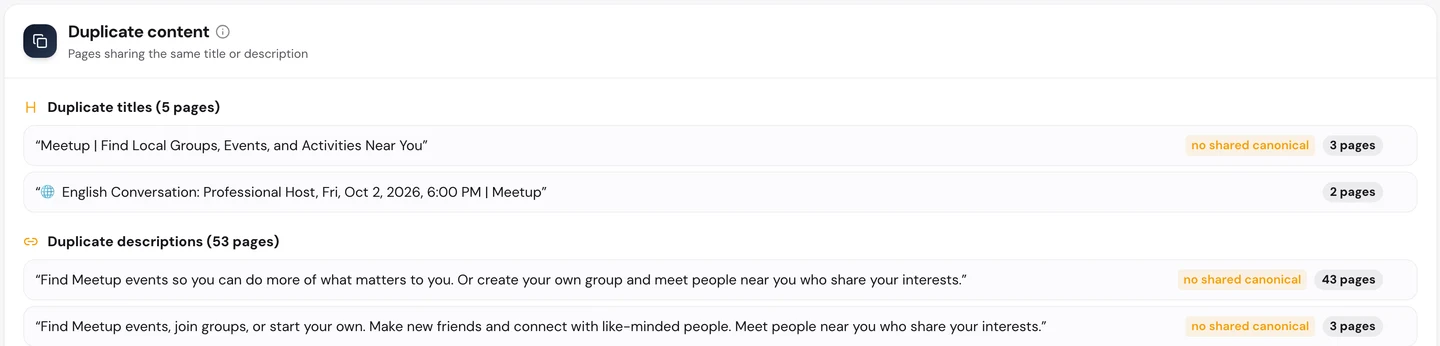
One description, "Find Meetup events so you can do more of what matters to you", is reused on 43 pages. Google can't tell those pages apart from their summary.
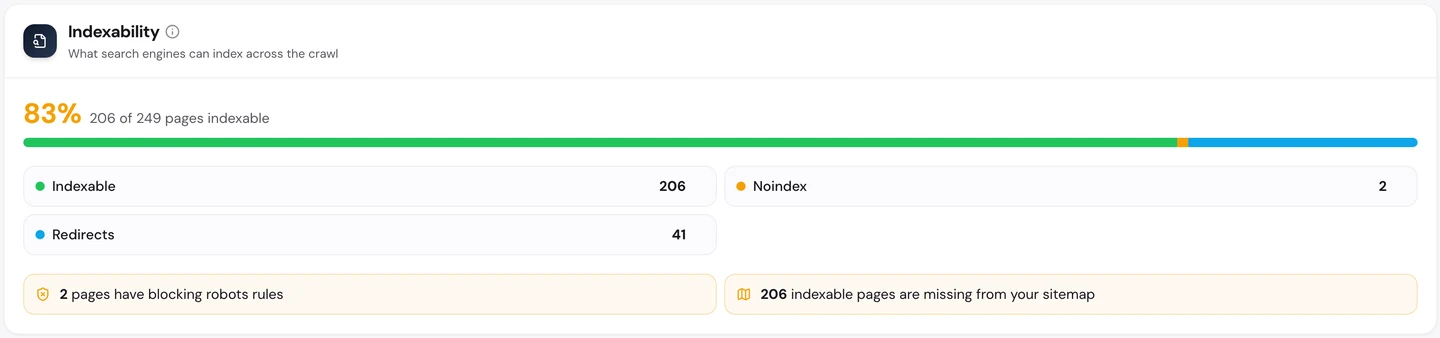
More than 4 in 5 crawled pages can be listed by Google. Most of the rest redirect somewhere else.
You don't have to work out what to fix first. The audit's AI tab writes the plan: a short summary, each problem with how to fix it, and a 90-day to-do list.
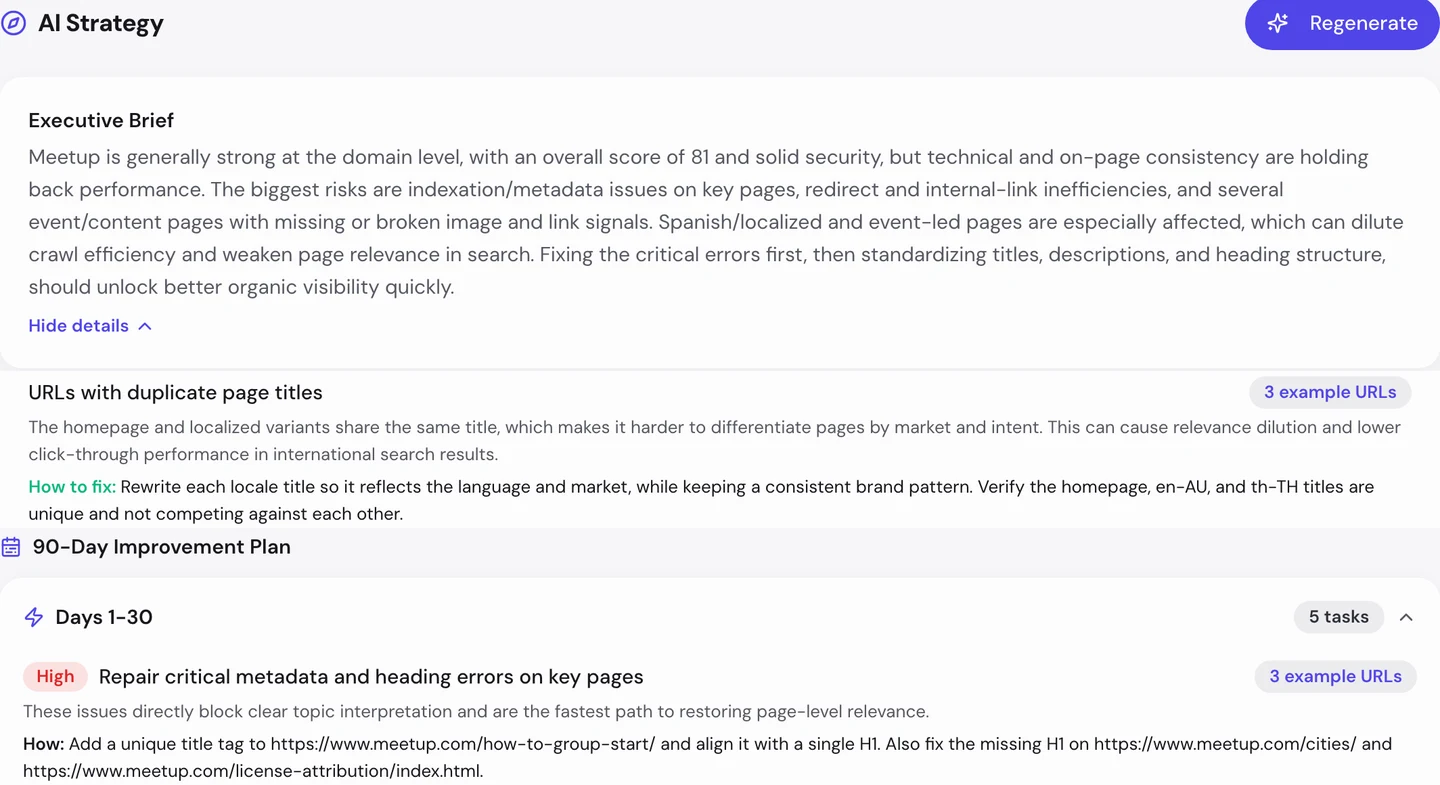
For Meetup, the first month goes to missing titles and headings, then to the homepage titles shared across countries.
So check the templates every page shares: the title, the description and the links. Fix one template, and hundreds of pages get better at once.
Speed up the phone version
The Performance tab of the audit shows Core Web Vitals. These are Google's 3 checks of how fast a page loads, how fast it reacts and whether it stays still, measured on real visitors' devices.
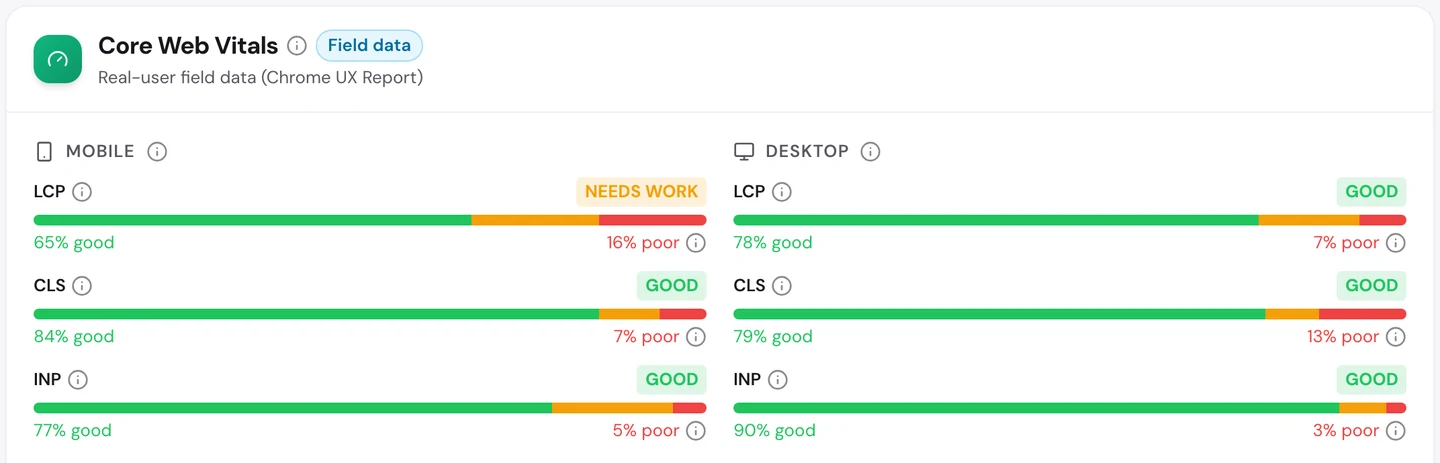
Meetup passes 5 of the 6 checks. The one that fails is how fast the main content shows up on phones.
About 1 in 6 phone visits waits too long. You're probably searching "near me" on your phone, so that's the visit that matters most.
So test your local pages on a phone first, and load the main picture and text before anything else. Our Site Speed tool shows what slows each page down.
Know your real rivals
The audit's Competitors tab lists the sites that rank for the same searches as you.
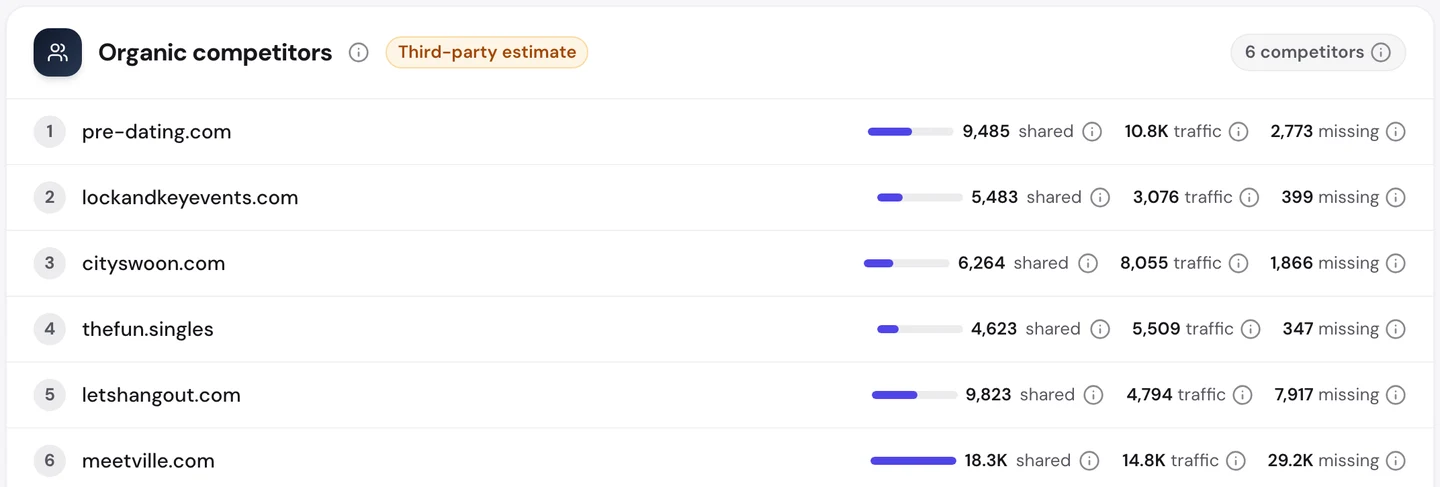
Here's another surprise. Most close rivals run singles events or dating sites, like Pre-Dating, Lock and Key and Meetville.
You'd think of Meetup as a place for all kinds of groups. But in search, its strongest fight is over people looking to meet someone.
Your rivals in search may not be the ones you think. Check yours, then track the searches you share with them in our Rank Tracker.
Send AI tools one clear signal
More and more people ask ChatGPT or Claude where to meet new people, instead of searching Google. So we checked which AI tools may read Meetup.
The rules for crawlers live in robots.txt, a file that tells crawlers what they may read, and our extension reads it for you.
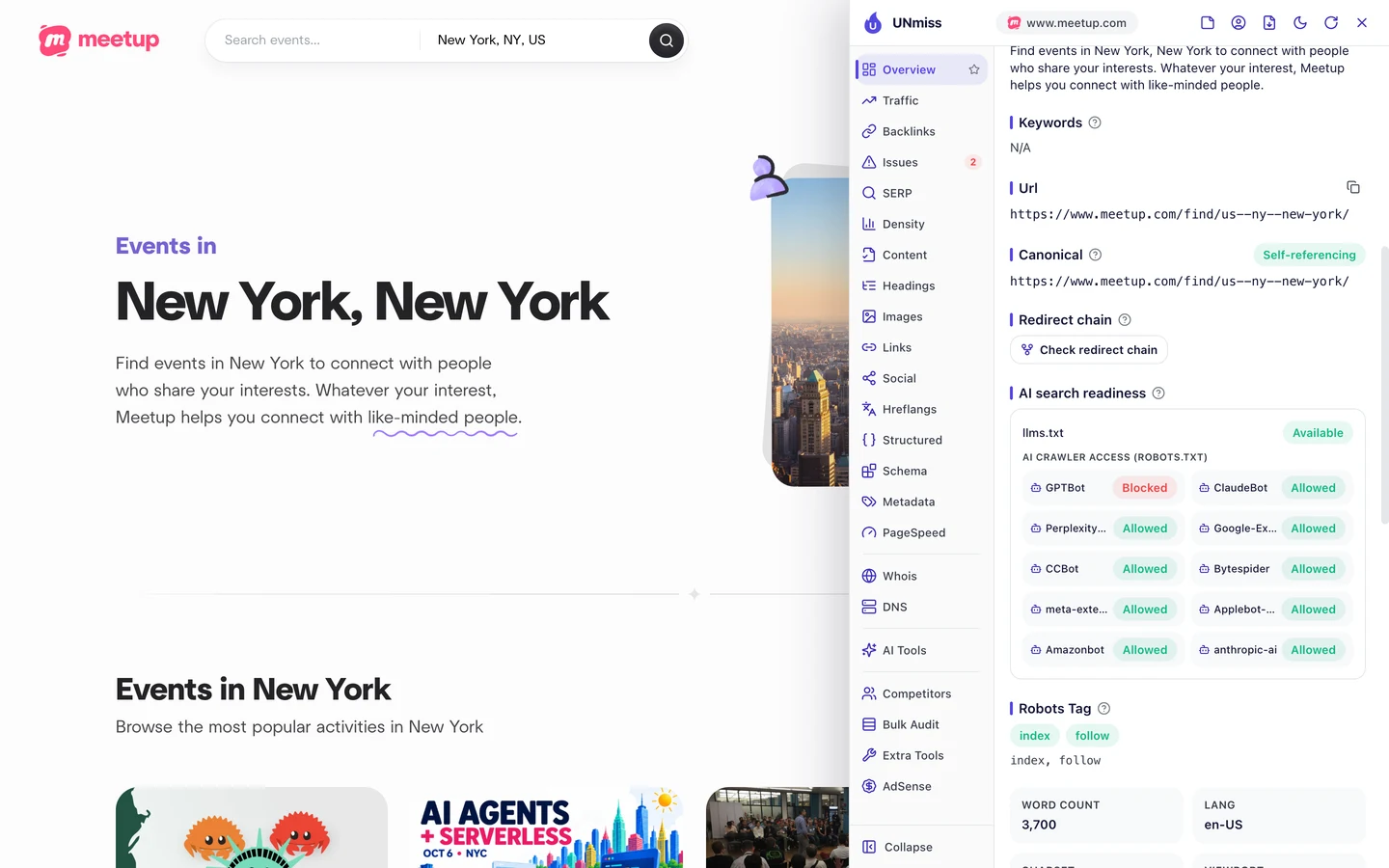
Meetup has an llms.txt file, a short guide that explains the site to AI tools. It describes groups, events and how to join.
But its robots.txt blocks GPTBot, the crawler from the company behind ChatGPT. So Meetup writes a welcome note for AI tools and then shuts the door on one of the biggest.
That may be on purpose. MDN, which we studied too, lets every AI crawler in, while TED blocks only the ones that train AI models.
Whatever you choose, make your signals agree. Write your rules with our robots.txt generator, then check whether AI tools mention you with our AI Visibility Checker.
Some of Meetup's best pages are written by its members. Our Organic Traffic Checker shows your top pages and the share each one brings, so you can see which kind of page is working for you.
- The same report that measured Meetup
- Each top page's traffic, share and top search
- Run it on any rival's domain too
What you cannot copy
First, the part you can't copy: millions of members and organisers who post groups and events every day.
Their pages are why Meetup ranks in cities it has never visited. If you're starting out, give your first customers a page they're proud to fill.
Now a few honest notes on the numbers.
We took our figures on 2 October 2026. The 378K figure counts US searches, and the 740K worldwide figure comes from the audit's Traffic tab.
Both are estimates. Nobody outside Meetup can count its real visits, so tools work them out from rankings and search volume.
We set the crawl to 250 pages, a sample of a very big site. So we used it to find problems that repeat, not to count every error.
The one number to take away
4.3M.
That's how many links point at one small Spanish-language Git user group, Meetup's most linked page. Meanwhile the pages that win searches, like the line-dancing group, earn their place with real details.
That's the lesson for any community site. Links help, but pages full of real, local detail are what win the search.
What does your best customer page look like? Check it the way Google would.
You can run every one of these checks on your own site, and on your rivals', and see the same numbers for yourself.
Frequently asked questions
Can pages written by users hurt my SEO?
They can if they're empty, spammy or copied. Set a few rules: a minimum amount of detail, a review for spam, and noindex on pages that stay empty.
What should happen to a group page when the group closes?
Keep it live for a while with a note and links to similar groups. If it has links pointing to it, redirect it to the closest active page later.
Do star ratings from members show in Google?
Sometimes, for certain types of pages, when the ratings come from real users. Google doesn't show stars for ratings a business gives itself.
How do I stop "near me" pages from looking the same?
Fill each one with what's really local: the places, the dates, the people and the photos. If two pages would say the same thing, merge them.
What is an llms.txt file?
A plain text file at the root of your site that explains it to AI tools in a few short sections. It's new and not every AI tool reads it yet.
Should I block GPTBot?
It depends on your goals. GPTBot collects pages for training. OpenAI's search crawler, OAI-SearchBot, is a separate one, so you can block one and allow the other.
How do I find pages that nothing links to?
Compare the pages in your sitemap with the pages a crawler finds by following links. Any page in the sitemap that the crawler never reached needs a link.
How long do member pages take to start ranking?
Often a few weeks after they fill up with real detail and get a link from a city or topic page. Empty pages may never rank at all.