itch.io gets about 2.7M visits a month from Google in the US, and some of its best wins are pages that game makers build themselves, named after their games.
itch.io is a shop where indie game makers sell or give away their games. Each maker gets a web address of their own, like a small site inside the big one.
We ran itch.io through our whole SEO toolkit. We found why those maker pages win, and a speed limit that stopped our crawler, a program that visits pages the way Google does.
Here are 9 lessons you can copy, plus the part you can't.
Give each creator their own page
We started with our Organic Traffic Checker. It estimates a site's organic traffic, meaning the people who find it on Google without ads.
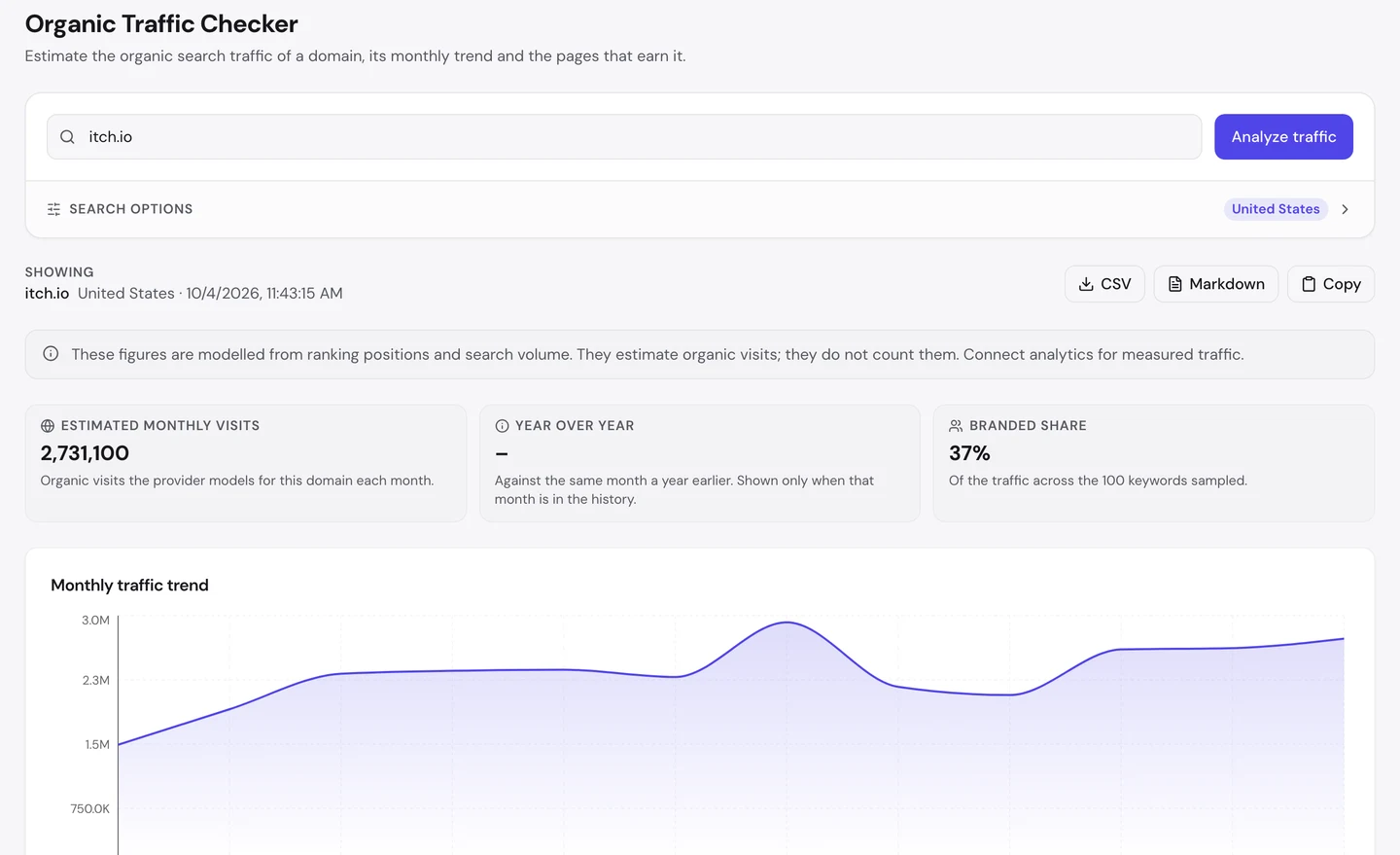
For itch.io, that's about 2.7M visits a month in the US. The trend has almost doubled over the past year.
Now look at the branded share. About 37% of the traffic we sampled came from people typing the name itch.io.
So nearly 2 in 3 visitors typed something else. Lots of them typed the name of a game.
Here's one of those games. Friday Night Funkin' is a rhythm game, and its makers host it on itch.io at their own address, ninja-muffin24.itch.io.
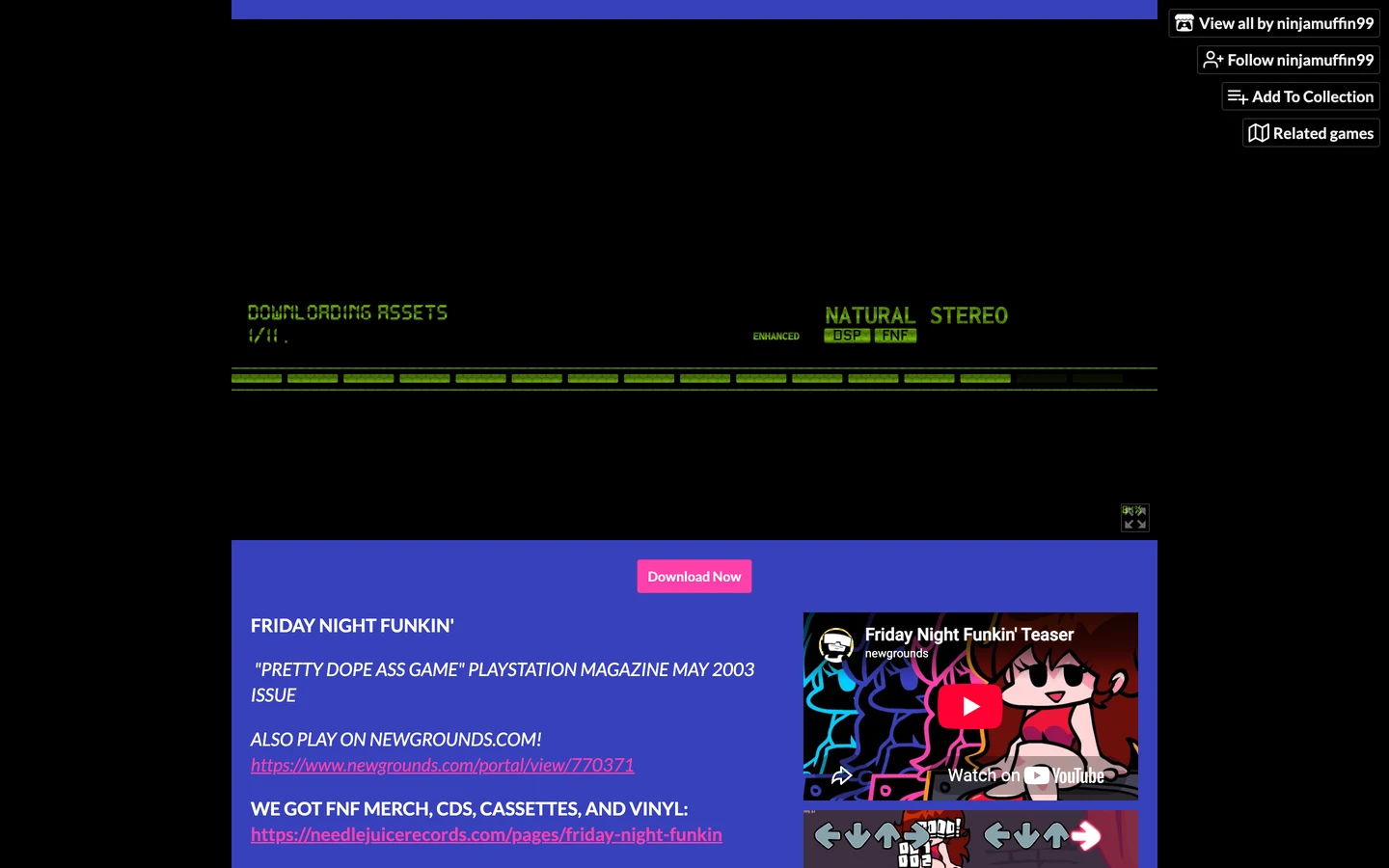
The page looks like the makers' own site. They pick the colours, write the text and add their links.
But it all lives on itch.io. So every visit to the game counts as a visit to itch.io too.
The Traffic tab of our Website Audit shows you the wider picture, all over the world.
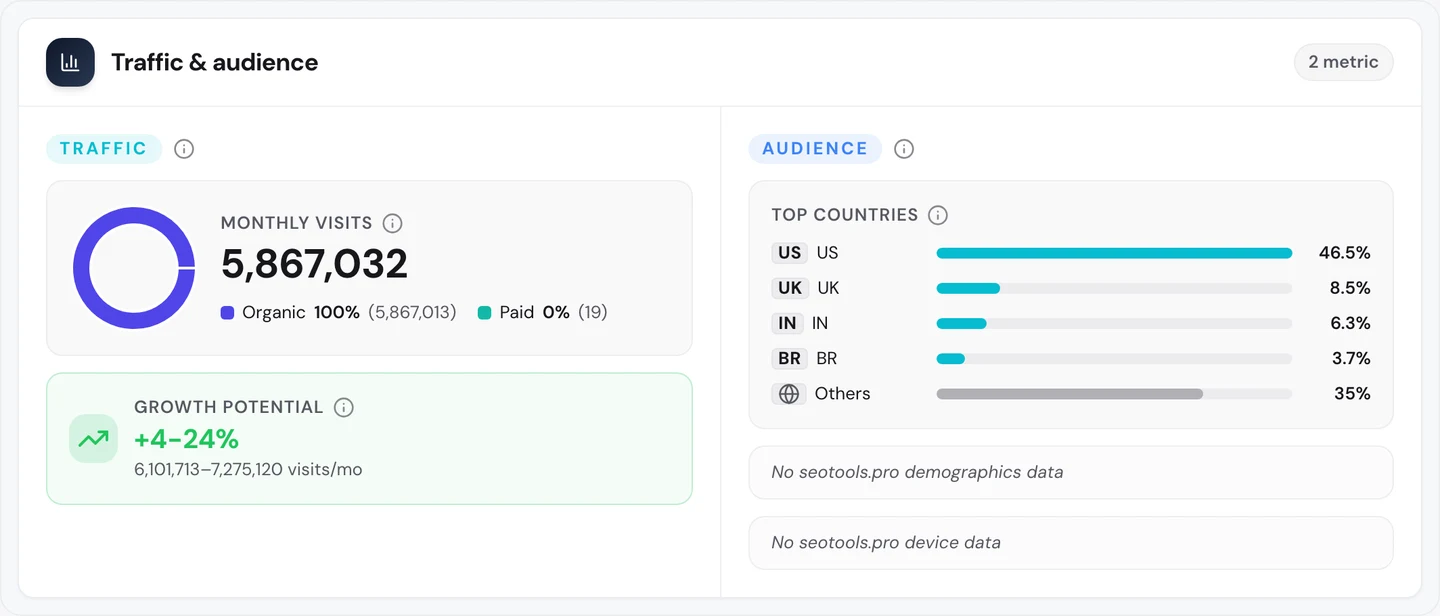
itch.io gets about 5.9M search visits a month worldwide. Almost half of them come from the US.
Meetup, which we studied too, also lets its members build pages of their own. So does Docker Hub, which gives its users public profiles.
So if your users make things, let them build pages on your site. Then see which pages earn you the visits with our Organic Traffic Checker.
Name each page after the game
The Keywords tab of our audit lists the searches a site ranks for. It shows you where each page ranks and how many visits each search sends.
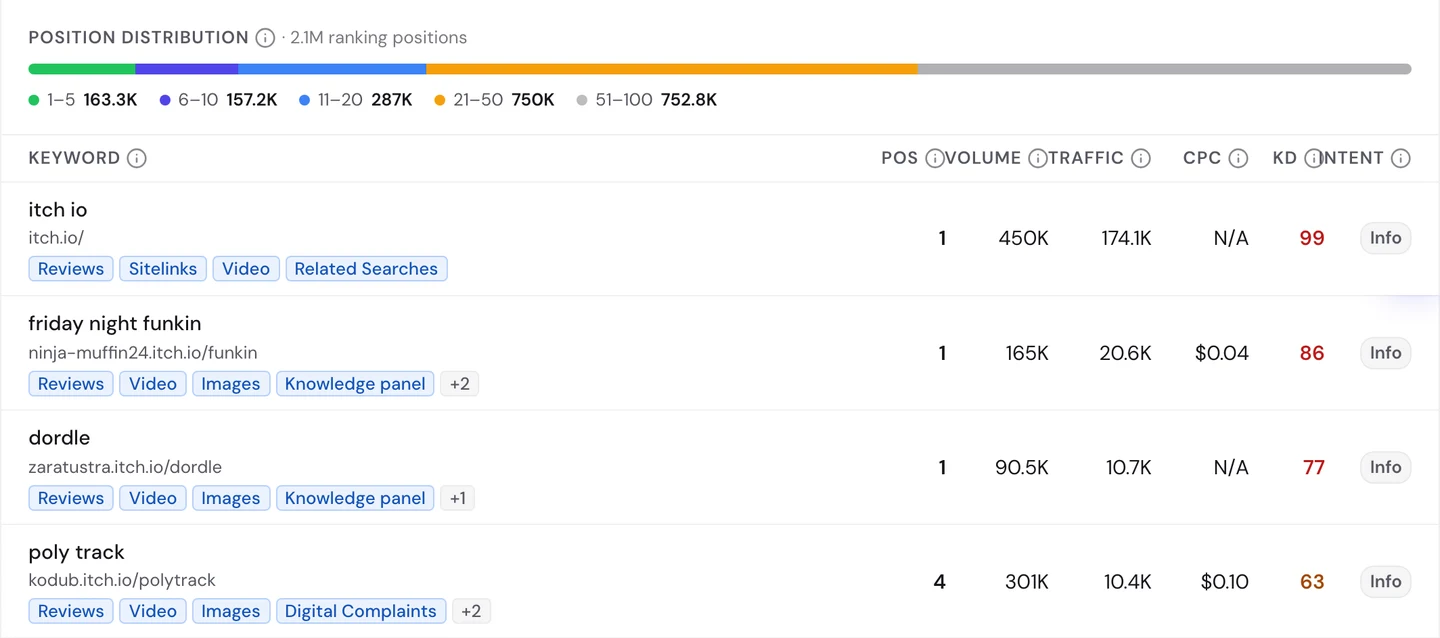
The first row is the brand. People search "itch io" about 450K times a month, and the homepage ranks first.
The next 3 rows are the fun ones. Each is a game page on its maker's own address.
Friday Night Funkin' ranks first for its own name, a search made about 165K times a month. It's also second for "fnf", the short name fans use.
Dordle ranks first for "dordle". PolyTrack ranks 4th for "poly track".
Each page wins because its name is what people type, word for word. Google doesn't have to guess what the page is about.
That's the deal itch.io offers. A maker brings a game people talk about, and itch.io gives it a page on a site Google already knows well.
So name each page after the exact thing people type. Our Keyword Research tool shows you those words and how often people search them.
Set limits on creator titles
Ranking is half the job. Once you're on the results page, your title and description decide whether people click.
Our free browser extension shows you how a page is built. Open the page, click the seotools.pro icon, and a panel opens beside it with 35 SEO checks.
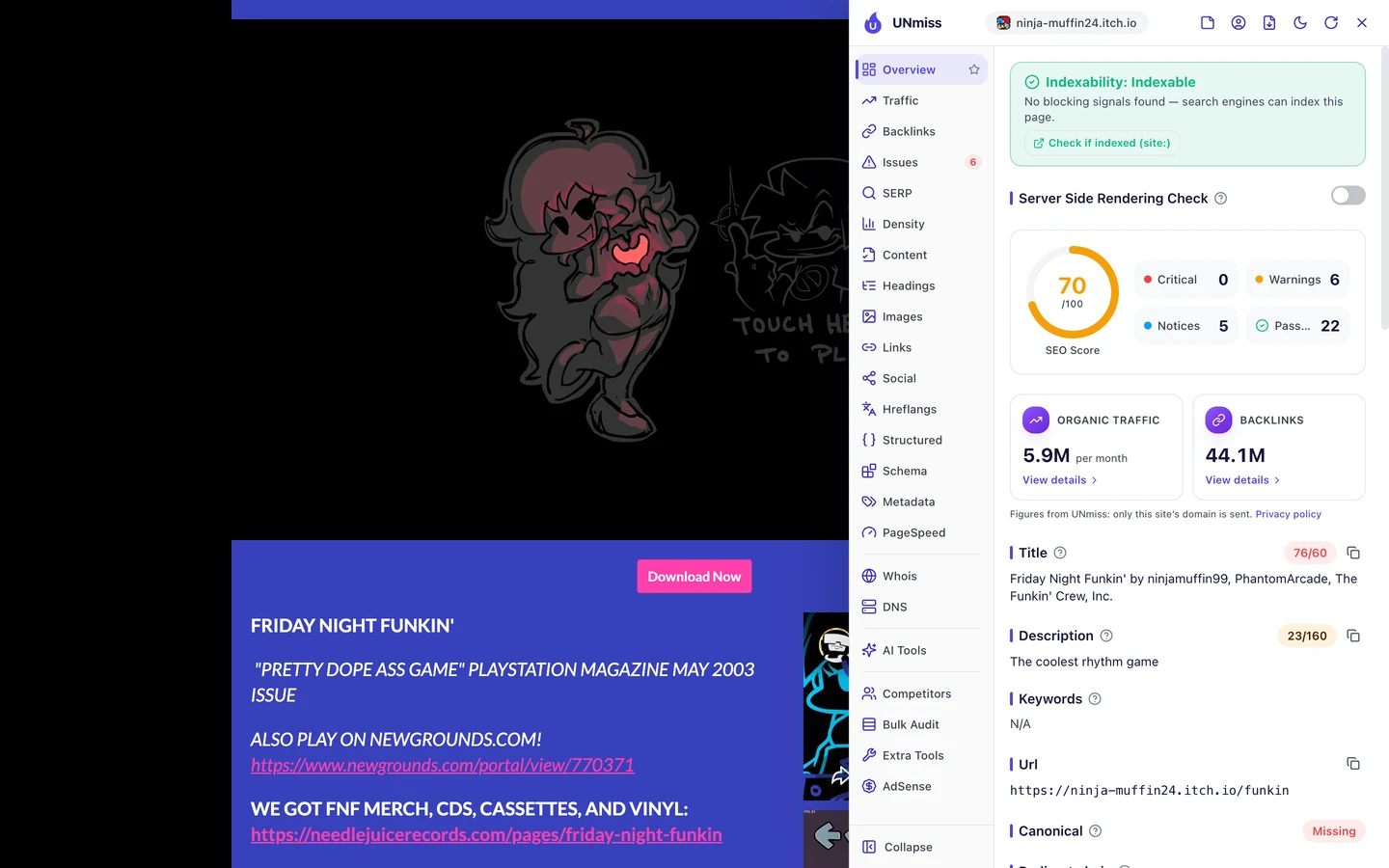
The Friday Night Funkin' page scores 70 out of 100. Its title is 76 characters long, because it lists every maker's name.
Google usually cuts titles at about 60 characters. So searchers may never see the end of it.
The description is the short summary Google may show under your title. Here it's "The coolest rhythm game", just 23 characters when Google can show about 160.
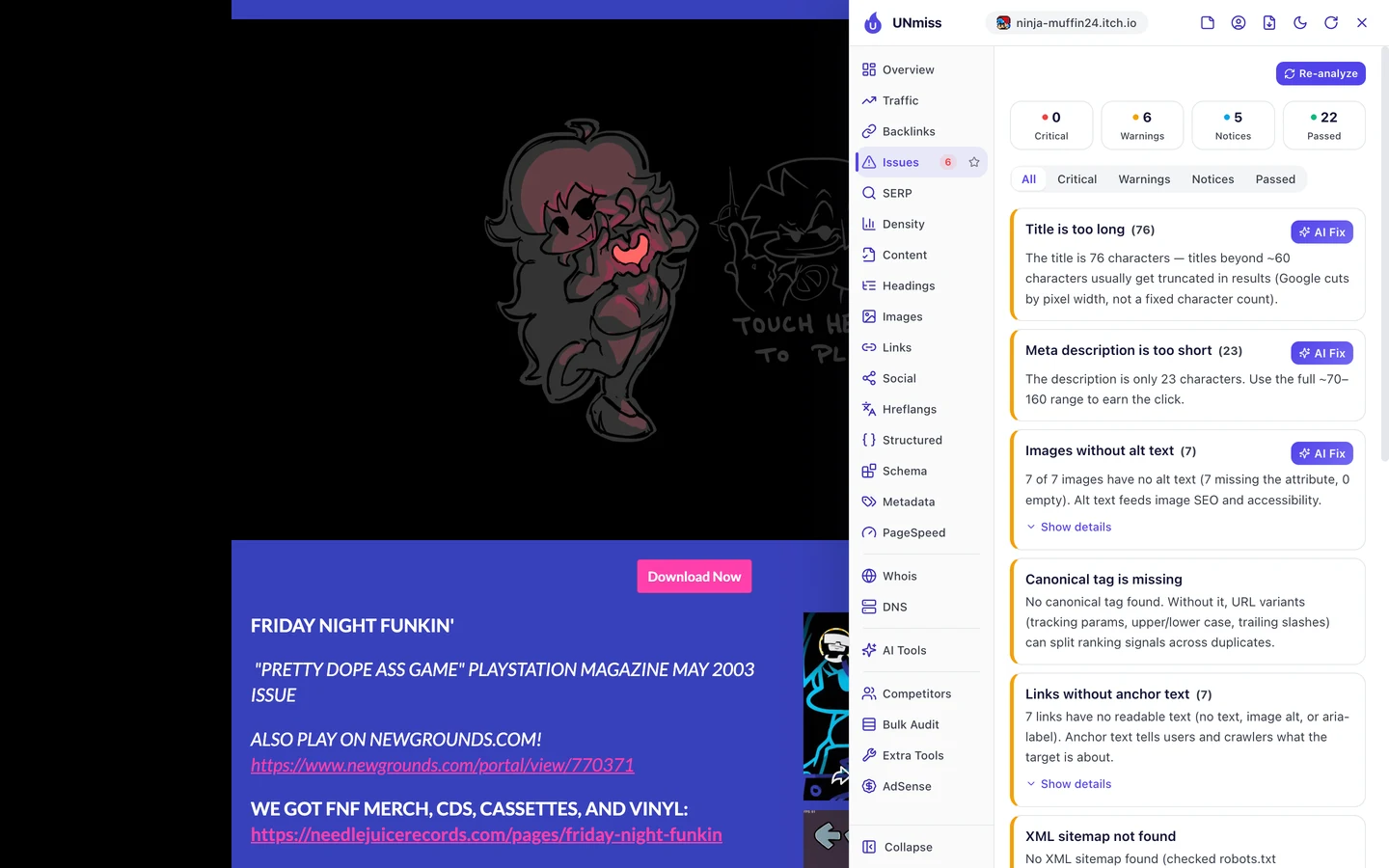
The Issues tab puts both at the top. Each one has an AI Fix button that writes a better version for you.
It also flags 7 images with no alt text, the description that tells Google and screen readers what an image shows.
The title looks built from a pattern: the game's name, then "by" and every maker on the team. With 3 makers, it runs long.
The description is the makers' own words. It sounds like fans talking, but it's too short to sell the click.
So set limits in your template. Cap the title, put the name people search first, and ask your users for a pitch of at least one full sentence.
Preview the result with our Meta Tag Generator. Then see how it looks on Google with our SERP Simulator.
Mark up every game in code
The words are the makers' job, but the code under the page is itch.io's. Structured data is code that tells Google what a page is, like a product, a recipe or a game.
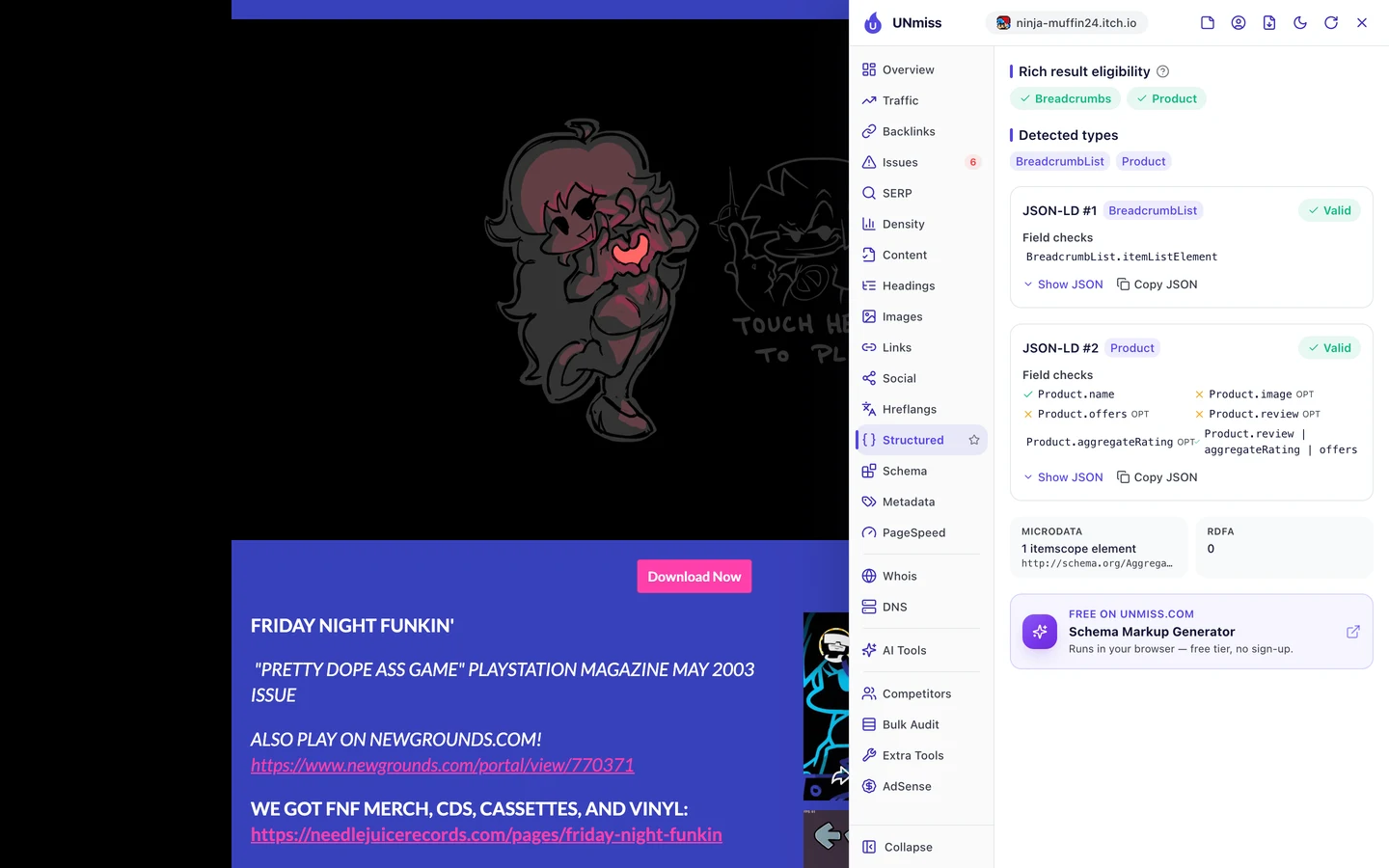
The Funkin' page carries 2 kinds. Breadcrumb code shows the page's place in the site, and Product code says it's something you can get.
Both pass the check. That makes the page eligible for rich results, the extras like a trail of links that Google can add to a result.
The Product code could say more, though. It skips the image, the price and the reviews, which are all optional.
Here's the smart part. Makers write the words, but itch.io's template adds this code for them.
So no maker has to learn code to get it right. Every game page gets the same clean setup.
So let your template handle the code, and leave the words to your users. Our Schema Markup Generator writes the code for you.
Slow down bots, but not Google
Good code only helps if Google can read the page. When our crawler read itch.io, it got stopped part of the way.
Our audit's Technical SEO tab lists pages that share the same title. One title came up 12 times: "429 Too Many Requests".
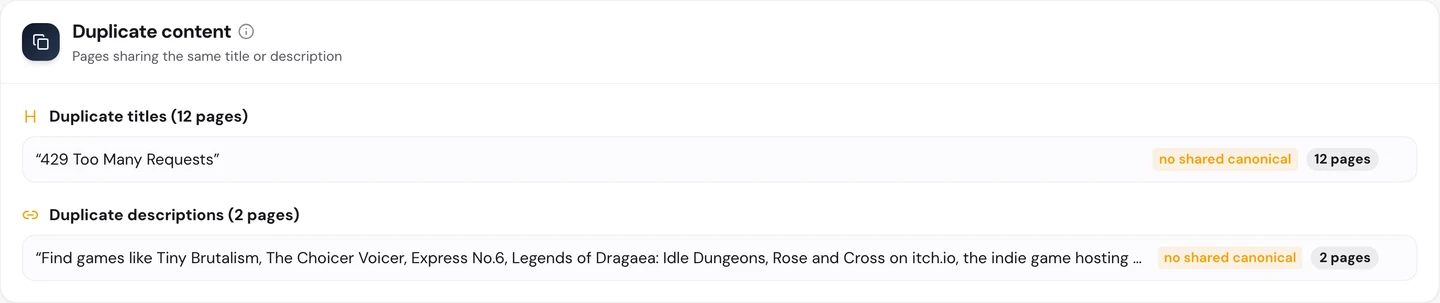
A 429 is the server's way of saying "slow down". Our crawler asked for pages too fast, so itch.io stopped sending them for a bit.
That's a rate limit, a cap on how many pages one visitor can ask for in a short time. Big sites use them to stop scrapers, programs that copy pages in bulk.
Open Library, which we studied too, uses a bot check to keep scrapers out as well.
A rate limit is a good idea. It keeps your site up when a bot gets greedy.
But Google's crawler is a bot too. If it hits the same wall, it slows down, and your new pages may wait longer to show up.
Then there's robots.txt, a file that tells crawlers what they may read. The extension reads it for you.
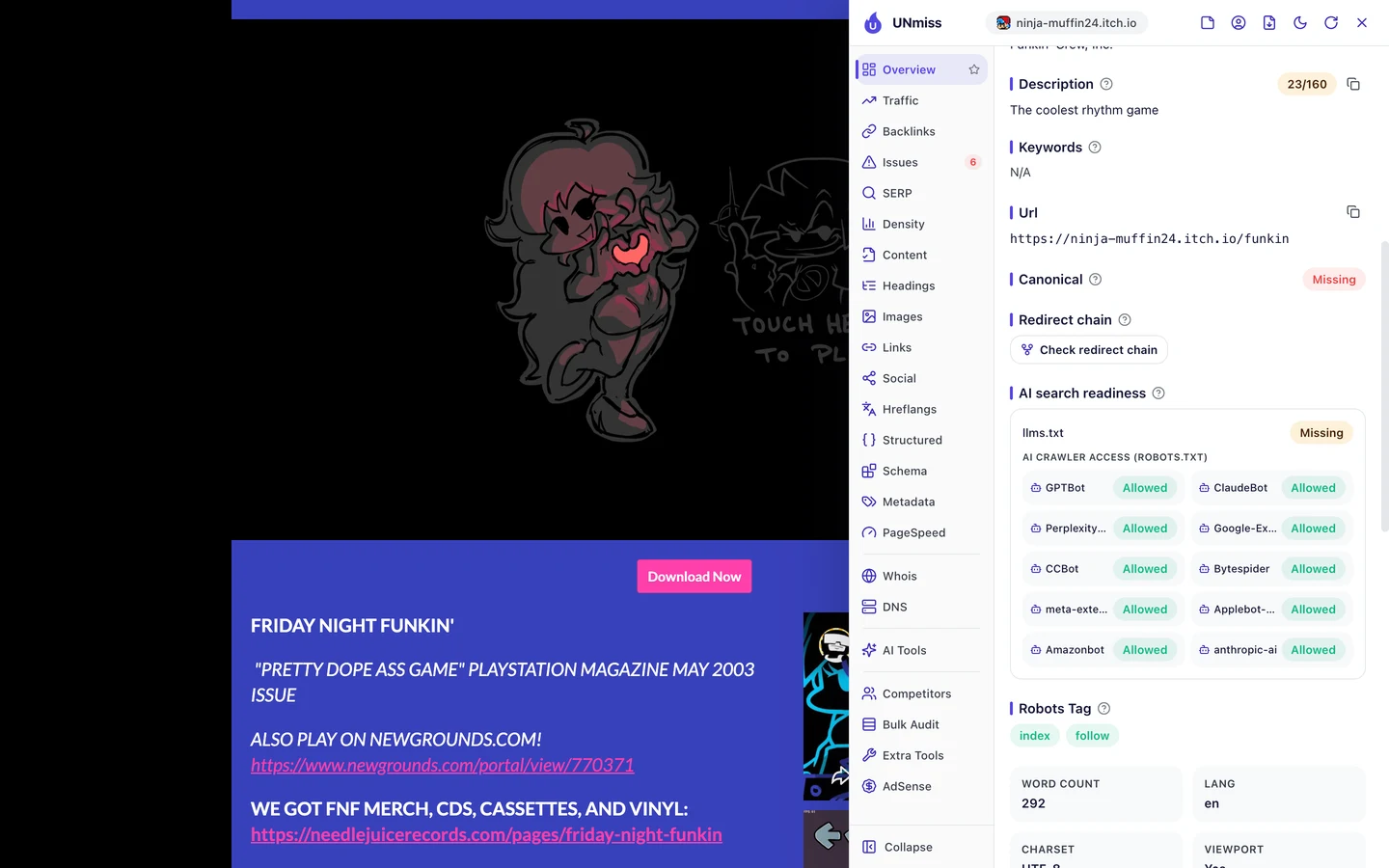
The robots.txt on this maker's address lets in all 10 AI crawlers the extension checks. So the door is open, and the rate limit sets the pace.
There's no llms.txt, a short file that explains a site to AI tools. We looked at how big sites treat AI crawlers in our robots.txt case study.
One more rule. Never send a "slow down" page as if it were a normal one, because Google may list the error in place of your page.
Send it with the 429 code, the number a server uses to say why a page didn't load. Then Google knows to come back later.
So let real search crawlers through, and slow down the rest. Check Google's crawl stats in Search Console, Google's own tool for site owners, to make sure it isn't being turned away.
Set your crawler rules with our robots.txt generator. Then see if AI tools mention you with our AI Visibility Checker.
Our crawler hit itch.io's rate limit and got "429 Too Many Requests" in place of real pages. We check how your site treats Google, AI crawlers and scrapers, then tune your limits so the right bots get through.
- We read your crawl stats and server logs
- We tune your rate limits and bot rules
- We fix error pages that look like real pages to Google
- SEO and GEO, so AI answers can quote you too
Audit your templates, not pages
Most of our crawl got through, so the rest of the report holds up. Our Website Audit checks hundreds of pages at once, so you can see which problems repeat.
We also gave it the sitemap, the file that lists a site's pages for Google. It checked 250 pages, and itch.io scored 82 out of 100, which the report rates as good.
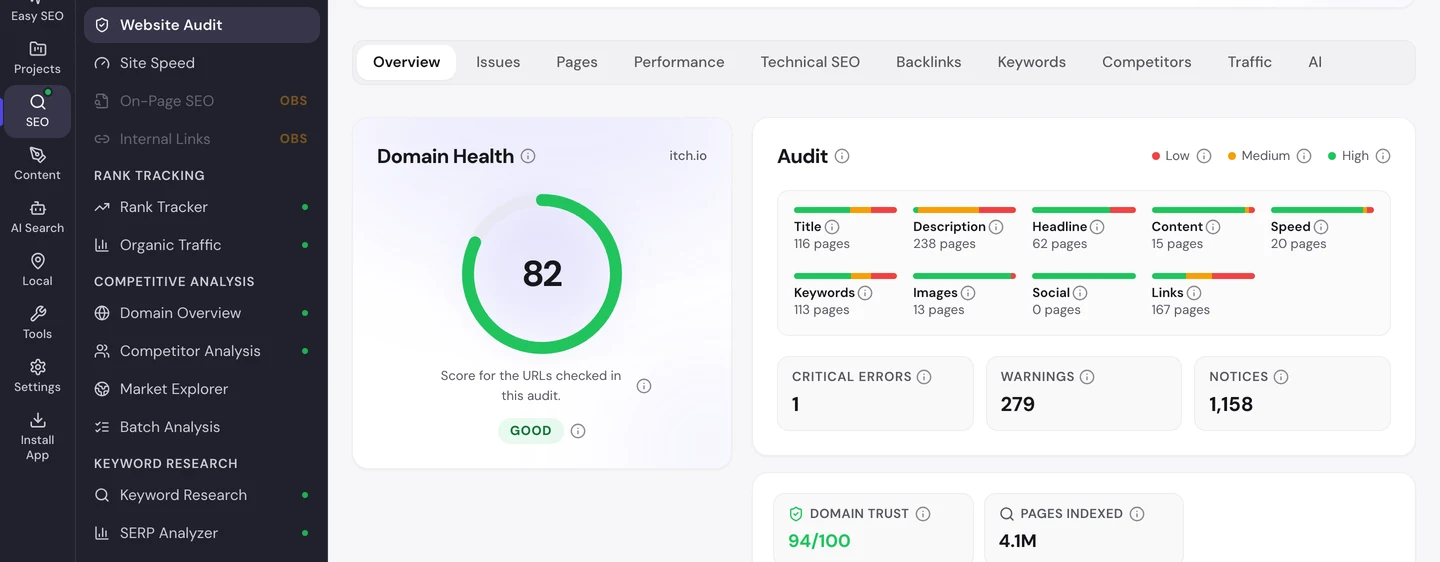
That's a strong score for a site this big. There's only 1 critical error.
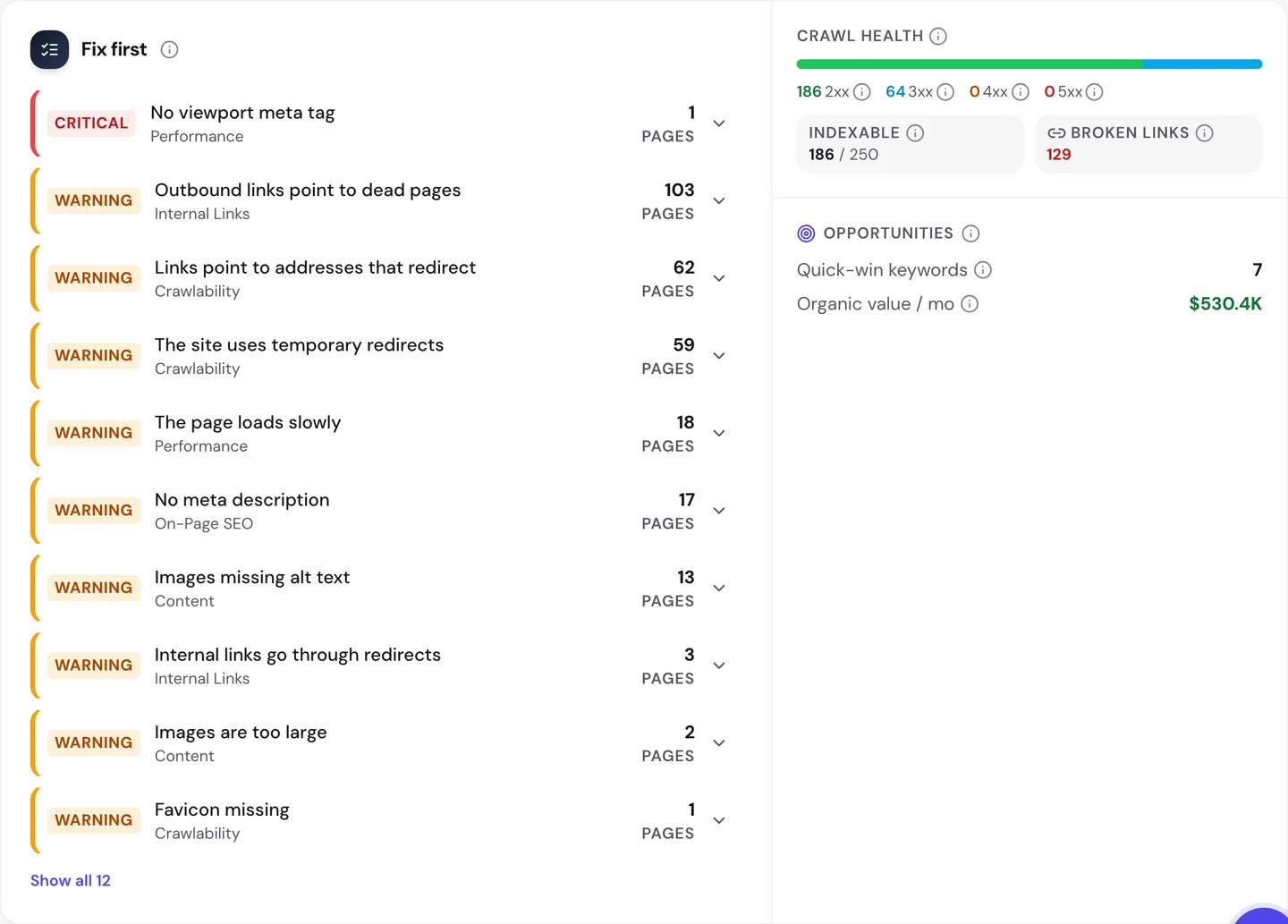
The critical one is a missing viewport tag, a line of code that tells phones how wide to draw the page. It's on just 1 page, the one for game developers.
The warnings matter more. About 100 pages link out to other sites that are dead now.
And about 60 pages use temporary redirects. A redirect sends visitors from one address to another, and a temporary one tells Google the move won't last.
The audit's plan ties some of them to the "Add To Collection" buttons on game pages. Those buttons are for people, so there's no reason for Google to follow them.
The Technical SEO tab shows you which pages Google may list.
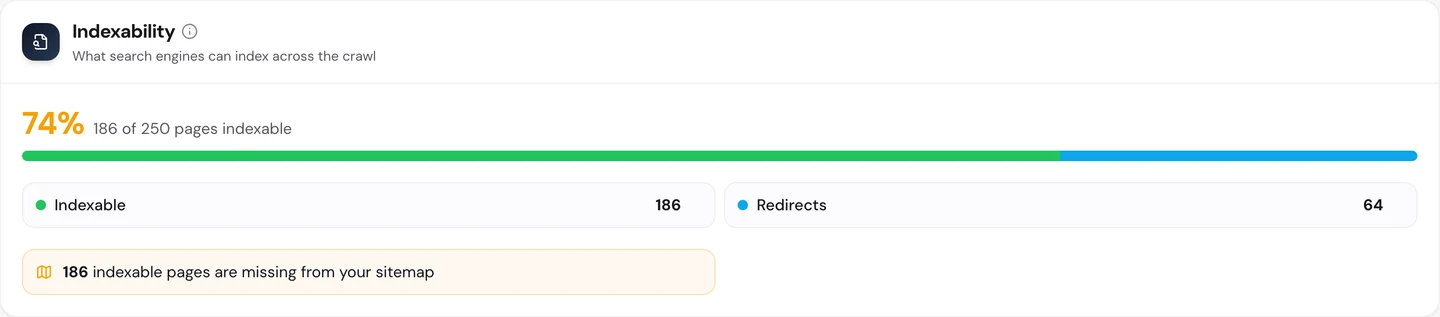
About 3 in 4 pages we crawled can be listed by Google. The rest are redirects, not broken pages.
The tab also says none of the listable pages are in the sitemap. A site this big may split its sitemap into many files, so check yours by hand.
You don't have to work out what to fix first. The audit's AI tab writes the plan: a short summary, each problem with how to fix it, and a 90-day to-do list.
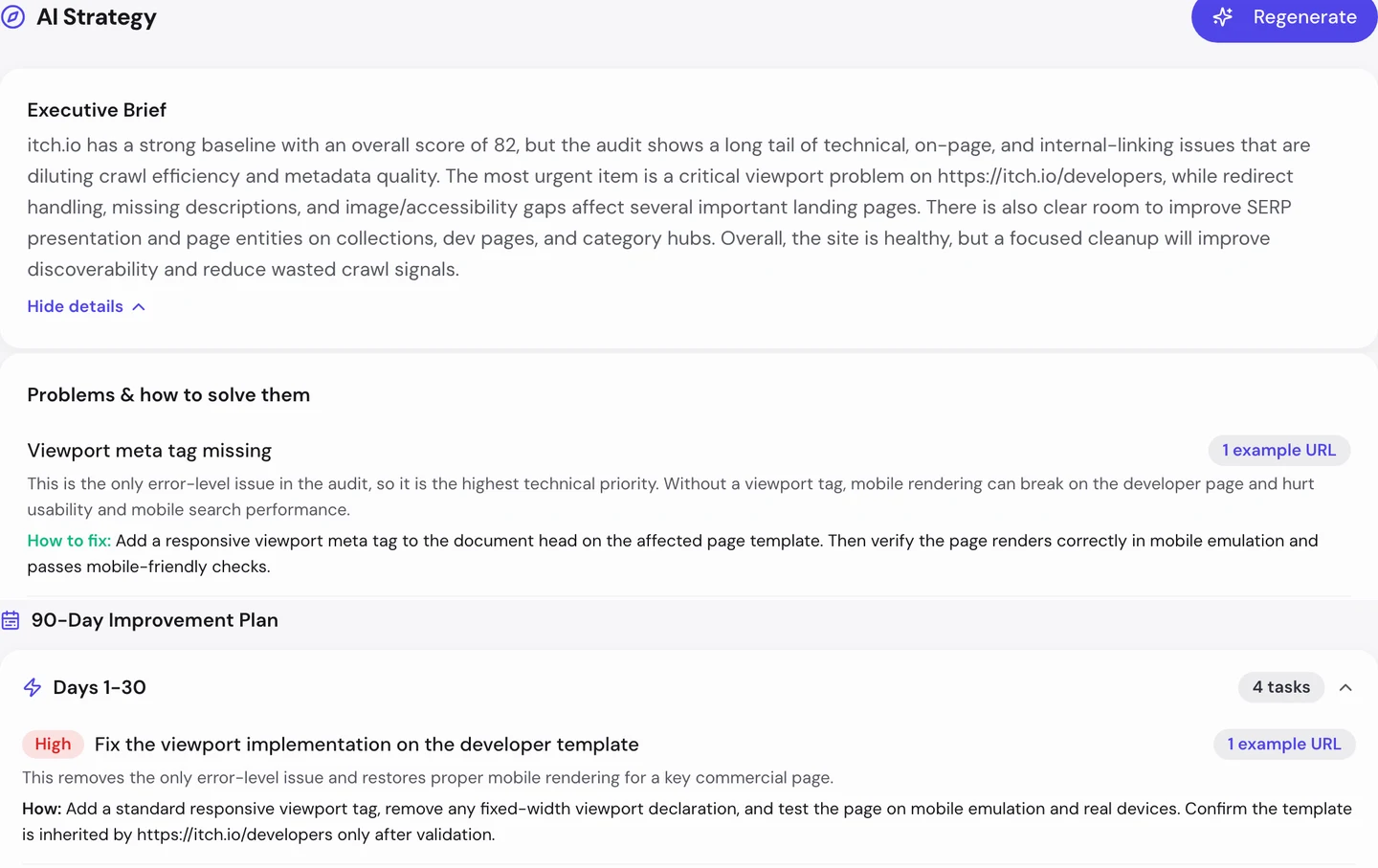
For itch.io, the first task is the viewport on the developer template. Next come the links that go through redirects and the "Add To Collection" redirects.
See the pattern? Fix a template once, and every page built from it gets fixed too.
So find the templates your pages share, and fix the problems that repeat. Run our Website Audit, fix one template, and hundreds of pages get better at once.
Give every image a fixed size
The Performance tab of the audit shows Core Web Vitals. These are Google's 3 checks of how fast a page loads, how fast it reacts and whether it stays still, measured on real visitors' devices.
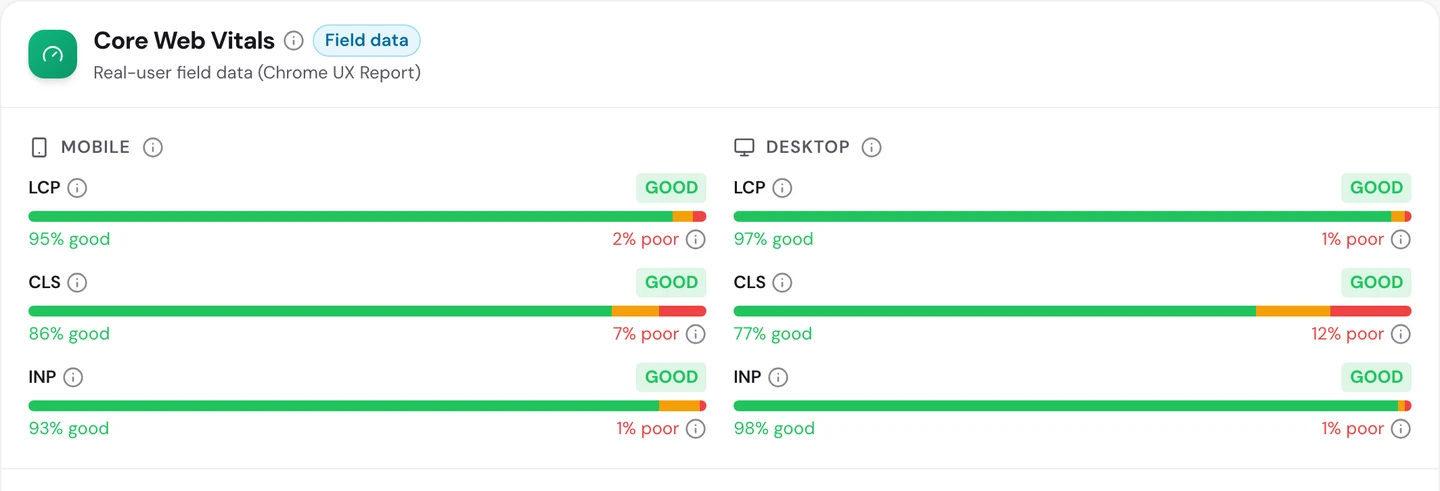
itch.io passes all 6 checks. Its pages load fast and react fast, on phones and on computers.
The weakest score is staying still. On computers, about 1 in 8 visits see the page jump around as it loads.
The extension points to one likely cause. On the Funkin' page, all 7 images have no set width or height.
Without a size, the browser doesn't know how much room to save. So the text jumps down when each image shows up.
The audit's speed test scores itch.io 70 out of 100 on phones and 92 on computers. So phones have the most room to improve.
So give every image a width and a height in your template. Our Site Speed tool shows you what slows each page down.
Find the keywords near page 1
Fast, steady pages help you climb. Our Domain Overview shows where itch.io stands right now.
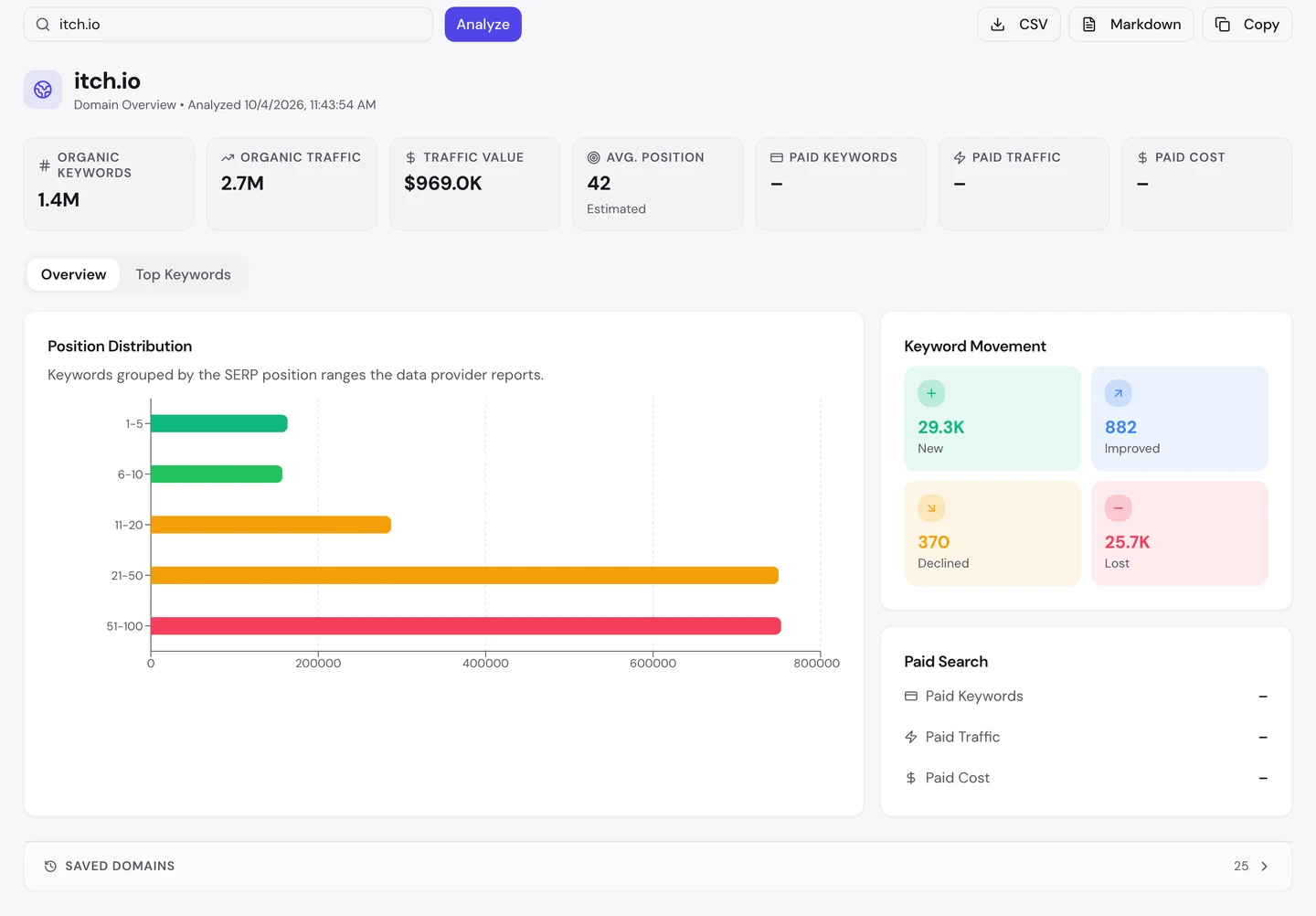
itch.io ranks for about 1.4M searches. Its traffic value, what those visits would cost as Google ads, is about $969K a month.
But its average position is 42, on page 5 of Google. Most of its keywords sit between spots 21 and 100, where few people click.
Look at the movement box too. It gained about 29K new keywords and lost about 26K.
The quickest wins sit on page 2, just short of the top 10. The Keywords tab counts about 287K of them, in spots 11 to 20.
So find your keywords between 11th and 20th, and improve those pages first. Then watch them climb in our Rank Tracker.
Check who you really compete with
Some of the searches you want are already won by someone else. The audit's Competitors tab shows you who.
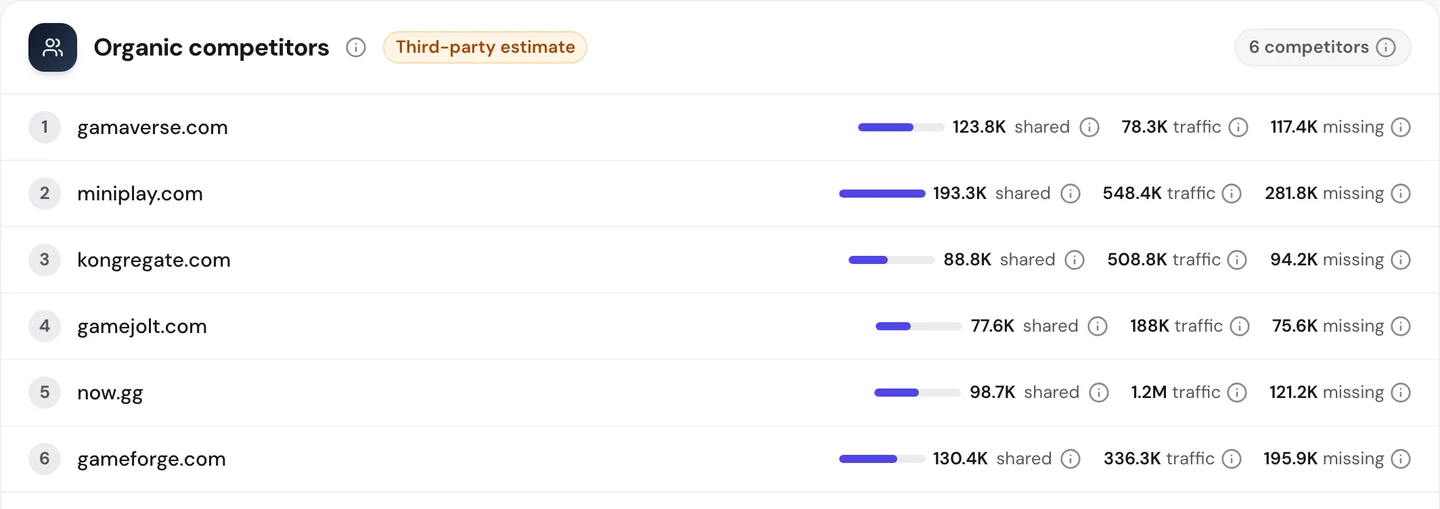
Every name on the list is a games site. Kongregate and Game Jolt are in there, along with names you may not know.
Miniplay shares the most searches with itch.io, about 193K. now.gg gets the most traffic, about 1.2M visits.
Now look at the "missing" column. Those are searches the rival ranks for and itch.io doesn't, about 282K for Miniplay alone.
That column is a ready-made to-do list. You can go through each search a rival wins and decide if you need a page for it.
So check who shares your searches with our Competitor Analysis, then go through the ones you're missing.
Only 37% of itch.io's US search traffic comes from people typing its name. Our Organic Traffic Checker shows your monthly visits, your trend and your branded share, so you know how many people find you through what they search for.
- The same report that measured itch.io
- Your branded share and 12-month trend
- Run it on any rival's domain too
What you cannot copy
First, the part you can't copy: itch.io is home to a huge number of indie games. When one of them takes off, its fans search for it and link to its page.
A backlink is a link from another website to yours. The extension counts about 44M backlinks to itch.io, and you can check your own in our Backlink Analyzer.
Our audit gives itch.io a Domain Trust of 94 out of 100, our score for a site's link strength. That's years of fans and links you can't buy.
A new site can copy the setup. It can't copy the crowd.
Now a few honest notes on the numbers.
We took our figures on <correct date>. The 2.7M figure counts US searches for itch.io only.
The 5.9M worldwide figure comes from the audit's Traffic tab. All of these are estimates, since nobody outside itch.io can count its real visits.
Tools work them out from rankings and search volume.
Our crawl checked 250 pages, a small sample of a very big site. So we used it to find problems that repeat, not to count every error.
Some of those pages came back as the "slow down" message, not the real page. So the duplicate titles we found come from that message, not from itch.io's own titles.
The audit's overview didn't show a link count for itch.io, so the backlink figure comes from the extension. And we checked one game page in depth, so other makers' pages may score higher or lower.
The one number to take away
165K.
That's about how many times a month people search "friday night funkin". The page that ranks first is the makers' own page on itch.io.
The makers bring the game and the fans. itch.io brings the template, the code and a domain Google knows well.
That's the lesson for any site that hosts other people's work. Give your users a good page, name it after what they made, and let the searches come to you.
You can run every one of these checks on your own site, and on your rivals', and see the same numbers for yourself.
Frequently asked questions
Should user pages live on a subdomain or in a folder?
Both can work. Google says it treats them much the same in most cases. Folders are simpler to run, while subdomains give each user a space that feels like their own site.
Do my users' pages help my main site rank?
They can, since every visit and every link to a user page lands on your domain. But lots of weak or empty pages can drag the rest down, so keep an eye on quality.
How do I keep spam off user pages?
Use noindex, a tag that tells Google not to list a page, on new or empty pages until they show real activity. Make links on user pages nofollow, and limit how fast new accounts can post.
How do I know if my rate limit blocks Google?
Open the crawl stats report in Google Search Console and look for a jump in errors or a drop in pages crawled. Your server logs also show if Googlebot got a "slow down" reply.
How can I tell the real Googlebot from a fake one?
Anyone can name their bot Googlebot. Google explains how to check where a visit really came from, so only let the checked ones skip your limit.
Will a short burst of "slow down" replies hurt my rankings?
Usually not. Google backs off and tries again later. If it goes on for days, though, Google may visit less often and drop some pages.
Should I write titles for my users or let them write their own?
Let them write the name and the pitch, then wrap it in a template. The template can cap the length, put the searched words first and add your brand at the end.
Which structured data fits a game page?
VideoGame or SoftwareApplication code can describe the name, the platform and the price. Only add ratings if real players left them on the page.