Eventbrite gets about 2.4M visits a month from Google in the US, and its biggest pages are simple city lists like "things to do in New York today".
Each one is a page that answers a question people type every day. Eventbrite builds them for every city, date and kind of event.
We ran Eventbrite through our whole SEO toolkit to see how those pages win, and where they're held back.
Here are 9 lessons you can copy, plus the part you can't.
Build a page for every city
We started with our Organic Traffic Checker. It estimates a site's organic traffic, meaning the people who find it on Google without ads.
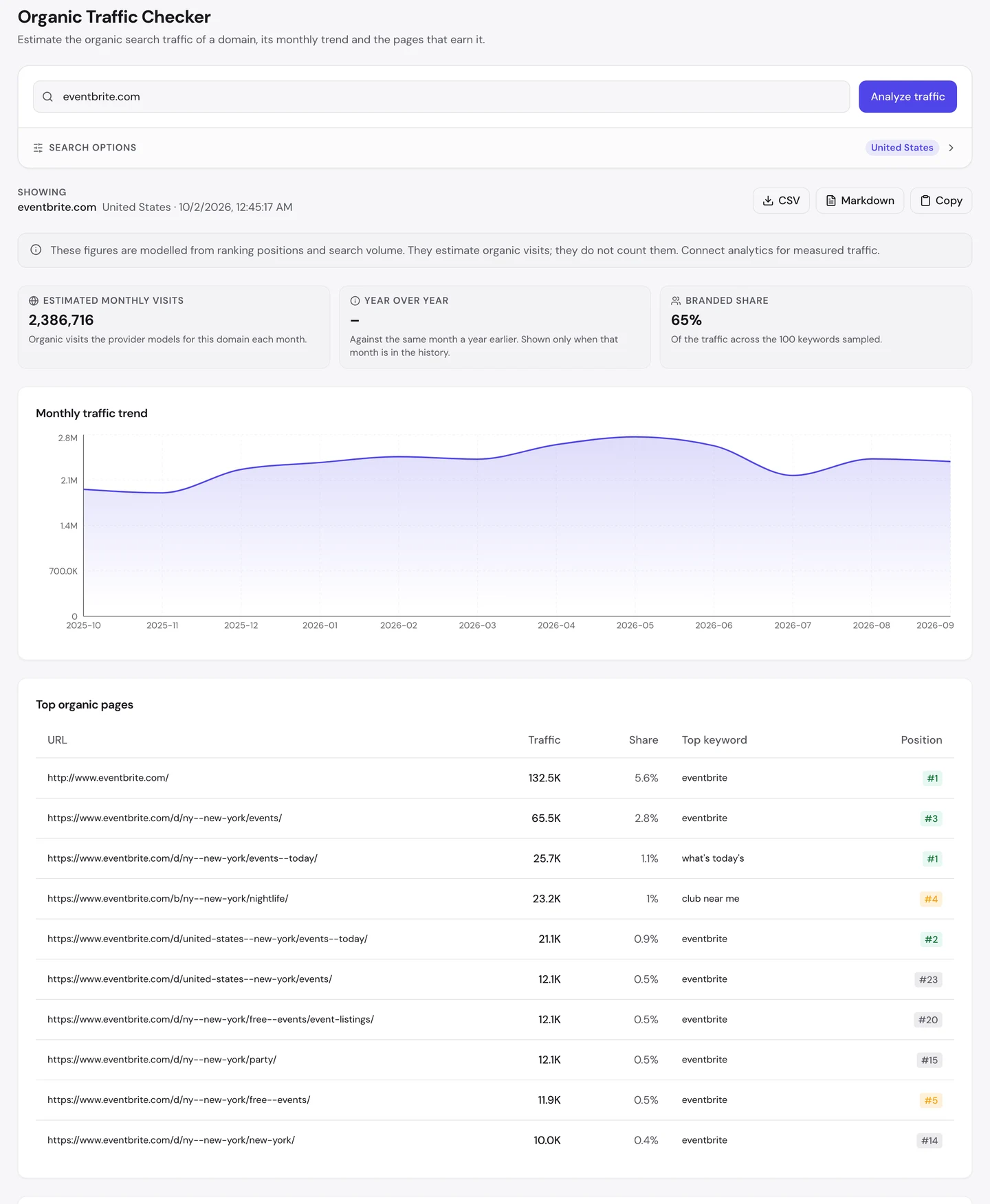
For Eventbrite, that's about 2.4M visits a month in the US. The chart has stayed between about 2M and 2.8M all year.
Now look at the top pages. After the homepage, almost every one is a list of events in New York: today, this weekend, free, nightlife, parties.
Each list is built from the same template. Change the city or the date, and you get a new page that answers a new search.
The Traffic tab of our Website Audit shows the whole world.
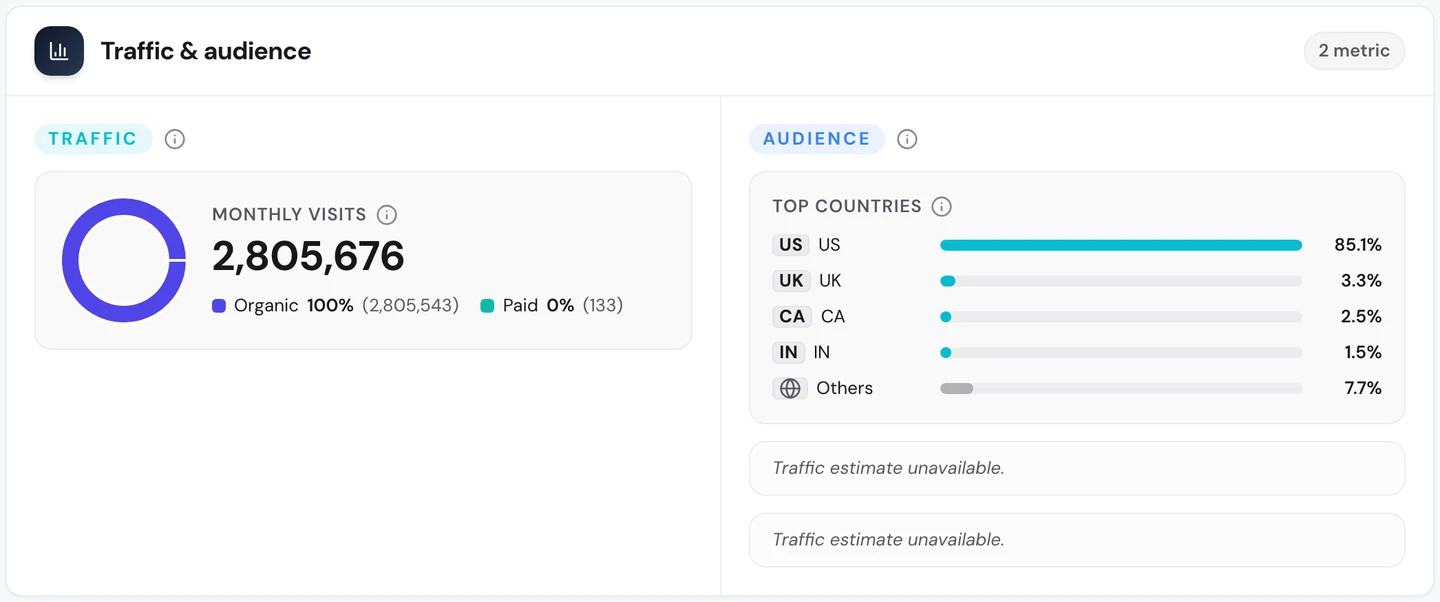
Worldwide it's about 2.8M search visits a month, and more than 8 in 10 come from the US.
Rotten Tomatoes, which we studied too, does the same with films. It has one page for every title, and the searches add up.
So if your business works in many places, give each place its own page. Each one is a door into your site.
Answer "today" and "this weekend"
You don't just search for events. You search for events you can go to right now.
Here's the New York "today" page, which ranks first for "what's today's".
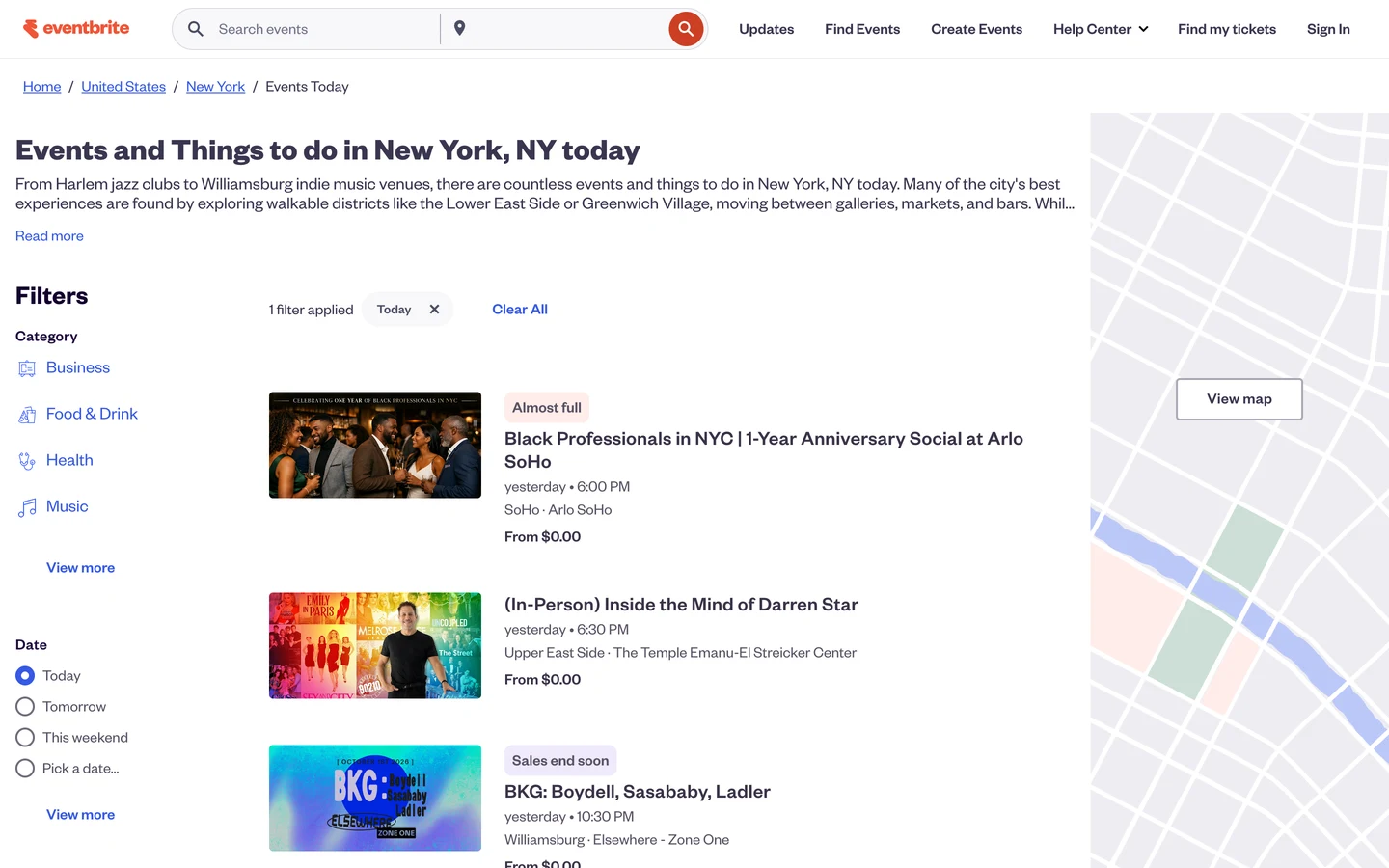
The "Today" filter isn't just a button. It's a page with its own address, its own title and its own intro.
Our free browser extension shows how the page is built. Open the page, Open the page, click the seotools.pro icon, and a panel opens beside it with 35 SEO checks., and a panel opens beside it with 35 SEO checks.
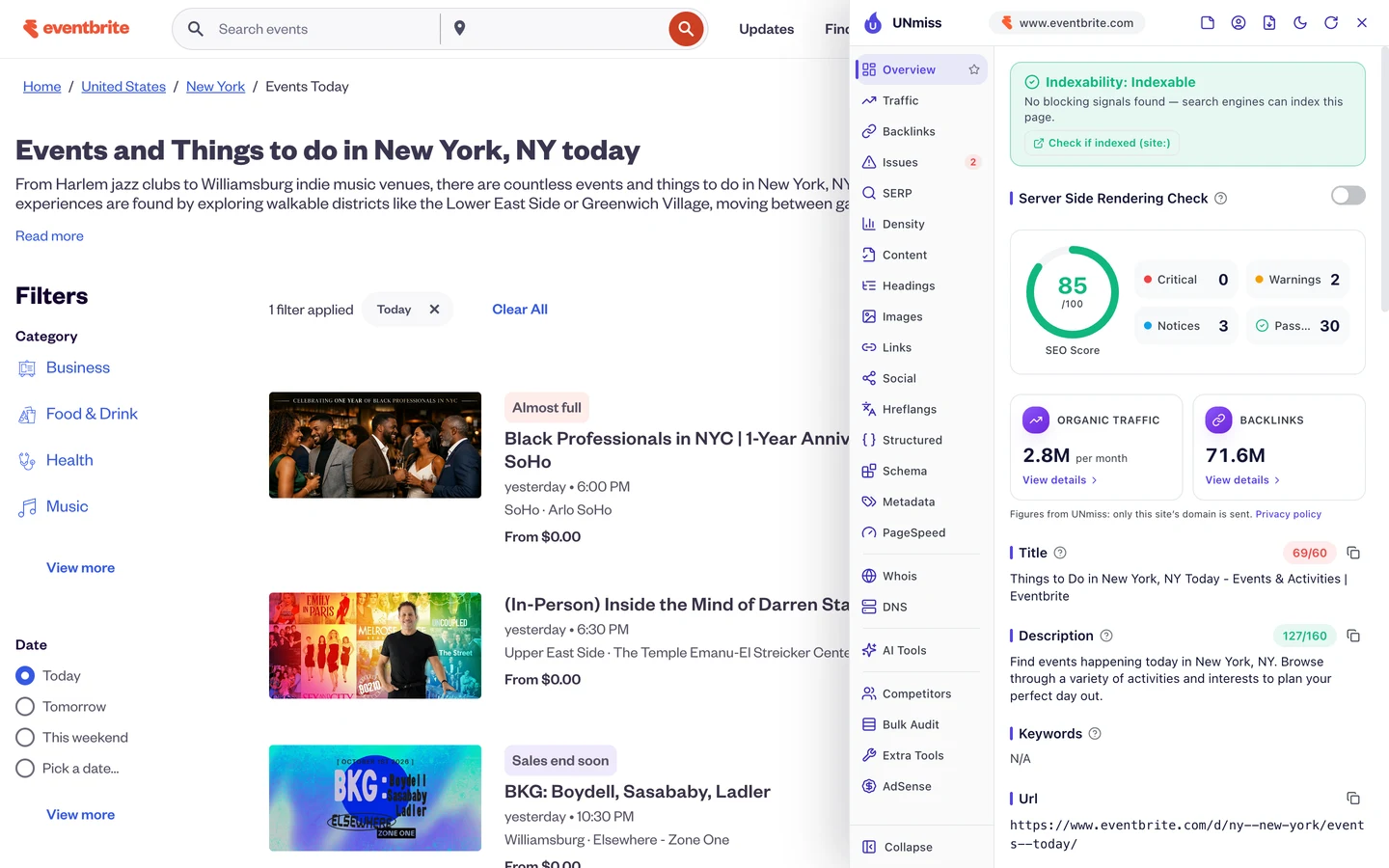
It scores 85 out of 100. The title and the description both say "New York" and "today", the exact words people search.
The Structured tab shows the hidden part. Structured data is code that tells Google what a page is.
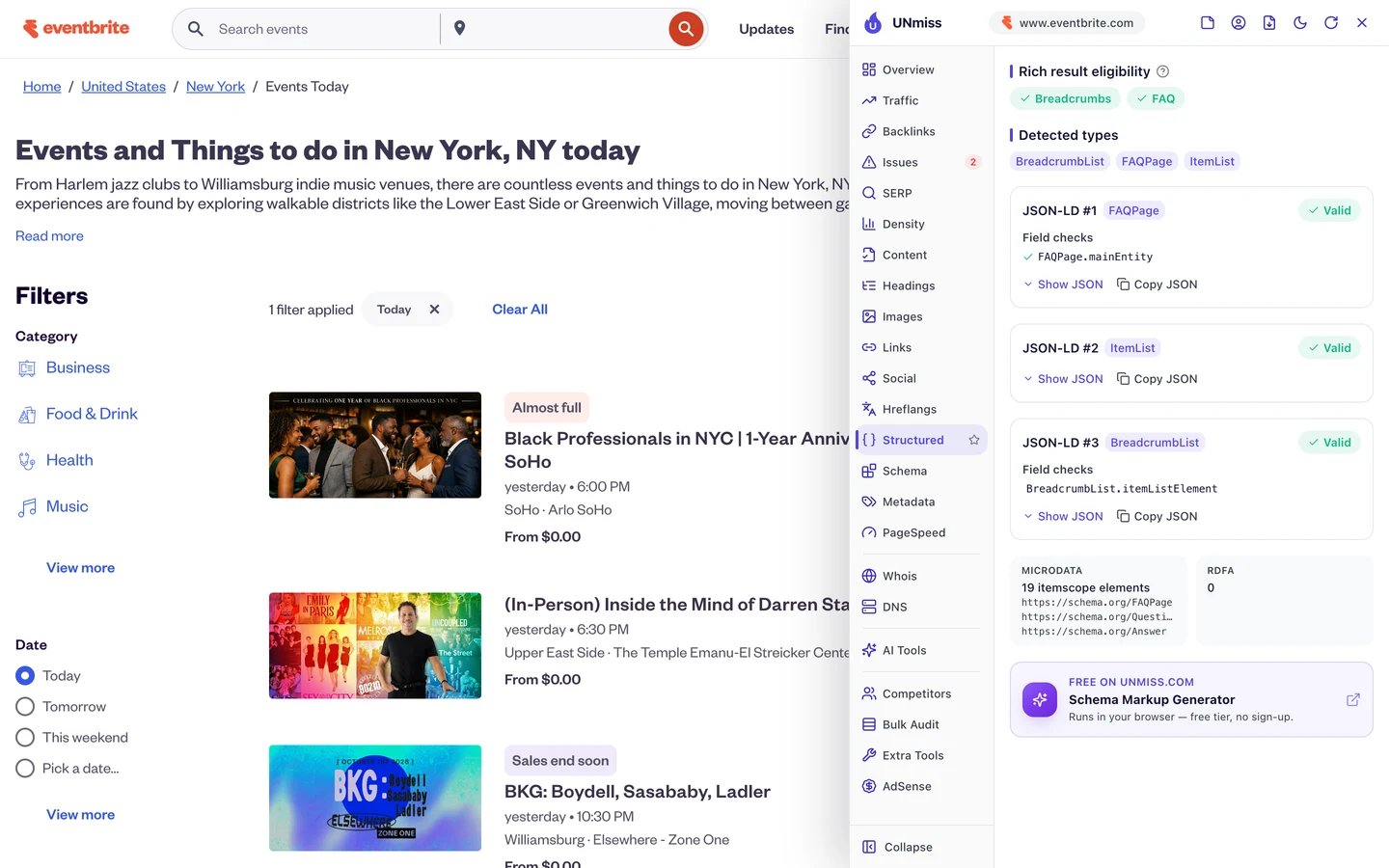
The page tells Google it's a list of events, where it sits in the site, and which questions it answers. All 3 are valid.
Each event page goes further. We checked one from this list, and its code tells Google the kind of event, the place and the ticket prices.
Google's own case study on Eventbrite says this event code, added back in 2015, helped double its traffic from event searches.
So make a page for each time people search: today, tonight, this weekend. Then describe it in code with our Schema Markup Generator.
Win searches beyond your name
The Keywords tab of our audit lists every search a site ranks for, where it ranks and how many visits each one sends.
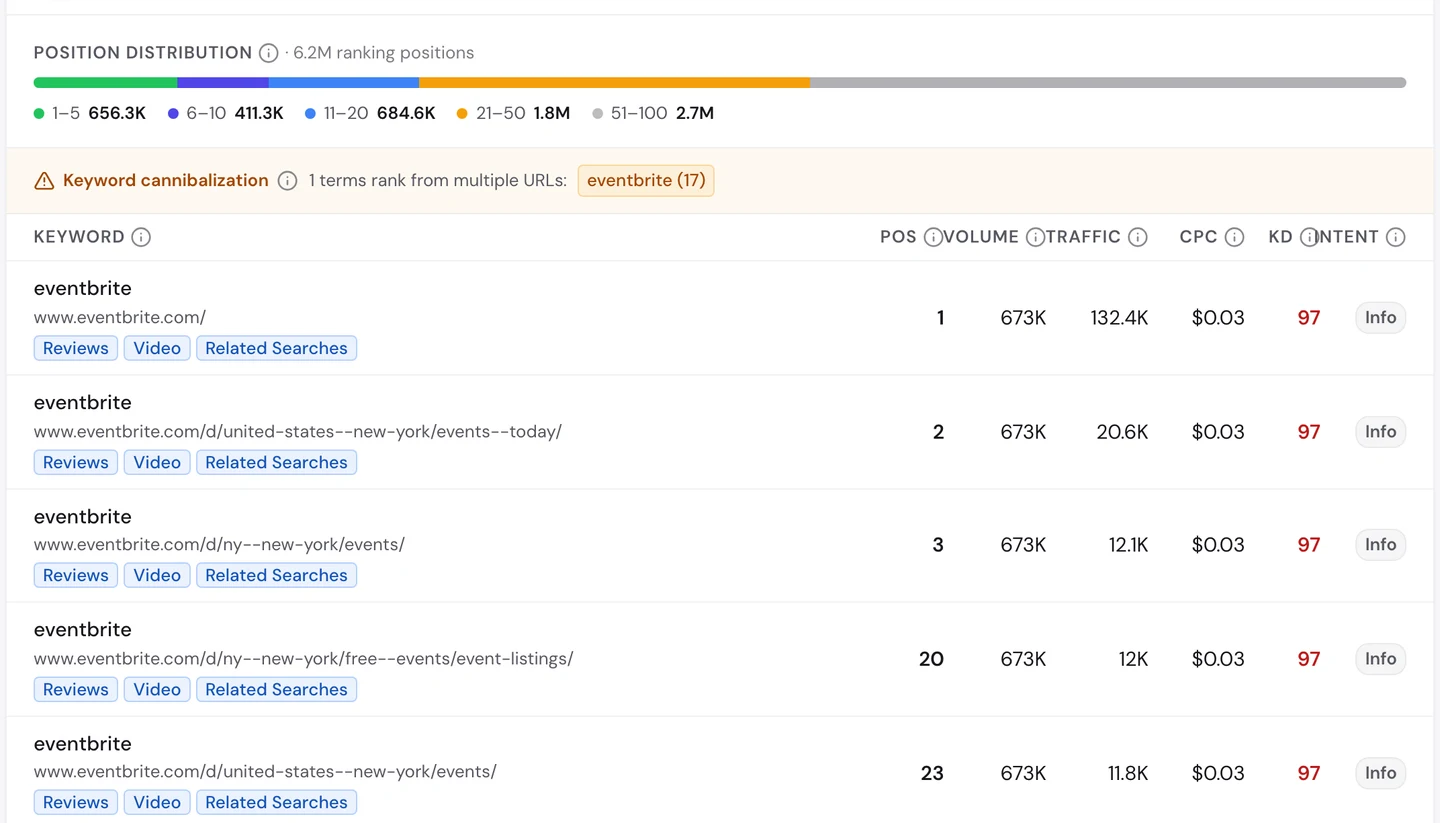
Here's a surprise for you. In the searches we sampled, 65% of the traffic came from people typing the name Eventbrite.
And look at the warning above the table. That one search, about 670K times a month, lands on 17 different Eventbrite pages.
That's called keyword cannibalization, when your own pages compete for the same search. GeeksforGeeks, which we studied too, has the same problem with the search "c".
The searches that don't use the name are the real prize. Further down the list, Eventbrite ranks first for "bike show" and fourth for "club near me".
Those are people who didn't know Eventbrite before they searched. If they were searching for your business, every one would be a new customer for you.
So point your name at one main page, and spend your effort on the searches strangers type. Find them with our Keyword Research tool.
Eventbrite wins searches in every city with one strong page template. We build location and listing pages like these for your business, so people find you wherever they search.
- We find the place and time searches your customers type
- We design one template that works for every location
- We make sure Google and AI tools can read every page
- SEO and GEO, so AI answers can quote you too
Give hosts a reason to link
A backlink is a link from another website to yours. Google treats each one a bit like a vote of trust.
The Backlinks tab of our audit shows the same data as our Backlink Analyzer.
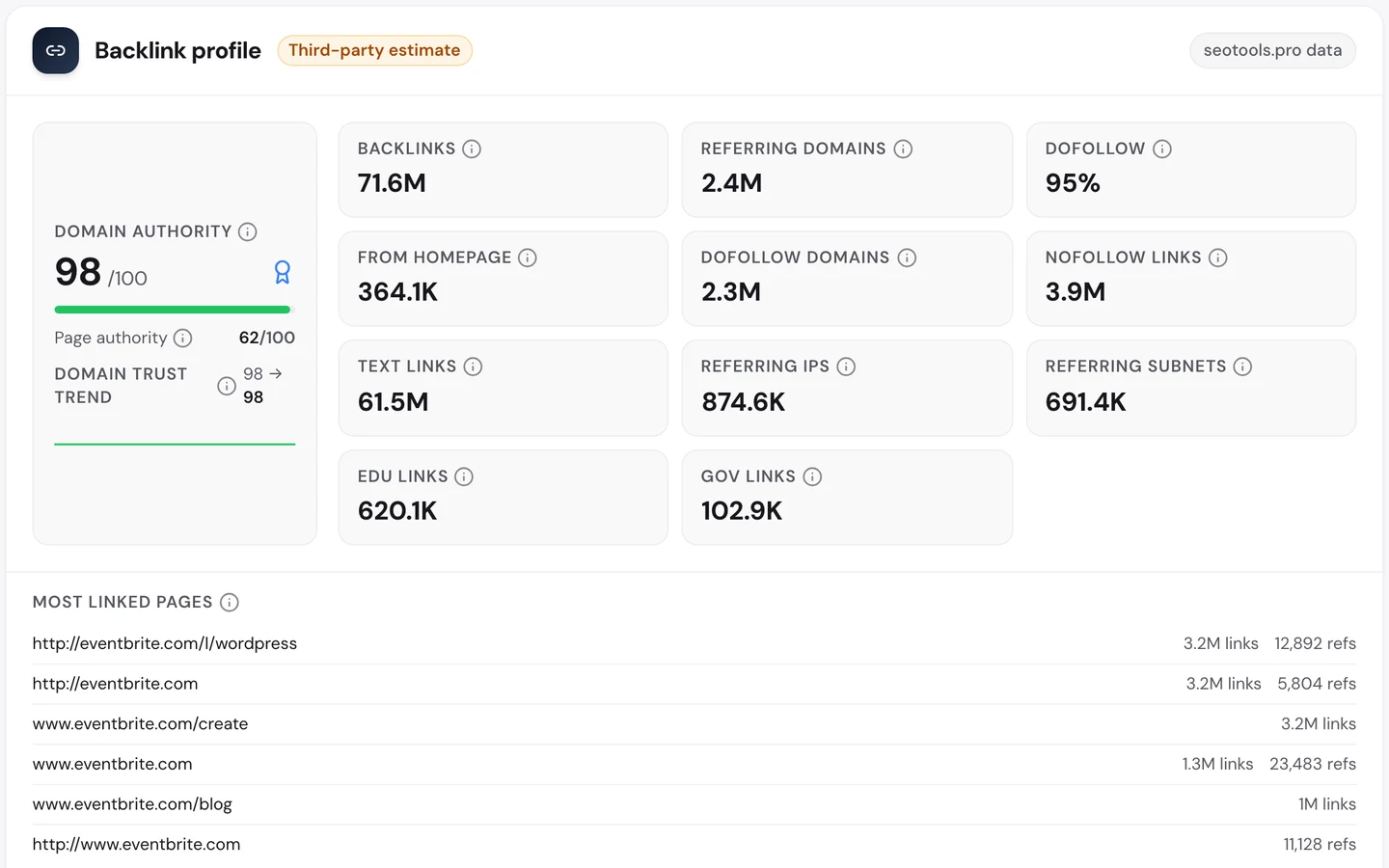
Eventbrite has about 72M links from about 2.4M websites. Its Domain Authority, our 0 to 100 score for a site's link strength, is 98.
Look at the most linked pages. The top one is a page about using Eventbrite with WordPress, with about 3.2M links from nearly 13K sites.
Another is the page where you create an event. Organisers link there because they use Eventbrite to sell their tickets.
The links come from the people who use the product. If your customers share your pages, every one of them is a link waiting to happen for you.
Links alone don't win searches, though. Meetup, which we studied on its own, has about 69M links but gets far fewer visits, because it lacks pages like these city lists.
So give your customers something to share, like a widget, a badge or a page they can link to. They'll build your links for you.
Write a real homepage description
The description is the short summary Google may show under your title. Here's what the extension found on Eventbrite's homepage.
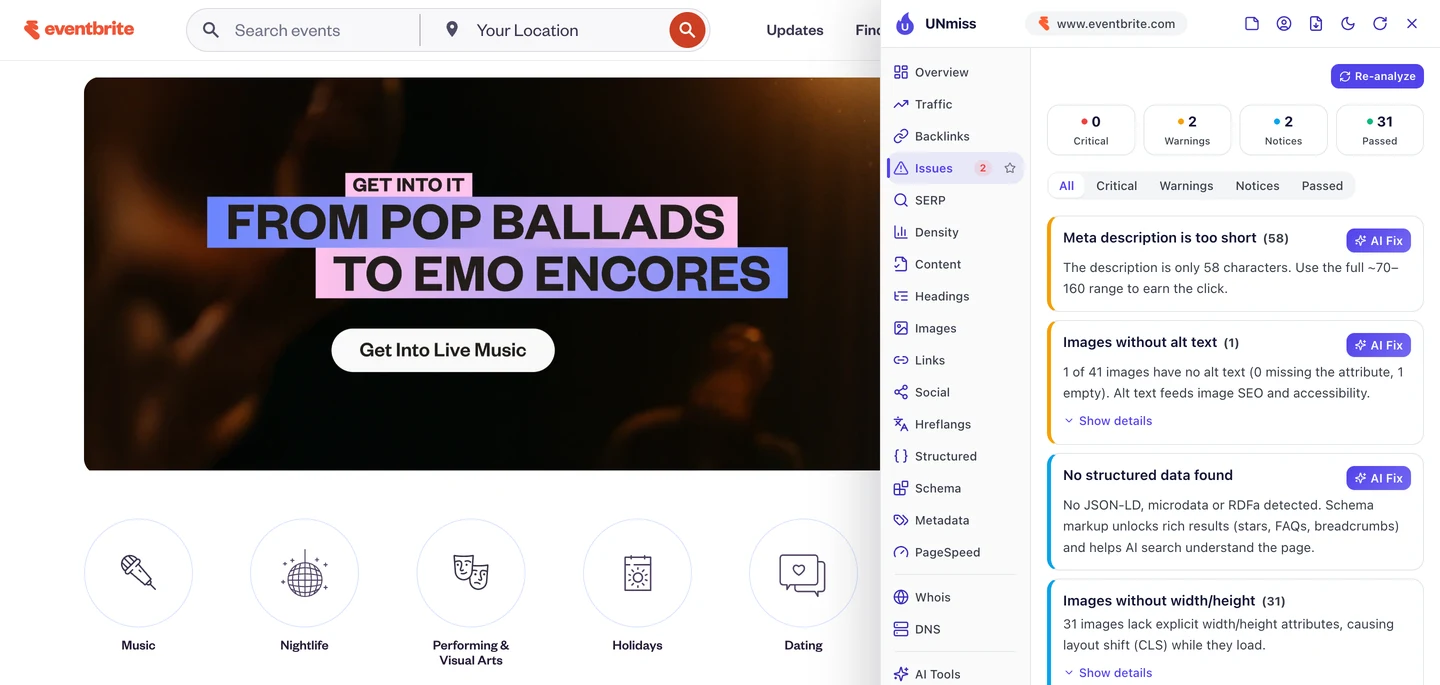
The homepage description is only 58 characters. It's the same text as the title, word for word, so Google gets nothing new to show.
The homepage also has no structured data at all, though its city pages have 3 kinds. The page that gets the most visits says the least about itself.
These are small fixes, and they're on the page that about 1 in 20 search visitors lands on.
So write a homepage description that says what you do and who it's for, in about 150 characters. Our Meta Tag Generator helps you write one.
Audit what bots really see
We checked Eventbrite with our Website Audit. It crawls a site the way Google does, opening each page and following the links to the next ones.
Align both mentions, e.g. 'We set the crawl to 250 pages and 249 were returned.' Eventbrite scored 66 out of 100, which the report rates as fair.
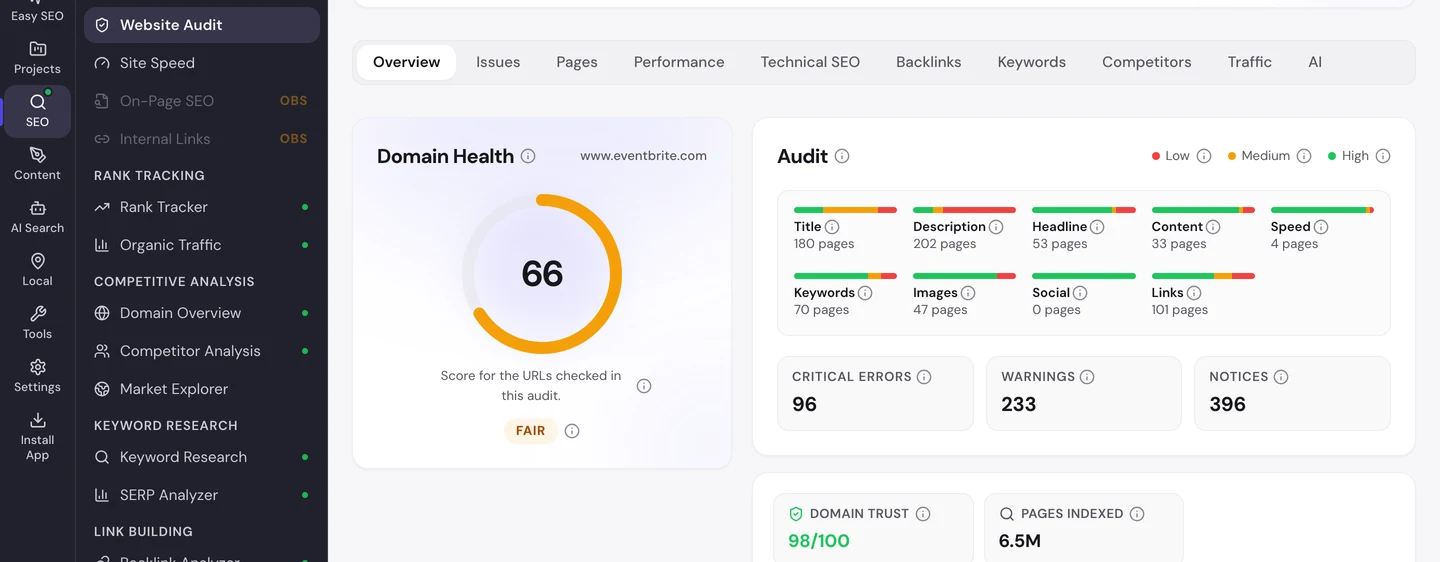
That's much lower than the 85 you saw on its city page. The Technical SEO tab shows you why.
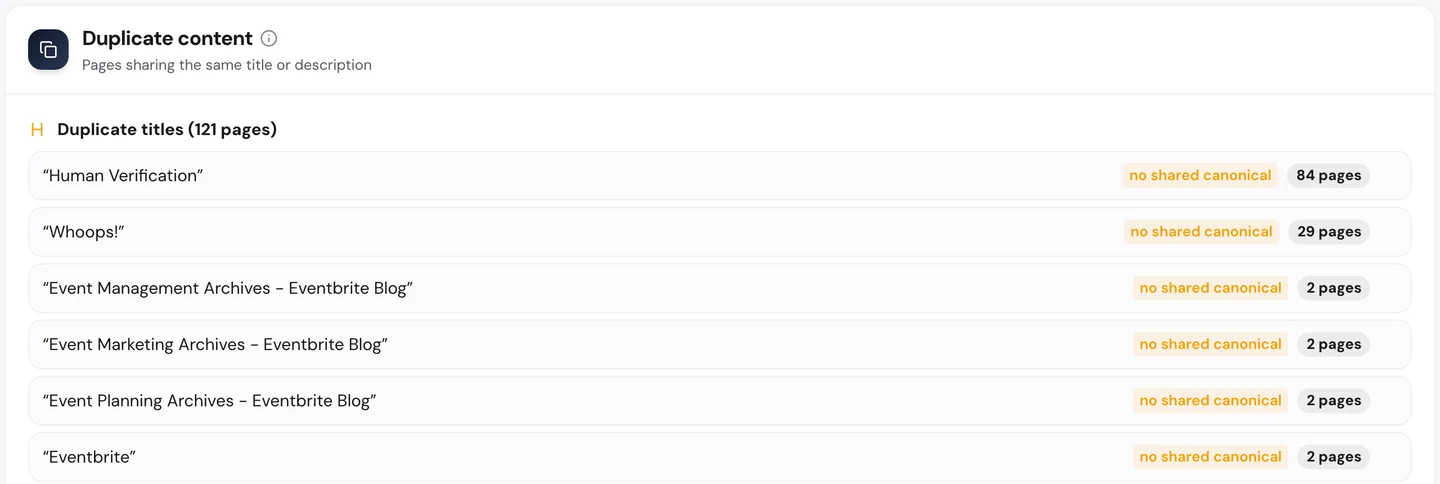
84 pages came back with the title "Human Verification". Every one of them was a city or state page, the kind that brings in most of Eventbrite's visits.
Eventbrite runs a bot shield, a system that asks visitors to prove they're human. Our crawler, a program that visits pages the way Google does, got a check page instead of the events.
We opened a city page in a normal browser, and it loaded fine for us.
So these aren't broken pages. They're pages a bot can't see.
Google is usually let through walls like this. But many other crawlers aren't, and that includes some AI tools.
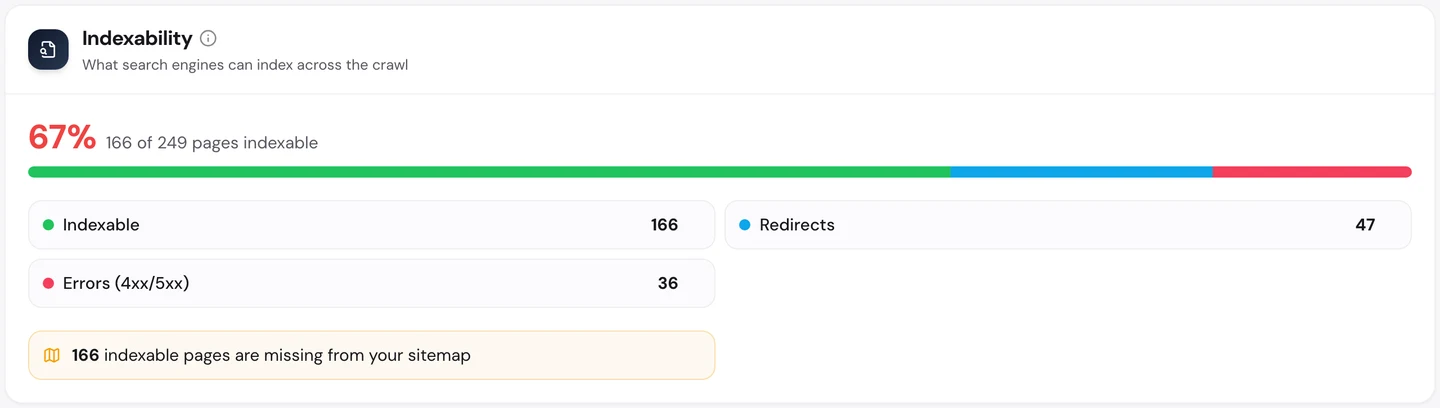
Only 2 in 3 of the pages we crawled could be listed by a search engine. Most of the rest hit the wall or redirected somewhere else.
The Issues tab sorts the problems by how much they matter to you.
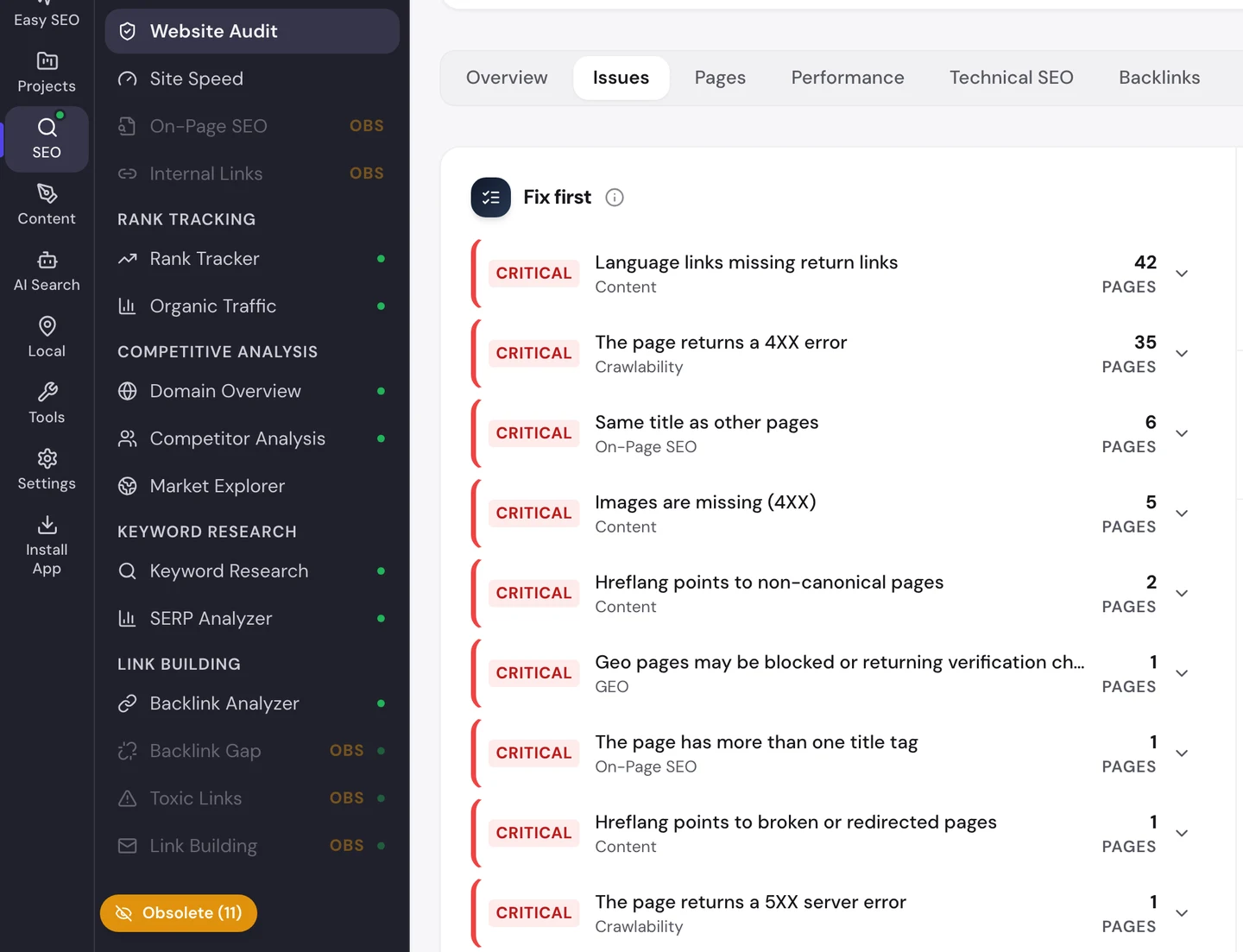
The top error is about hreflang, a tag that tells Google which language version of a page to show. On 42 pages, a language version doesn't point back to the page that points to it.
Further down, the audit flags the wall itself: pages that "may be blocked or returning verification challenges".
You don't have to work out what to fix first. The audit's AI tab writes the plan: a short summary, each problem with how to fix it, and a 90-day to-do list.
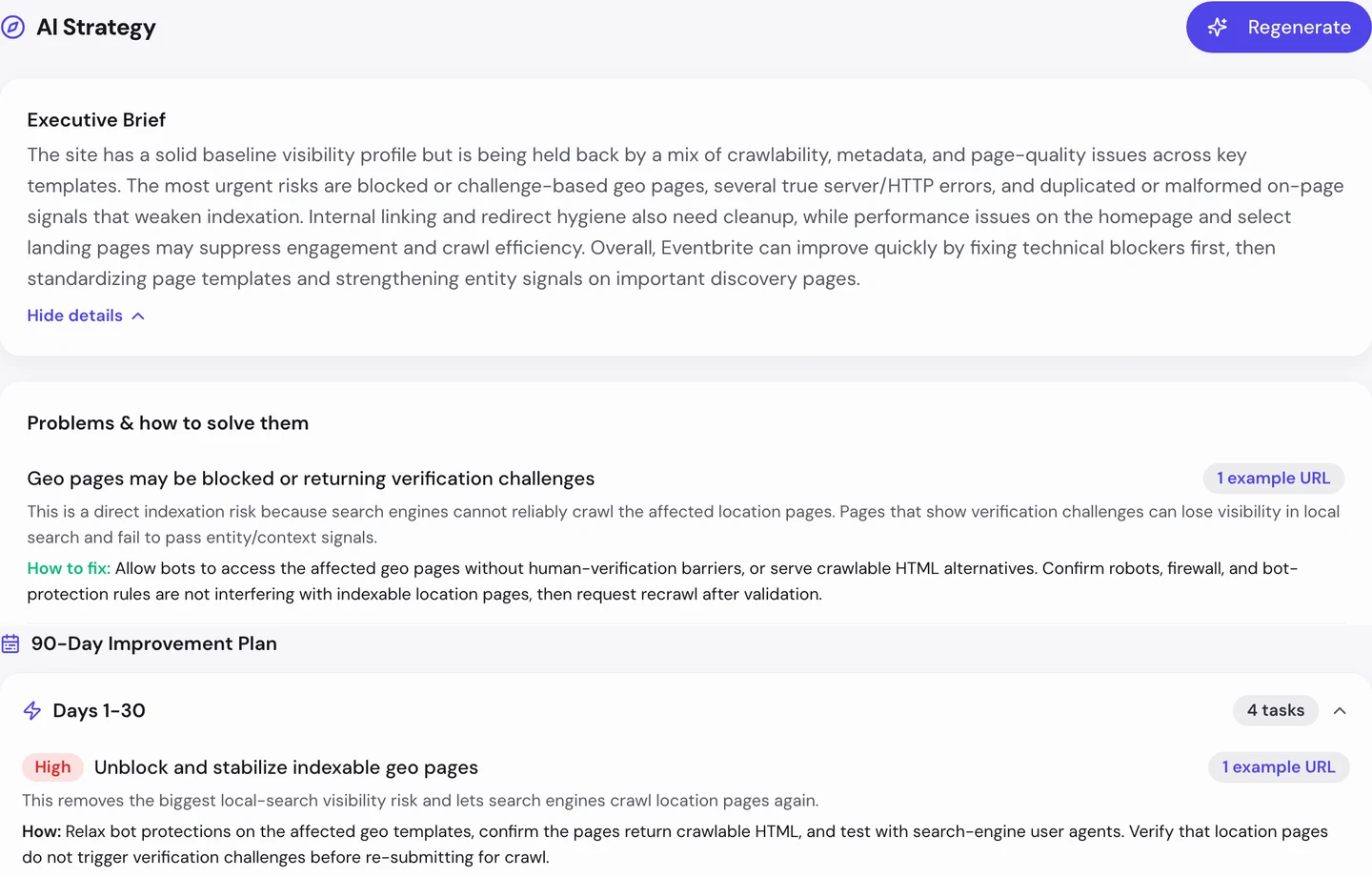
For Eventbrite, the first task is to unblock the city pages, so every crawler that should see them can.
So check your own site through a crawler's eyes, not just your browser's. If your best pages show a check page to bots, decide on purpose which bots get through.
Speed up the main content
The Performance tab of the audit shows Core Web Vitals. These are Google's 3 checks of how fast a page loads, how fast it reacts and whether it stays still, measured on real visitors' devices.
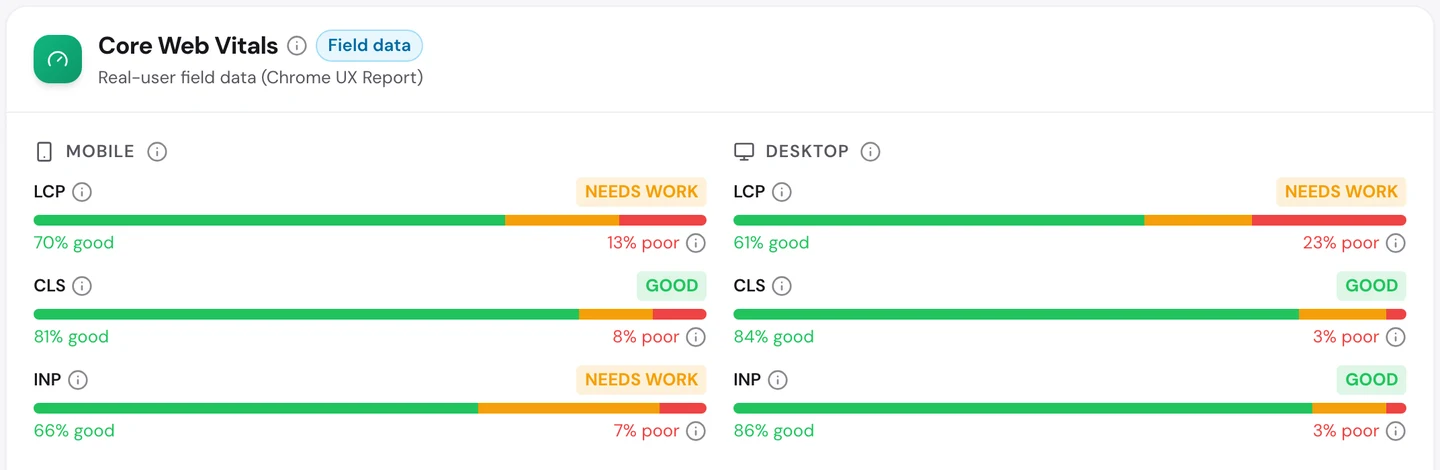
Pages stay still while they load, which is good. But the main content loads too slowly, and on desktops almost 1 in 4 visits waits too long.
On phones, taps also aren't quick on about 1 in 3 visits. That's when you tap a filter and nothing seems to happen.
Event pages are full of photos, maps and filters. Each one you add is a reason for your page to slow down.
So load the event list first, and the map and extras after it. Our Site Speed tool shows what slows each page down.
Know who lists the same events
The audit's Competitors tab lists the sites that rank for the same searches as you.
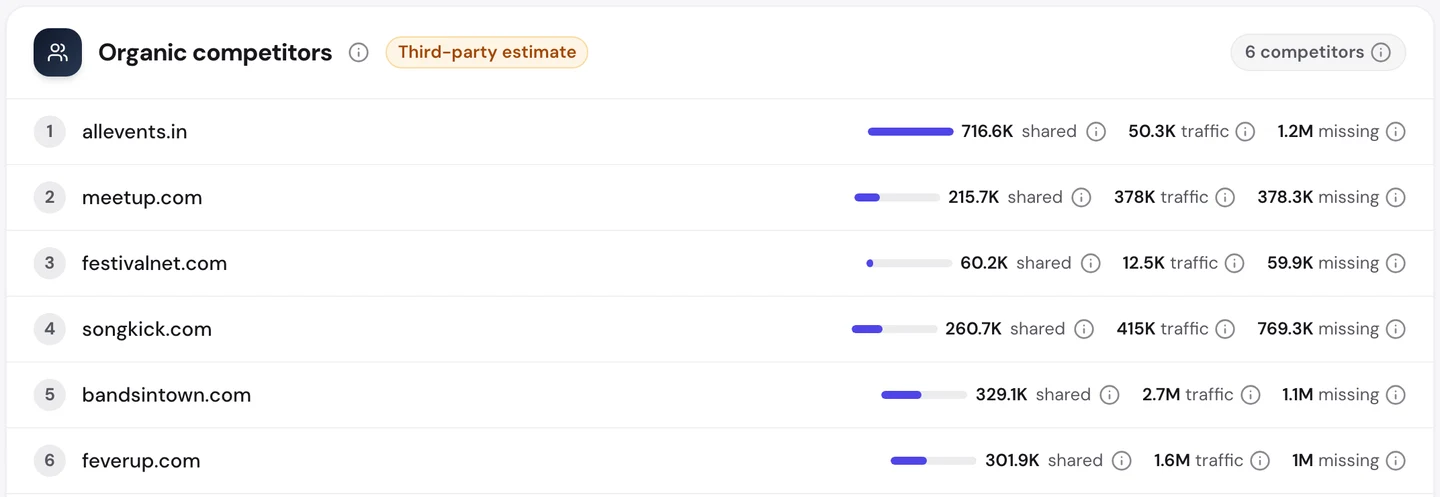
AllEvents shares about 717K searches with Eventbrite. Bandsintown, Fever, Songkick and Meetup follow, all chasing the same "what's on" searches.
Our Domain Overview shows what that fight looks like underneath.
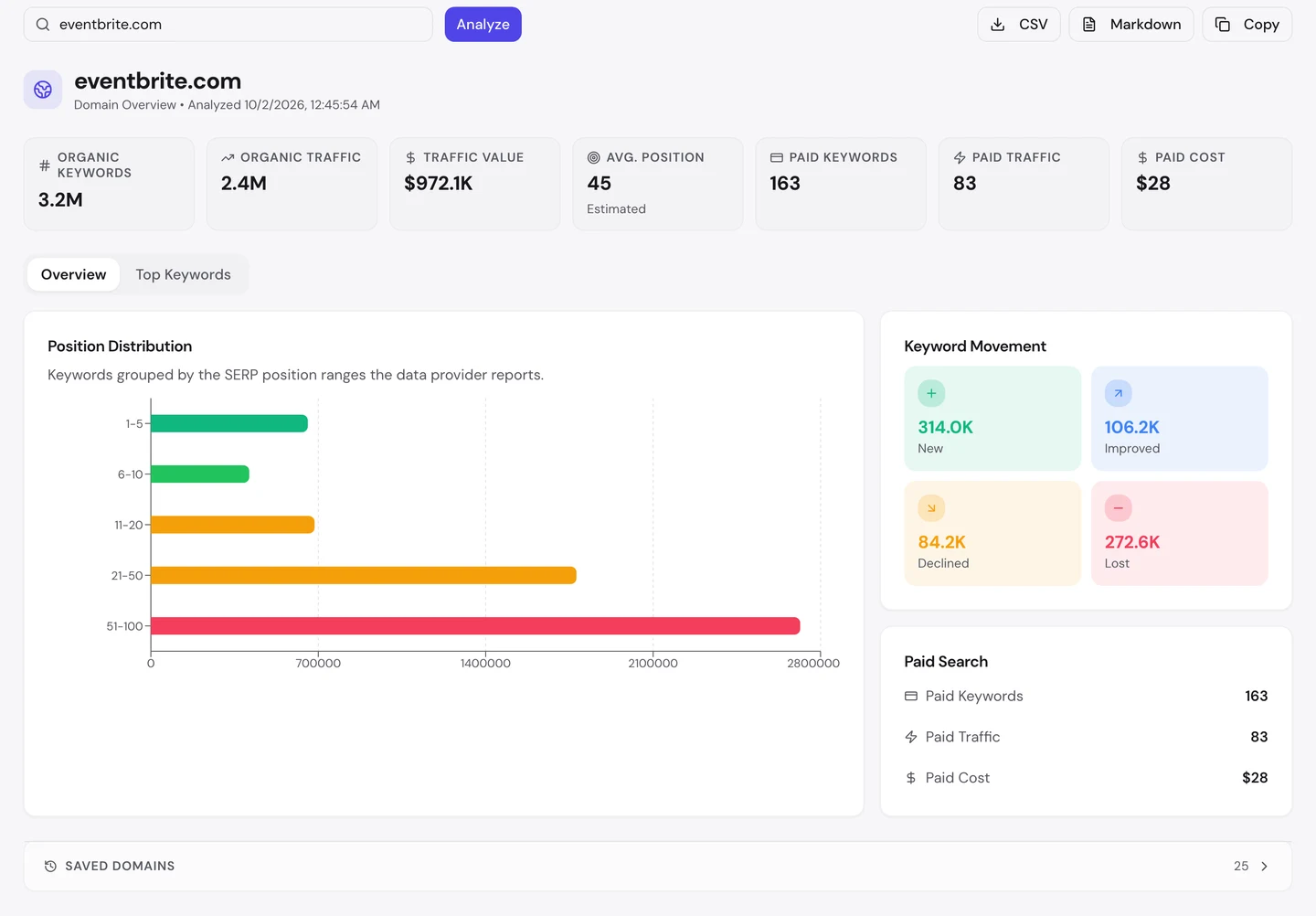
The traffic is worth almost $1M a month in ad money. But hundreds of thousands of keywords arrive and drop away, as events start and end.
That's normal for a site where every event has a date. You'll see the same if your pages expire: the city pages stay, and the event pages come and go.
So track the city and category searches that matter most to you in our Rank Tracker. They're the pages that last.
Let AI tools find your events
More and more people ask ChatGPT or Claude what to do this weekend, instead of searching Google. So we checked which AI tools may read Eventbrite.
Each AI tool sends a crawler, a program that visits pages and reads them. The rules for crawlers live in robots.txt, a file that tells crawlers what they may read, and our extension reads it for you.
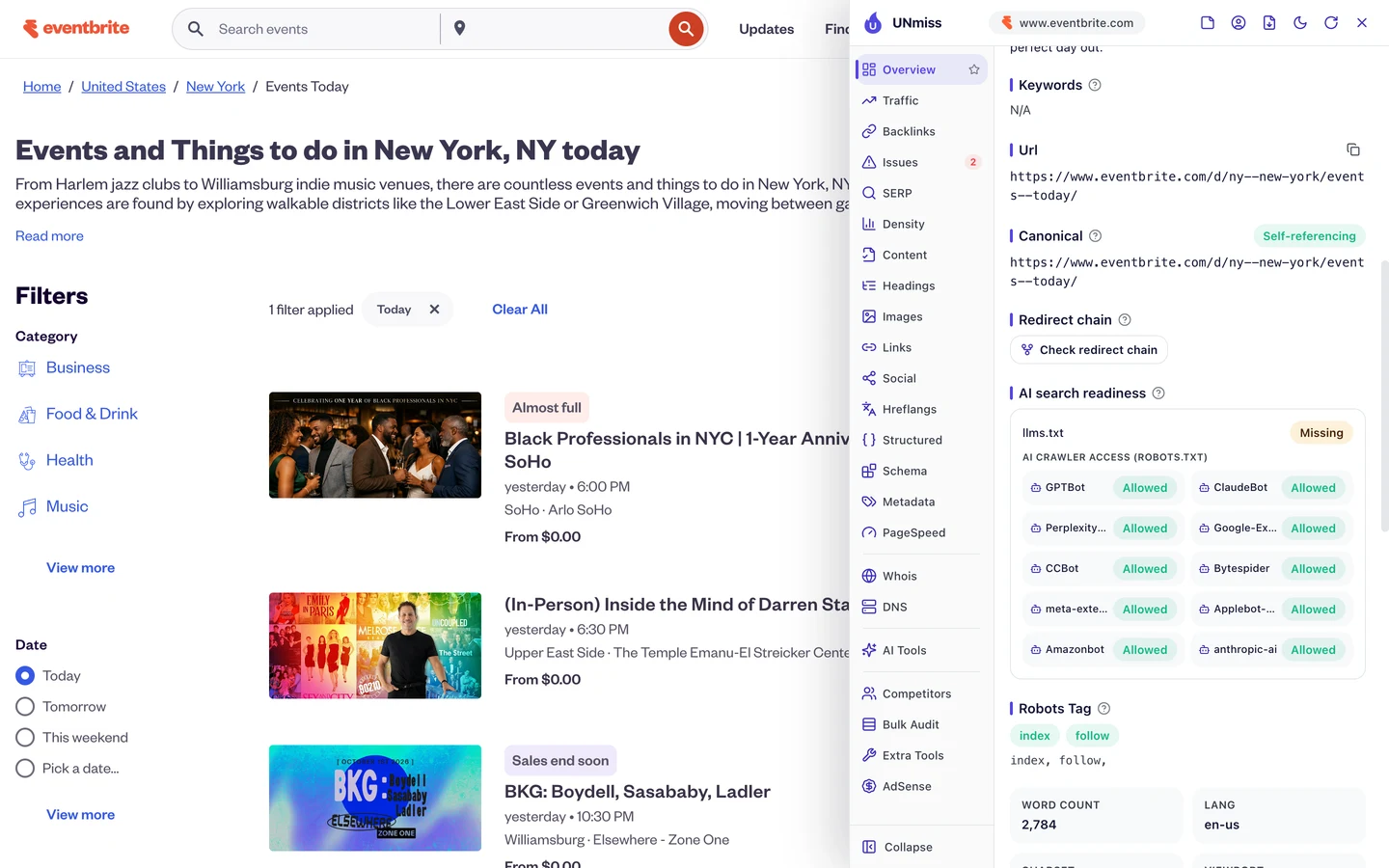
Eventbrite's robots.txt lets every AI crawler in. You could call it an open invitation.
But remember the wall from the audit. Robots.txt says who may come in, and the bot shield decides who actually gets through.
If the shield stops an AI crawler, the invitation doesn't matter. TED, which we studied too, writes its AI rules down in robots.txt, so it's clear who's welcome.
So make your robots.txt and your bot shield agree. Write your rules with our robots.txt generator, then check whether AI tools mention you with our AI Visibility Checker.
Eventbrite's top pages are city lists built from one template. Our Organic Traffic Checker shows your top pages and the share each one brings, so you can see which kind of page is working for you.
- The same report that measured Eventbrite
- Each top page's traffic, share and top search
- Run it on any rival's domain too
What you cannot copy
First, the part you can't copy: millions of events, posted by the hosts themselves, in thousands of cities.
Eventbrite doesn't write its city pages. Its customers fill them every day.
If you're starting out, pick one city and one kind of event you know well.
Now a few honest notes on the numbers.
We took our figures on 2 October 2026. The 2.4M figure counts US searches, and the 2.8M worldwide figure comes from the audit's Traffic tab.
Both are estimates. Nobody outside Eventbrite can count its real visits, so tools work them out from rankings and search volume.
We set the crawl to 250 pages, a sample of a very big site. A third of them hit the bot shield, so we counted those as unseen, not as errors.
The one number to take away
84.
That's how many city pages showed our crawler a "Human Verification" check instead of events. They're the same kind of page that earns Eventbrite most of its visits.
That's the lesson for any site with a bot shield. The pages you're proudest of are only worth something if the right bots can read them.
Not sure what bots see on your site? A crawl will show you in a few minutes.
You can run every one of these checks on your own site, and on your rivals', and see the same numbers for yourself.
Frequently asked questions
How do I know if my bot protection blocks Google?
Open Google Search Console and use the URL Inspection tool on a page. It shows the page exactly as Google fetched it. If you see a check page instead of your content, your shield is blocking Google.
Should every city really get its own page?
Only cities where you have something real to show. A page with no events or listings is thin, and Google may ignore it. Start with your busiest places and add more as they fill up.
What happens to an event page after the event ends?
Keep it live with a note that it's over, and link to similar upcoming events. If the event repeats, reuse the same address next year so its links keep working.
Is it bad if my brand name ranks with many pages?
Not always, but it splits your clicks. Make your homepage the clear best match for your name, and give other pages titles that describe what's different about them.
Do date words like "today" really get searched?
Yes, a lot. People add "today", "tonight" and "this weekend" when they want to act soon. Those searches change every day, so the page has to update itself.
Can a small event business compete with Eventbrite?
Yes, in a smaller space. Pick one city or one kind of event, and make the most useful page for it. Big sites spread their effort thin, and a focused page can beat them.
Does a widget that links back to me count as a good link?
It can, if people choose to use it. Keep the link honest and relevant, like your brand name. Hidden or stuffed links in widgets can break Google's rules.
How often should I check what bots see?
After any change to your firewall, bot shield or hosting, and once a month otherwise. A security update can block crawlers overnight without anyone noticing.